
Articles about “Inflation”

Decision to invest taken – what happens next?
As an investor, you will come across several parties or institutions in the fund selection and securities account opening process.

Understanding fund risks – nothing ventured, nothing gained
In this blog we analyse the different types of risk that one should be aware of before investing in a fund. We show which considerations should be made regarding the time of entry and the investment period.

Upbeat markets at the beginning of the year
Despite uncertainties, the stock and bond markets got off to a friendly start in the new year. In the USA, economic data recently surprised on the upside. Is the situation better than the mood?

Ten topics for 2023
The previous year was marked by unexpectedly high inflation and rapid key interest rate hikes – but what will the new year bring?
In his article, Chief Economist Gerhard Winzer presents ten topics that could be particularly relevant for the financial markets in 2023.

Market commentary: What will the new year 2023 bring?
In the past year, numerous trouble spots preoccupied the markets. In his market commentary, Gerald Stadlbauer, Head of Discretionary Portfolio Management, gives an outlook on what 2023 might bring.
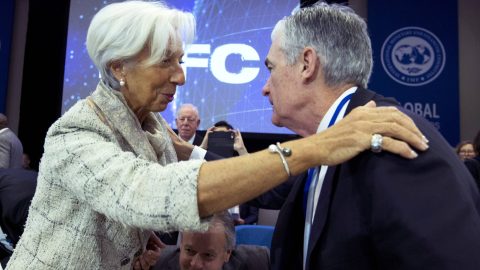
Thrilling decisions before Christmas
This week, the financial markets are once again in for an exciting ride: The European Central Bank and the US Federal Reserve will decide to what extent interest rates will be raised again.
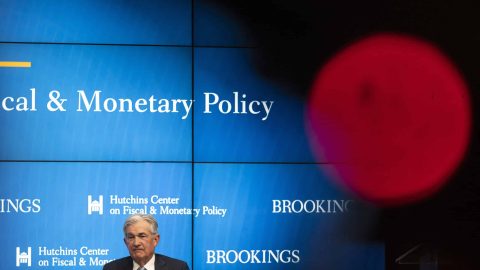
High uncertainty reduces potential for asset price increases
The environment for the financial markets remains highly uncertain. The further development of inflation and economic growth is not sufficiently foreseeable. This points to continued high fluctuations in asset prices.

Ceteris Paribus
The indications that the inflation peak will be exceeded are growing. If the relationship between inflation surprises (upside) and asset prices (downside) were to hold, that would be, all other things being equal, good news for the financial market.

Transition Phase
So far this year, high inflation rates have been the driving factor on the financial markets. This could now change, as Chief Economist Gerhard Winzer writes. Disappointingly weak indicators of economic activity could now increasingly come into focus.

One month is not yet a trend
The rise in inflation in the USA was recently lower than expected, which led to a significantly brighter mood on the markets. However, a favourable inflation report is not yet a trend, as Chief Economist Gerhard Winzer emphasises.

Review and outlook: “2022 turned out to be a tough year for equities”
On the stock markets, the year 2022 was characterized by high uncertainties and volatility. Tamás Menyhárt, senior fund manager at Erste Asset Management and equity expert, therefore draws an initial summary of the stock market year and ventures an outlook for the coming months on the markets.

Reduction in the pace of key interest rate increases
More and more central banks are signalling a reduction in the pace at which they are raising key interest rates. However, as Chief Economist Gerhard Winzer explains, this does not necessarily mean that central banks are softening their focus on fighting inflation. Rather, a pause in the rate hike cycle would require a change in inflation dynamics.
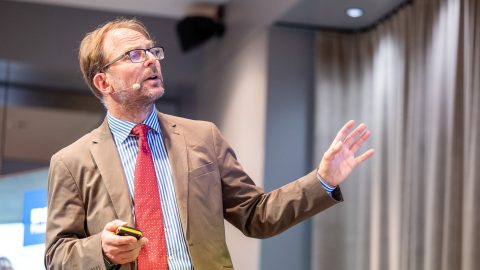
Economy and interest rates in the context of global risks
What do global risks and rising interest rates mean for the economy? We talked to
Prof. Dr. Ernest Gnan, Secretary General of SUERF – The European Money and Finance Forum and former Head of the Economic Analysis Department of the Oesterreichische Nationalbank.

Good nerves and stamina required
The mood on the capital markets has deteriorated further over the last months. In a comprehensive market update, Gerald Stadlbauer, Head of Discretionary Portfolio Management at Erste Asset Management, explains why stamina is needed in the current situation.

What happens to equities when interest rates rise?
So far, the year 2022 has brought significant price losses on the stock markets. Inflation and rising interest rates are often cited as the reason. But why is that the case?

Rapid and synchronous key rate hikes
Central banks are responding to high inflation by raising key interest rates. Further key rate hikes are likely this week as well.

Monetary tightening even as growth slows further?
Last week, three major central banks have raised their key interest rates further. By nature, however, it is not easy to find the right key interest rate level – especially in the current environment.

For some time valid: Elevated recession risks and restrictive monetary policy
The central banks want to achieve their long-term inflation target of 2%. In order to achieve this goal, they have raised key interest rates and are implementing a restrictive monetary policy. The higher key interest rates will weaken economic growth and also the labour market. Whether this can be achieved without a recession or whether there will be a “soft landing” is currently the subject of heated debate.

Jackson Hole – Focus on Monetary Policy
This week, the highly acclaimed Jackson Hole Economic Symposium will take place. Fed Chairman Jerome Powell’s speech will be the center of attention.

Very tight labor market in the USA
Many economic indicators point to weakening economic momentum. Meanwhile, the US labor market continues to be very robust, which recently mitigated the immediate risks of recession in the United States.

The Euro – a Snapshot
For more than 20 years, the euro has been the instrument of payment for around 340 million people. What is the current state of our currency and what opportunities and challenges does the euro face?

Energy commodities and inflation – where are we going?
Prices for energy and food have risen significantly, putting a strain on consumers’ wallets. If the Russia-Ukraine war does not ease, the situation may deteriorate even further.

Recession Risks
Ahead of the upcoming interest rate decision by the Federal Reserve, a number of economic indicators point to increasing risks of growth or recession. There are also uncertainties regarding the further development of inflation and the effectiveness of monetary policy measures.
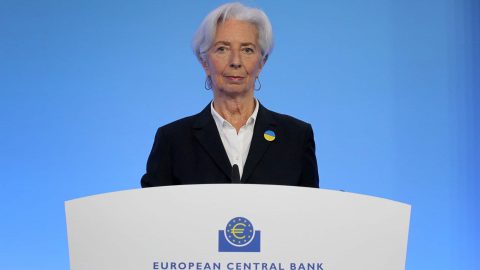
Mega interest rate hikes indirectly increase purchasing power
Gerhard Winzer, Chief Economist at Erste Asset Management, provides an overview of recent economic developments and explains, among other things, what structural problems the euro is facing.

Mixed outlook for the second half of the year
Ahead of the upcoming reporting season, several negative factors dominate the markets. Tamás Menyhárt, Senior Fund Manager at Erste Asset Management, sums up the stock market year so far and shares his views on the further development.

Fund savings plan: Why it pays off to persevere
The bears have gained the upper hand on the stock markets. How investors and savers can overcome this phase and why perseverance could pay off right now.

Central Banks Attempt to Prevent Inflationary Spiral
Since the beginning of the year, the bond markets have been in a bear market. What are the implications for the economy? Erste Asset Management Chief Economist Gerhard Winzer analyzes three models in relation to the development of inflation and their implications.

Increasing growth risks
Inflation, the war in Ukraine and monetary policy are driving the markets and stoking fears of an impending recession. Initial economic indicators also point to gloomy growth prospects.

Toothless central banks: will the interest rate increases remain ineffective?
Rising credit rates and prices for goods and services are hampering consumer demand. Which future scenario can be expected? Interview with Péter Varga, Senior Professional Fund Manager at Erste Asset Management.

Way Out Recession?
The prices of risk asset classes are subject to downward pressure. Is an inflation spiral likely to occur? Will the increase in key interest rates trigger a recession?

High inflation rates increase downside risks
Inflation rates continue to rise, prompting central banks to accelerate rate hikes. Which models for the future inflation development are conceivable? Erste Asset Management Chief Economist Winzer analyzes which scenarios are imaginable in the future.
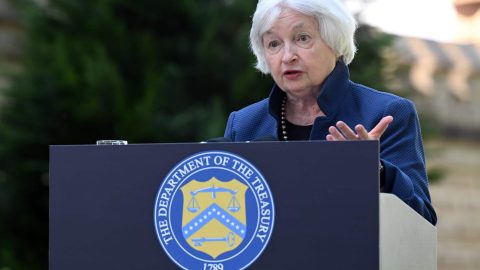
Despite high inflation, U.S. Treasury Secretary Yellen sees little risk of recession
Sentiment among U.S. consumers has fallen to a record low due to high inflation. How does this data affect the economy? Is a recession looming? Are solid corporate results being ignored?

Growth fears
Inflation has been the underlying factor in economy for some time. A recovery of GDP on a pre-pandemic level should be reached soon. The probability of a growth phase has increased. What further developments are expected?

Tightening of financial condition
The global economy has been confronted with two stagflationary events in the last two years: the Covid-19 pandemic and the war in Ukraine. What factors are influencing the uncertainty in the markets? Erste Asset Management Chief Economist Winzer analyzes which scenarios are conceivable in the future.
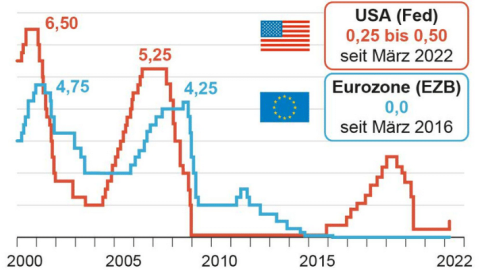
How far will the interest rates be rising, Mr. Zemanek?
With the first interest rate hike in five years, the US Federal Reserve has ushered in a new era. Is the period of cheap money now over? When will the European Central Bank follow suit?
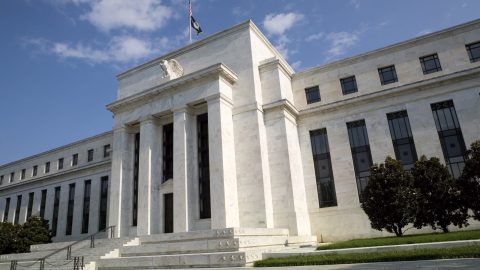
The hour of the hawks
In the US, interest rate hikes to a level of 3% by the end of 2023 have become likely. When will the European Central Bank follow? Erste Asset Management Chief Economist Gerhard Winzer analyses the interest rate policies of the central banks.

The invasion of Ukraine by Russia and its massive effects
Within two years, the global economy has been confronted by two negative events or, indeed, shocks: the Covid pandemic was the first one, having not only killed six million people globally at this point, but having also caused an unprecedented slump in the global economy and the subsequent recovery. The second one, i.e. the invasion of Ukraine by Russia, is of a geopolitical nature and has triggered a commodity price shock.

Two stagflationary shocks: pandemic and war in Ukraine
The global economy was confronted with two negative developments within two years: the Covid-19 pandemic and the Ukraine war. Erste Asset Management’s Chief Economist Winzer analyzes the stagflationary state of the economy.

Investment Update: First steps to interest rate hikes and volatility in the stock markets
Stocks posted significant gains on Wednesday after U.S. Federal Reserve Chairman Jerome Powell signaled that the central bank would begin raising interest rates this month. Stock markets interpreted this as a positive signal in the sense that the threat to growth posed by the war in Ukraine did not justify a change of course in monetary policy at the moment.

Interest rate policy quo vadis? 3 monetary policy scenarios
Rising inflation and rising bond yields have recently caused uncertainty among investors. Will key interest rates in the USA be raised soon? Erste Asset Management’s Chief Economist Winzer outlines 3 scenarios for the interest rate policy of the central banks.

Stock markets off to a bumpy start in 2022
Inflation has risen sharply and the first interest rate hikes are expected from the Federal Reserve in the USA. What impact could this have on stocks?

Investing – a long term story
We have seen some extraordinary years speaking about equity and multi asset performance. Interest rates were low, volatility – representing the average daily price changes – was comparably low. What is the situation today?
10 theses for 2022
Waves of infections will continue to influence economic activity and the markets. What will happen in China, what are the inflation risks and will it be volatile? Our chief economist Gerhard Winzer has drawn up 10 theses for the year 2022.
Pandemic year three: what are the challenges ahead?
We are now into the third year of the pandemic. Since the spring 2020 collapse, economic activity and markets have shown exceptional resilience. This is not to be taken for granted. After all, the list of potential negative influences (“challenges”) is long.

Investors bought the dip. Again.
Just when it looked like a quiet end to the year on the stock markets, the emergence of Omicron shook investor confidence and led to a sell-off lasting several days. How has market optimism evolved since then? Our stock expert Tamás Menyhárt gives an outlook.

Inflation at its peak – what are the reasons?
At 5.2% y/y, consumer price inflation for the OECD region reached the highest value in October since 1997. Has inflation peaked, or are we at the outset of a sustained period of high inflation?
Inflationary Boom – A thin red line towards welfare
The global view on inflation has turned completely since Spring 2020. While low inflation has been an issue between the Great Financial Crisis and the start of the pandemic, multi-year-highs in inflation were reached in Spring 2021. What will happen next?

Stagflation – a serious risk scenario
In recent months, the risk of stagflation (the simultaneous occurrence of economic stagnation and inflation) has increased. Without the pandemic, output would be higher and inflation lower: bottlenecks in production and logistics have slowed economic activity and caused prices in the goods sector to rise sharply.

Global economy running into headwind
The global economy is in the recovery phase of the cycle. Economic growth is well above the long-term trend, but headwinds have increased recently. What needs to happen to ensure that growth does not slow down? Chief Economist Gerhard Winzer analyses the prospects for the future.
Erste Asset Management financial markets outlook for the second half of 2021
Since the beginning of the year, the rapid recovery of the economy has mainly supported securities such as equities. But what happens next? Erste AM Managing Director Heinz Bednar and Head of Multi Asset Alexander Lechner explain how the second half of 2021 and especially our focus on sustainability will continue to develop in our outlook for the next six months.