

The market environment remains generally positive, but the combination of persistent inflation, geopolitical tensions, and climate-related challenges calls for a nuanced perspective.
The environment for risky asset classes remains fundamentally favorable. Global growth indicators are improving, while two major risks have recently subsided somewhat: a further escalation of tensions in the Strait of Hormuz and an abrupt end to the technology boom. As a result, the scenario of inflationary growth—which is favorable for risky investments—remains intact for the time being.
Nevertheless, it is too early to assume the risks have passed. Geopolitical conflicts and the consequences of climate change are increasingly affecting the global economy simultaneously. This dynamic has a stagflationary effect: the supply of energy, transportation capacity, and other key factors of production is becoming less available or more expensive. Higher costs reduce household purchasing power and put pressure on corporate margins. At the same time, limited availability can trigger additional price increases.
The base scenario therefore remains positive but vulnerable to disruptions.
Growth: The global economy is gaining slight momentum
The key growth indicators point to a moderate acceleration in the global economy. These include the purchasing managers’ indices (which are trending upward), Germany’s expansionary fiscal policy, the beginning of an inventory buildup, and spillover effects from the technology and AI boom into other sectors of the economy. Fiscal support measures in China are also having a stabilizing effect.
Global growth of around 2.6 percent is expected for 2026. In developed economies, real gross domestic product is projected to grow by about 1.6 percent in 2026 and around 1.7 percent in 2027. The global economy is thus operating roughly at its potential, possibly even slightly above it.
However, growth is distributed very unevenly. Regionally, the US in particular, as well as technology-oriented economies such as Taiwan and Singapore, are showing comparatively strong momentum. In the eurozone, growth is still low but is expected to gradually gain momentum. There are also significant differences across sectors: While IT, infrastructure, and investment-related sectors are expanding, growth in many traditional economic sectors remains subdued.
US: Weak Labor Market, Strong Technology Momentum
This dichotomy is particularly evident in the US Employment growth has fallen to just around 20,000 new jobs on a three-month average. This is a warning sign, but not yet clear evidence of an impending downturn. The relationship between employment growth and economic growth appears to have shifted.
In addition, however, the technology boom is making an exceptionally large contribution to growth. Investments in information technology, data centers, semiconductors, and AI infrastructure are estimated to contribute about 0.8 percentage points to US GDP growth. The share of investment income in GDP has reached a very high level of about 18 percent. This supports corporate profits and provides, at least in part, a fundamental justification for the high stock valuations.
Unit labor costs are also showing a favorable trend. Their year-over-year growth has fallen to around 1.4 percent, primarily because hourly compensation growth has slowed to about 3.7 percent. Productivity growth, meanwhile, has remained stable so far (2.2% year-over-year). The hoped-for broad-based productivity gains from artificial intelligence are therefore not yet evident at the macroeconomic level. The immediate effect of the technology boom currently lies more in higher investment, profits, and investment income than in a sharp rise in productivity.
Private consumption is key to the economic outlook going forward. So far, it has been strong to solid in the US, but has been financed in part by a declining savings rate and rising asset values, particularly in the stock market. Retail sales figures due out this Friday are therefore an important indicator of whether consumers can maintain their spending despite slowing job growth and persistently high prices.
Inflation: Will 3 Percent Become the New 2 Percent Target?
Inflation rates remain stubbornly above central banks’ targets. For developed economies, an inflation rate of around 3.3 percent is expected for the fourth quarter of 2026. It may not fall back to about 2.3 percent until the end of 2027.
This raises a fundamental question: Could an inflation rate of around 3 percent effectively become the new normal?
Several structural factors point in this direction:
- The working-age population is growing more slowly or declining.
- Deglobalization and economic nationalism are driving up production costs.
- Geopolitical conflicts are leading to more frequent energy and supply shocks.
- Building more resilient supply chains requires additional inventory and investment.
- Climate change and adaptation measures are driving up the costs of energy, transportation, and infrastructure.
- High levels of government debt make it difficult to maintain a strongly restrictive monetary policy over the long term.
Nor is the AI boom automatically deflationary in the short term. Initially, it increases demand for data centers, electricity, semiconductors, copper, and other scarce resources. The associated investments have an immediate effect of driving growth and pushing up prices. Any price-dampening effect resulting from higher productivity is likely to materialize, if at all, only after a time lag.
Central Banks: Small Interest Rate Hikes to Safeguard Credibility
Central banks face a difficult trade-off. On the one hand, employment growth in the US is weak, and the economy in Europe remains sluggish. On the other hand, inflation stays well above target levels, while overall economic growth is at or slightly above potential.
The most likely scenario, therefore, is small but symbolically significant hikes in key interest rates. These are intended to prevent higher long-term inflation expectations from becoming entrenched. At the same time, the aim is to avoid overly aggressive rate hikes that could trigger an economic downturn.
For the US Federal Reserve, the upper end of the target range is expected to rise from 3.75 to 4.0 percent by December 2026. For the ECB, an increase from 2.25 to 2.5 percent is anticipated. Despite these steps, monetary policy would remain neutral to accommodative overall due to comparatively low real interest rates.
Note: Prognoses are not a reliable indicator of future performance.
At the Federal Reserve, a shift in communication strategy is also taking place. Fed Chairman Kevin Warsh is refraining from providing specific forward guidance, while several members of the Open Market Committee are explicitly advocating for interest rate hikes. For the bond markets, both developments point in the same direction: either expected policy rates will rise, or uncertaintyand, with it, term risk premiums will increase. Both factors tend to point toward higher yields.
Currencies: Interventions Do Not Solve Japan’s Underlying Problem
Noteworthy was the joint intervention by the US and Japan to prop up the yen. As part of the intervention, the US bought yen and sold euros. The European Central Bank was informed only after the fact.
One possible motivation is to stabilize the yen without forcing Japan to engage in extensive sales of US Treasury bonds. Such sales could further reinforce the already upward trend in yields on the US bond market.
Please note: Past performance is no reliable indicator of future value development.
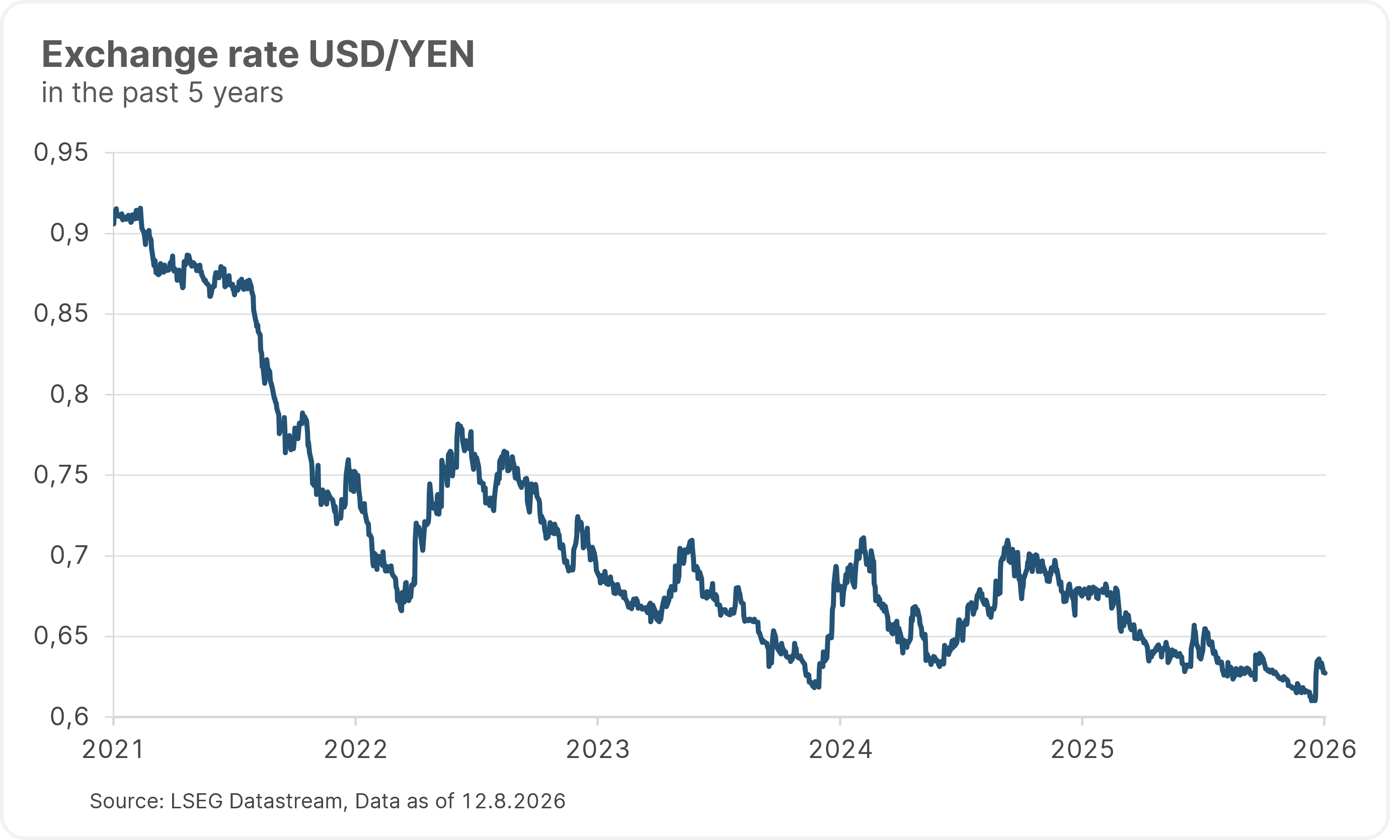
Nevertheless, a sustained reversal in the yen’s trend remains difficult to imagine as long as Japan’s monetary and fiscal policies remain expansionary. Interventions can slow the depreciation, but they can hardly eliminate the fundamental causes of the currency’s weakness. Therefore, the outlook for the yen continues to be neutral. On the other hand, the US technology boom, combined with the Fed’s expected interest rate hikes, continues to support the US dollar against the euro.
A broader appreciation of Asian currencies would also have global consequences. A strengthening of the yen, renminbi, and South Korean won would make exports from these countries more expensive. For the rest of the world, this would create an inflationary impulse that could exert additional upward pressure on yields. In the affected Asian economies themselves, the effect would be more deflationary and could point to falling yields.
Geopolitics and Climate: Supply Shocks on Multiple Levels
Talks between Oman and Iran regarding the Strait of Hormuz have initially contributed to a decline in oil prices. However, a permanent reopening of the strait is by no means guaranteed. Iran’s political conditions, the US position, and issues regarding monitoring, security, and potential transit fees remain key obstacles.
As long as no robust solution is in place, the risk of another spike in energy prices persists. Even if the strait were to reopen, shipping traffic would likely return to normal only gradually. In addition, increased insurance and security costs could persist in the long term.
At the same time, extreme weather conditions are placing additional strain on energy supply and transportation. Heat waves in Europe are increasing electricity demand for air conditioning. Meanwhile, high water temperatures and low water levels are impairing electricity production at certain nuclear and coal-fired power plants that rely on river water for cooling.
Shipping is also affected. Low water levels in European rivers are driving up the cost of freight transport. In the Panama Canal, high demand for transit rights is leading to rising transit costs. As a result, several supply shocks are converging simultaneously: energy, cooling, shipping, and logistics are becoming more expensive or less reliable.Der Klimawandel wirkt dadurch nicht nur langfristig. Er wird zu einem aktuellen makroökonomischen Faktor, der Inflation, Investitionen und Lieferketten beeinflusst.
Therefore, climate change is not merely a long-term issue. It is becoming a current macroeconomic factor that influences inflation, investment, and supply chains.
Impact on Positioning
The environment described above calls for a fundamentally positive but selective positioning:
- Equities remain overweight because growth is resilient and tail risks have eased somewhat.
- US equities as a whole remain underweight, primarily due to high market concentration. Within the US, however, preference is given to high-quality companies, IT, high-dividend stocks, and companies with solid earnings.
- European small-cap stocks, Japan, Latin America, and commodity and mining companies are benefiting from the investment cycle, a value-oriented approach, and rising metal prices.
- Duration remains moderately short, as persistent inflation risks, high levels of investment, and modest increases in key interest rates point to rising yields—or at least yields that are unlikely to fall sustainably.
- Government bonds remain underweight, while EUR corporate bonds, emerging-market bonds denominated in local currency, and money market investments are favored.
- Commodities are viewed as neutral overall. Industrial metals are receiving structural tailwinds from AI, infrastructure, the energy transition, and defense. In the energy sector, however, geopolitical developments are the dominant factor.
- Gold remains attractive in the long term, but in the short term it is being held back by potential profit-taking and slightly rising key interest rates.
- The US dollar is favored over the euro, while the outlook for the yen remains neutral.
Please note: investing in securities involves risks as well as opportunities.
Conclusion: Positive, but not carefree
The global economy is proving more resilient than many had expected. Improved leading indicators, expansionary fiscal policy, and the investment boom surrounding artificial intelligence point to a slight increase in global growth. At the same time, risks related to the Strait of Hormuz and the technology cycle have eased somewhat.
However, the current upswing differs significantly from earlier, disinflationary periods of growth. Geopolitical tensions and climate change are putting pressure on the supply side and, together with high levels of investment, are keeping price pressures elevated. Inflation of 3 percent could therefore continue to prove persistent.
For investors, this means that risky assets remain attractive. In the bond market, however, the current environment calls for a cautious approach to duration and a stronger focus on carry. The base-case scenario remains one of inflationary growth.
Legal disclaimer
This document is an advertisement. Unless indicated otherwise, source: Erste Asset Management GmbH. The language of communication of the sales offices is German and the languages of communication of the Management Company also include English.
The prospectus for UCITS funds (including any amendments) is prepared and published in accordance with the provisions of the InvFG 2011 as amended. Information for Investors pursuant to § 21 AIFMG is prepared for the alternative investment funds (AIF) administered by Erste Asset Management GmbH pursuant to the provisions of the AIFMG in conjunction with the InvFG 2011.
The currently valid versions of the prospectus, the Information for Investors pursuant to § 21 AIFMG, and the key information document can be found on the website www.erste-am.com under “Mandatory publications” and can be obtained free of charge by interested investors at the offices of the Management Company and at the offices of the depositary bank. The exact date of the most recent publication of the prospectus, the languages in which the fund prospectus or the Information for Investors pursuant to Art 21 AIFMG and the key information document are available, and any other locations where the documents can be obtained are indicated on the website www.erste-am.com. A summary of the investor rights is available in German and English on the website www.erste-am.com/investor-rights and can also be obtained from the Management Company.
The Management Company can decide to suspend the provisions it has taken for the sale of unit certificates in other countries in accordance with the regulatory requirements.
Note: You are about to purchase a product that may be difficult to understand. We recommend that you read the indicated fund documents before making an investment decision. In addition to the locations listed above, you can obtain these documents free of charge at the offices of the referring Sparkassen bank and the offices of Erste Bank der oesterreichischen Sparkassen AG. You can also access these documents electronically at www.erste-am.com.
Our analyses and conclusions are general in nature and do not take into account the individual characteristics of our investors in terms of earnings, taxation, experience and knowledge, investment objective, financial position, capacity for loss, and risk tolerance. Past performance is not a reliable indicator of the future performance of a fund.
Please note: Investments in securities entail risks in addition to the opportunities presented here. The value of units and their earnings can rise and fall. Changes in exchange rates can also have a positive or negative effect on the value of an investment. For this reason, you may receive less than your originally invested amount when you redeem your units. Persons who are interested in purchasing units in investment funds are advised to read the current fund prospectus(es) and the Information for Investors pursuant to § 21 AIFMG, especially the risk notices they contain, before making an investment decision. If the fund currency is different than the investor’s home currency, changes in the relevant exchange rate can positively or negatively influence the value of the investment and the amount of the costs associated with the fund in the home currency.
We are not permitted to directly or indirectly offer, sell, transfer, or deliver this financial product to natural or legal persons whose place of residence or domicile is located in a country where this is legally prohibited. In this case, we may not provide any product information, either.
Please consult the corresponding information in the fund prospectus and the Information for Investors pursuant to § 21 AIFMG for restrictions on the sale of the fund to American or Russian citizens.
It is expressly noted that this communication does not provide any investment recommendations, but only expresses our current market assessment. Thus, this communication is not a substitute for investment advice.
This document does not represent a sales activity of the Management Company and therefore may not be construed as an offer for the purchase or sale of financial or investment instruments.
Erste Asset Management GmbH is affiliated with the Erste Bank and austrian Sparkassen banks.
Please also read the “Information about us and our securities services” published by your bank.
More on the topic

The Triple B Plan
Donald Trump’s “Big Beautiful Tax Bill” package is intended to bring comprehensive tax cuts in the US. The already high budget deficit would increase further. This would also have an impact on US government bond yields, which have been rising for months anyway. There is a threat of a downward spiral with unforeseeable consequences.

Sovereign defaults and their debt restructuring
A glance at history shows that it is not unheard of for a state to go bankrupt. How does an entire country actually go bankrupt, what are the consequences and how do you react to this in fund management? Fund manager Felix Dornaus explains this in his blog post.

Japan’s Bond Yields Climb to Highest Level Since the 1990s
Interest rates are rising again in Japan. Find out what’s behind this trend and what role inflation, energy prices and the central bank are playing in it in our latest blog post.