
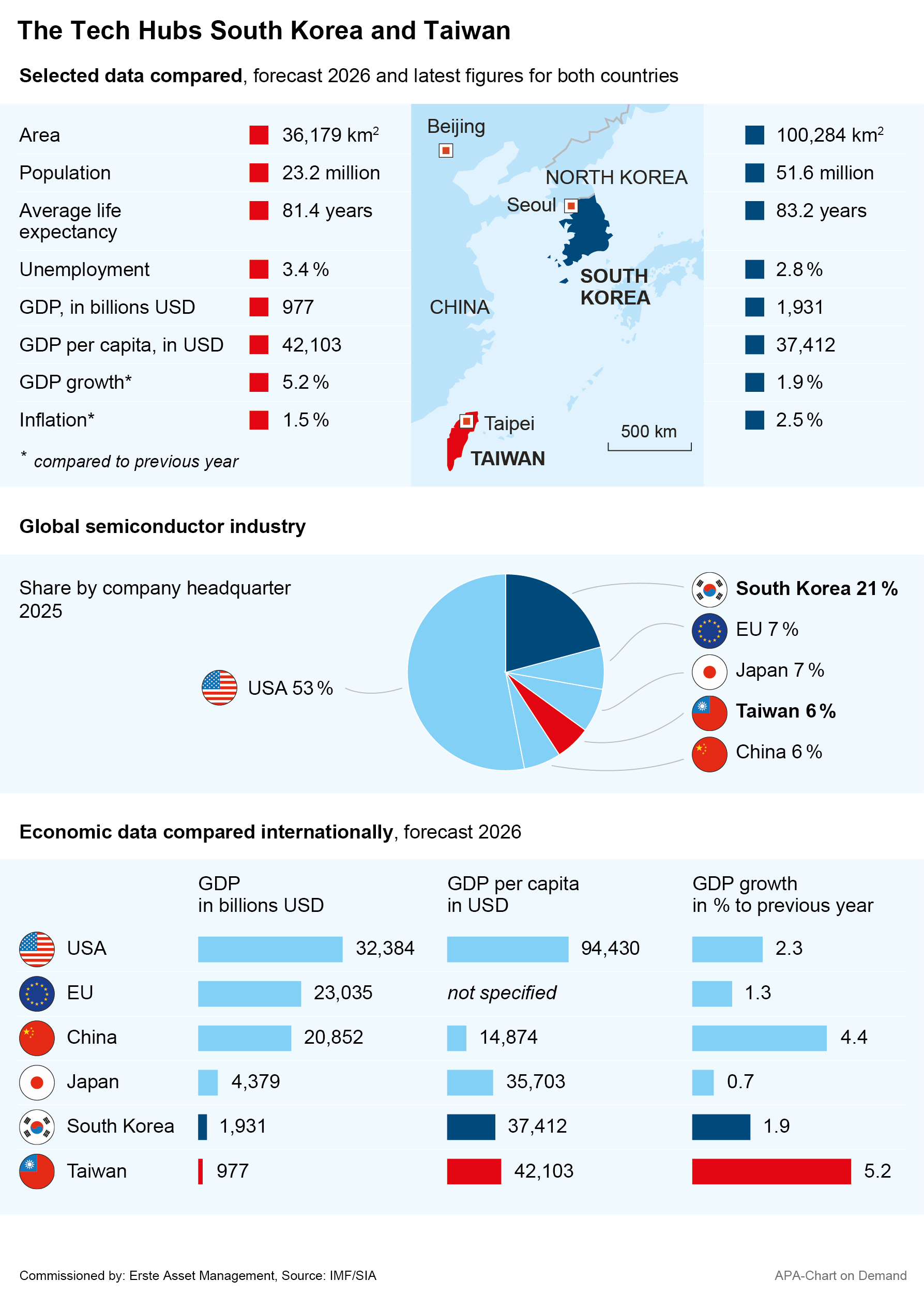
The ongoing AI boom and the rapidly rising demand for the computer chips required for it have recently put South Korea and Taiwan in the spotlight. A large proportion of the profits generated by the expansion of AI are made in these two countries. Both economies are benefiting enormously from their corporations, which play a huge role in AI applications. More than half of the high-performance memory chips vital for AI data centres come from South Korea, whilst more than half of all semiconductor components manufactured worldwide come from Taiwan, a country with a population of just 24 million.
The extent of the industry’s euphoria was evident this spring at the Computex trade fair in the Taiwanese capital, Taipei. The rush to Asia’s largest electronics trade fair was enormous, and the gold-rush atmosphere saw the event set a new visitor record. Corporate and government leaders exchanged views here, agreed on major investments and partnerships, and vied with one another to make optimistic statements about the sector’s growth prospects. At the trade fair’s opening, Taiwan’s President Lai Ching-te described his country’s role in the AI sector as “indispensable”.
Taiwan’s economy grew by almost 10 per cent in the second quarter
Thanks to the AI boom, Taiwan has risen to become one of the world’s fastest-growing economies. The country’s statistics authority forecasts economic growth of 9.6 per cent for 2026. This would be the strongest growth in 16 years. In the second quarter, GDP grew by a surprisingly strong 12.9 per cent compared with the same period last year. Experts had only anticipated growth of just over 10 per cent. In the first quarter, GDP growth was as high as 14.6 per cent, making it the strongest rise in almost 40 years. Export orders have also risen rapidly recently; thanks to strong demand for semiconductors fuelled by the AI boom, export orders in June rose by 59.4 per cent year-on-year to 95.26 billion dollars. This marked the 17th consecutive monthly increase and exceeded expectations, which were already high to start with.
Order intake at Taiwanese firms is regarded as a key leading indicator of global demand for technology products. Taiwan plays a crucial role in the global AI supply chain. Companies such as Nvidia and Apple rely on the country’s state-of-the-art chips. The country owes this position primarily to the world’s largest contract semiconductor manufacturer, Taiwan Semiconductor Manufacturing Company (TSMC).

Please note: the companies mentioned in this article have been selected as examples and do not constitute investment recommendations.
TSMC and Foxconn reported sharp increases in the quarter
Most recently, TSMC reported its fifth consecutive record quarterly profit. Asia’s most valuable listed company increased its net profit in the second quarter by 77 per cent to the equivalent of 19.15 billion euros. This was around 2 billion euros more than analysts had expected and marked the ninth consecutive double-digit percentage increase. When presenting its figures, the world’s largest contract chip manufacturer also raised its full-year targets. It stated that demand would remain strong until at least 2030. The Taiwanese company also forecast higher investment and held out the prospect of building additional factories in the US.
Foxconn, also based in Taiwan, has recently seen its turnover surge thanks to rapidly growing demand for AI. In the second quarter, the world’s largest electronics contract manufacturer’s revenue grew by almost 40 per cent year-on-year to around 2.5 trillion Taiwanese dollars, or just under 69 billion euros. The company, which acts as Nvidia’s main server manufacturer and Apple’s largest iPhone assembler, thus exceeded analysts’ estimates. Foxconn explained that strong demand for AI had led to robust revenue growth in its cloud and network products division. Furthermore, the company reported significant growth in its smart consumer electronics division, which includes iPhones. The group expects further growth in the third quarter.
South Korea’s growth recently surprised on the upside
Economic growth in South Korea is moderate compared with Taiwan but has also recently surprised on the upside thanks to demand for chips and booming semiconductor exports. The country’s GDP rose by 0.6 per cent in the second quarter compared with the previous quarter. Economists polled by Reuters had only expected an increase of 0.4 per cent. Exports were the main drivers of growth in the spring, rising by 1.4 per cent.
This was primarily due to rising demand for semiconductors, machinery and equipment. South Korea is home to sought-after companies such as memory chip manufacturer SK Hynix, industry giant Samsung Electronics and chip equipment supplier Hanmi Semiconductor, which supply key equipment for the construction of AI data centres. The country’s central bank only raised its growth forecast for the full year 2026 to 2.6 per cent in May. It now believes an even higher growth rate is possible. “If growth in the second half of the year averages more than minus 0.1 per cent, we could see growth of 3 per cent for the year as a whole,” said a central bank representative.
SK Hynix and Samsung on course for record results
South Korean chip manufacturer SK Hynix has recently posted record profits once again, driven by the booming AI business. In the second quarter, the company increased its operating profit sixfold to 60.6 billion won (around 36.5 billion euros). Turnover climbed by 257 per cent to 48.15 billion euros, though this fell short of estimates.
SK Hynix is thus continuing its virtually uninterrupted growth trajectory of recent years. The driving force behind this rapid growth is the enormous demand for state-of-the-art memory chips required for AI applications. SK Hynix is one of the global market leaders in high-margin chips; in the High Bandwidth Memory (HBM) sector, which is particularly important for AI applications, the group holds a 61 per cent global market share.
South Korean electronics giant Samsung is also continuing to set new records in the wake of the ongoing AI boom. In the second quarter, the group posted an operating profit of just over 89 trillion won (around 51 billion euros), a 19-fold increase compared with the same quarter last year. Samsung thus set a new company record for the third consecutive financial quarter.
Major investments and partnerships set to secure growth
Both the heads of government and business leaders from South Korea and Taiwan have recently expressed optimism about the semiconductor industries and aim to secure their countries’ positions through further investment and collaboration. South Korea, for example, has announced new projects in the AI sector totalling 950 billion dollars. South Korean conglomerates such as Samsung Electronics and the SK Group, as well as US technology firms, are involved. The SK Group alone has signed contracts worth 750 billion dollars, according to the South Korean Presidential Office. This includes a partnership between its subsidiary SK Hynix and the US chip giant Nvidia worth more than 500 billion dollars. Samsung Electronics has also signed a memorandum of understanding with Broadcom worth up to 200 billion dollars, covering, amongst other things, memory chips and contract manufacturing.
The agreements represent the latest move by US AI firms to secure capacity early on with South Korea’s leading semiconductor manufacturers in the face of high demand for computing power. Customers were requesting far more storage capacity than expected, said SK Group Chairman Chey Tae-won. Nvidia’s projected storage requirements for the next five years could soon prove to be too low. “I wouldn’t be surprised if (Nvidia CEO) Huang tells me at our next meeting that these figures were too low and demands: ‘I want more.’” Samsung, too, expects the global chip shortage to worsen through to 2028. “The shortage is expected to worsen further in 2027 compared with this year and persist into 2028,” said Jaejune Kim, head of Samsung’s memory division, during the presentation of the quarterly results.
On the stock markets, the positive outlook for companies from South Korea and Taiwan has been reflected in a share price rally this year. Although concerns over inflated stock market valuations and excessive expectations recently triggered a noticeable correction, the stock markets in both countries are still showing strong growth on an annual basis. Both South Korea’s Kospi share index and Taiwan’s TAIEX are currently around 50 per cent above their levels from the start of the year.
Investing in Taiwan and South Korea
With the ERSTE STOCK EM GLOBAL, investors can specifically capitalize on the growth opportunities in global emerging markets. Currently, more than half of the fund’s portfolio is invested in South Korea and Taiwan—two key markets in the global AI and semiconductor boom. Taiwan Semiconductor, Samsung Electronics, and SK Hynix—three leading technology companies—constitute the fund’s largest holdings. Learn more now about the ERSTE STOCK EM GLOBAL and its long-term investment opportunities. Note: Please be aware that investing in securities involves risks as well as opportunities.
Risk notes ERSTE STOCK EM GLOBAL
Please note that investing in securities also involves risks besides the opportunities described.
The fund employs an active investment policy. The assets are selected on a discretionary basis. The fund is oriented towards a benchmark (for licensing reasons, the specific naming of the index used is made in the prospectus (12.) or KID “Ziele”). The composition and performance of the fund can deviate substantially or entirely in a positive or negative direction from that of the benchmark over the short term or long term. The discretionary power of the Management Company is not limited.
Legal disclaimer
This document is an advertisement. Unless indicated otherwise, source: Erste Asset Management GmbH. The language of communication of the sales offices is German and the languages of communication of the Management Company also include English.
The prospectus for UCITS funds (including any amendments) is prepared and published in accordance with the provisions of the InvFG 2011 as amended. Information for Investors pursuant to § 21 AIFMG is prepared for the alternative investment funds (AIF) administered by Erste Asset Management GmbH pursuant to the provisions of the AIFMG in conjunction with the InvFG 2011.
The currently valid versions of the prospectus, the Information for Investors pursuant to § 21 AIFMG, and the key information document can be found on the website www.erste-am.com under “Mandatory publications” and can be obtained free of charge by interested investors at the offices of the Management Company and at the offices of the depositary bank. The exact date of the most recent publication of the prospectus, the languages in which the fund prospectus or the Information for Investors pursuant to Art 21 AIFMG and the key information document are available, and any other locations where the documents can be obtained are indicated on the website www.erste-am.com. A summary of the investor rights is available in German and English on the website www.erste-am.com/investor-rights and can also be obtained from the Management Company.
The Management Company can decide to suspend the provisions it has taken for the sale of unit certificates in other countries in accordance with the regulatory requirements.
Note: You are about to purchase a product that may be difficult to understand. We recommend that you read the indicated fund documents before making an investment decision. In addition to the locations listed above, you can obtain these documents free of charge at the offices of the referring Sparkassen bank and the offices of Erste Bank der oesterreichischen Sparkassen AG. You can also access these documents electronically at www.erste-am.com.
Our analyses and conclusions are general in nature and do not take into account the individual characteristics of our investors in terms of earnings, taxation, experience and knowledge, investment objective, financial position, capacity for loss, and risk tolerance. Past performance is not a reliable indicator of the future performance of a fund.
Please note: Investments in securities entail risks in addition to the opportunities presented here. The value of units and their earnings can rise and fall. Changes in exchange rates can also have a positive or negative effect on the value of an investment. For this reason, you may receive less than your originally invested amount when you redeem your units. Persons who are interested in purchasing units in investment funds are advised to read the current fund prospectus(es) and the Information for Investors pursuant to § 21 AIFMG, especially the risk notices they contain, before making an investment decision. If the fund currency is different than the investor’s home currency, changes in the relevant exchange rate can positively or negatively influence the value of the investment and the amount of the costs associated with the fund in the home currency.
We are not permitted to directly or indirectly offer, sell, transfer, or deliver this financial product to natural or legal persons whose place of residence or domicile is located in a country where this is legally prohibited. In this case, we may not provide any product information, either.
Please consult the corresponding information in the fund prospectus and the Information for Investors pursuant to § 21 AIFMG for restrictions on the sale of the fund to American or Russian citizens.
It is expressly noted that this communication does not provide any investment recommendations, but only expresses our current market assessment. Thus, this communication is not a substitute for investment advice.
This document does not represent a sales activity of the Management Company and therefore may not be construed as an offer for the purchase or sale of financial or investment instruments.
Erste Asset Management GmbH is affiliated with the Erste Bank and austrian Sparkassen banks.
Please also read the “Information about us and our securities services” published by your bank.
More on the topic

Microfinance: A Journey Through Romania
After a period of political uncertainty, Romania is once again entering a phase of stabilization. Microfinance fund manager Martin Cech reports on his trip to the country and his impressions of the local microfinance institutions.