

What opportunities and risks are currently emerging for investors? Which regions and sectors could shape stock market performance in the second half of 2026? And how should portfolios be positioned amid geopolitical challenges, high volatility, and growth opportunities? We posed these questions to two asset management equity experts, who painted a fascinating picture of the current situation in global stock markets.

Note: Please be aware that investments have opportunities and risks.
The Stock Market Caught Between a Rock and a Hard Place
As an investor, it’s not easy right now to make sense of the current situation in the financial markets: Normally, one would have expected the numerous geopolitical crises and the associated rise in oil prices to send the stock markets into a tailspin. But the exact opposite has happened: Despite the negative environment, stock indices have risen and are currently at or near all-time highs. How is this possible?
A Question of Earnings Growth
Tamás Menyhárt, fund manager of the ERSTE RESPONSIBLE STOCK GLOBAL, does not see any contradiction in this development, but admits that it can cause confusion. For greater clarity, he recommends taking a closer look at the background: “It’s not what it seems at first glance. The geopolitical crises have certainly had consequences and have not left the stock markets unscathed.” As a result, valuations of U.S. stocks have also fallen significantly since the beginning of the year, and the price-to-earnings ratio for the S&P 500 has dropped from 22 to 20, which has made investing in stocks attractive again.
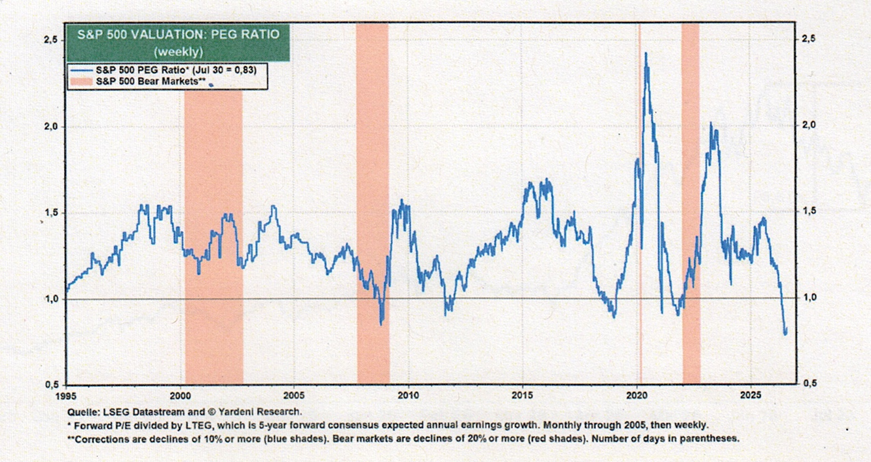
However, he sees the much more important reason for the positive sentiment in the financial markets in the positive momentum of earnings growth: “Corporate earnings expectations have been rising steadily for a year and have even doubled recently,” explains Menyhárt. For many investors, he says, the key factor is how much growth they get for the price of a stock. “The price-earnings-growth ratio, which compares the stock price to expected earnings growth, is currently at its lowest level in decades and has made stock investments attractive,” the expert notes. He adds: “Investors are literally chasing earnings, the setup for stocks is really strong right now!”
The PEG ratio is at its lowest level in decades
Please note: Past performance is not a reliable indicator for future performance.
Toward Greater Market Depth
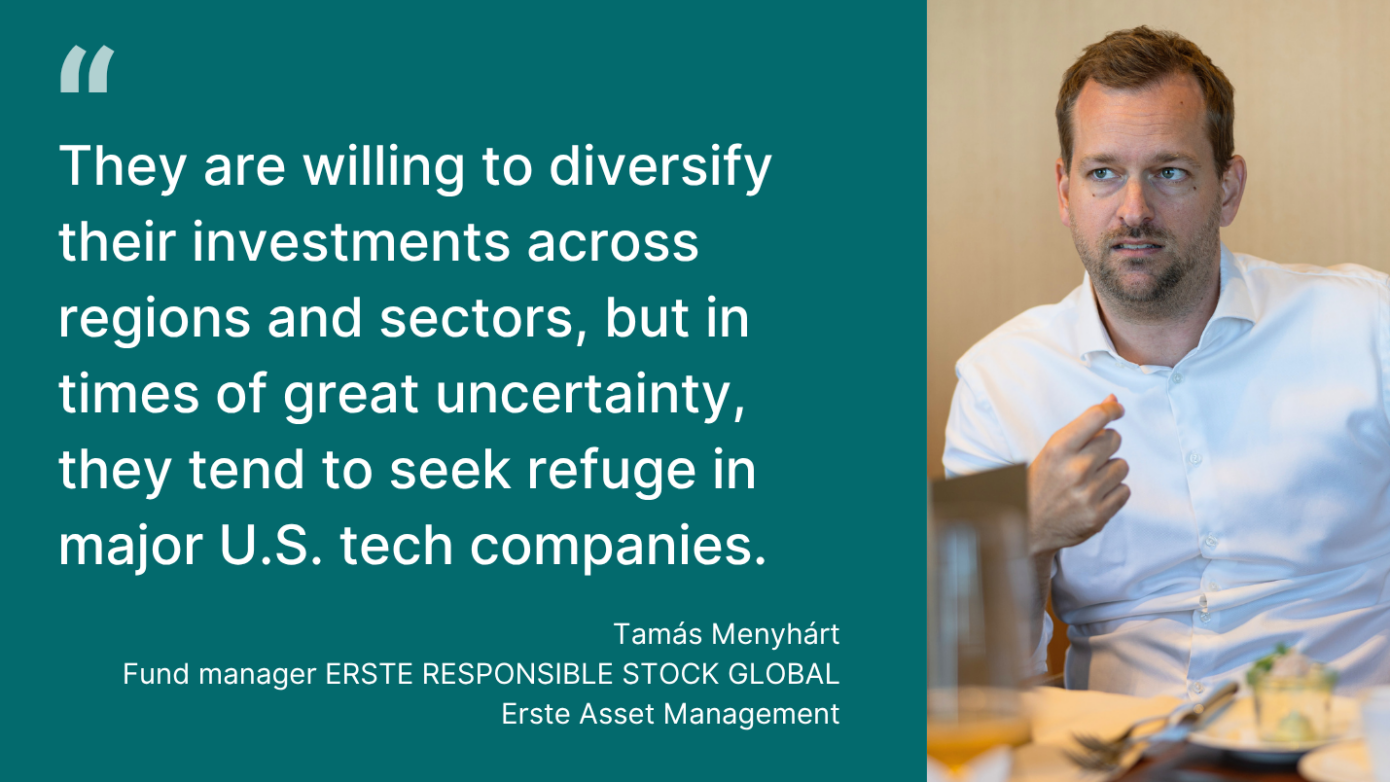
Menyhárt also points out that even higher bond yields and stock market slumps, such as the recent plunge in semiconductor stocks, have failed to dampen the current stock market boom. This was primarily due to inflated market expectations and profit-taking, which led investors to immediately reallocate their capital and invest in other sectors and regions. “Europe, among others, has benefited from this,” Menyhárt notes. In general, he sees an unbroken trend toward market diversification, fueled by a large number of investors who want to spread their money as widely as possible.
Artificial Intelligence as a Driver in the Stock Markets
Christoph Vahs, fund manager of the ERSTE RESPONSIBLE STOCK AMERICA, cites another reason for the stock market rally: The expansion of artificial intelligence is leading to billions in investments in data centers, cloud infrastructure, and electrification, which is boosting technology stocks in particular, but also stocks in related infrastructure sectors.
Vahs believes that developments in the field of artificial intelligence are still in their infancy and expects them to drive growth for years to come. As an example, he cites numerous companies “that are giving up their retail business because their order books in the business-to-business segment are so full that they can barely keep up with fulfilling them.”
Bubble or a new era?
When asked whether artificial intelligence could follow a similar trajectory to the dot-com bubble of the late 1990s, Vahs points out significant differences from that time: “The valuations of some dot-com companies were extremely high back then, even though they weren’t generating any profits. As a result, numerous tech stocks plummeted starting in 2000.” In contrast, the major IT companies that are investing heavily in artificial intelligence today can actually afford these investments because they have sufficient capital reserves. One side effect of these massive investments, however, is that the profits of the “Magnificent 7”, which include Nvidia, Microsoft, Apple, Alphabet, Amazon, Meta, and Tesla, are suffering as a result, causing their stocks to underperform the rest of the tech market. All in all, the fund manager sees artificial intelligence as an opportunity that can bring about significant change. However, the rapid expansion of the necessary infrastructure is crucial.
Please note: The companies mentioned in this article have been selected as examples and do not constitute investment recommendations. Investments have also risks.
A Hunger for Storage, Energy, and Manpower
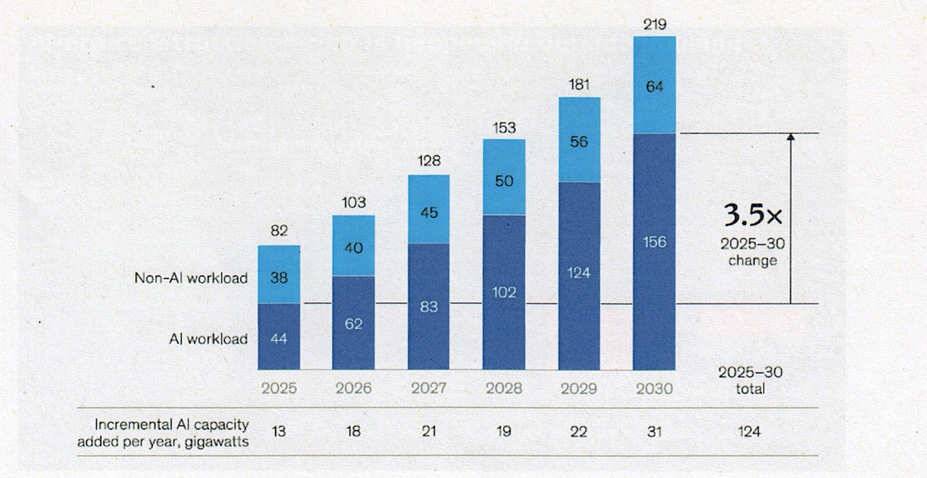
The expected increase in electricity demand alone, required to power AI data centers – will give the energy sector a massive boost in the coming years. According to estimates, electricity consumption caused by data centers is expected to increase by 350% by 2030.
Please note: Prognoses are not a reliable indicator of future performance.
Power Requirements for Data Centers
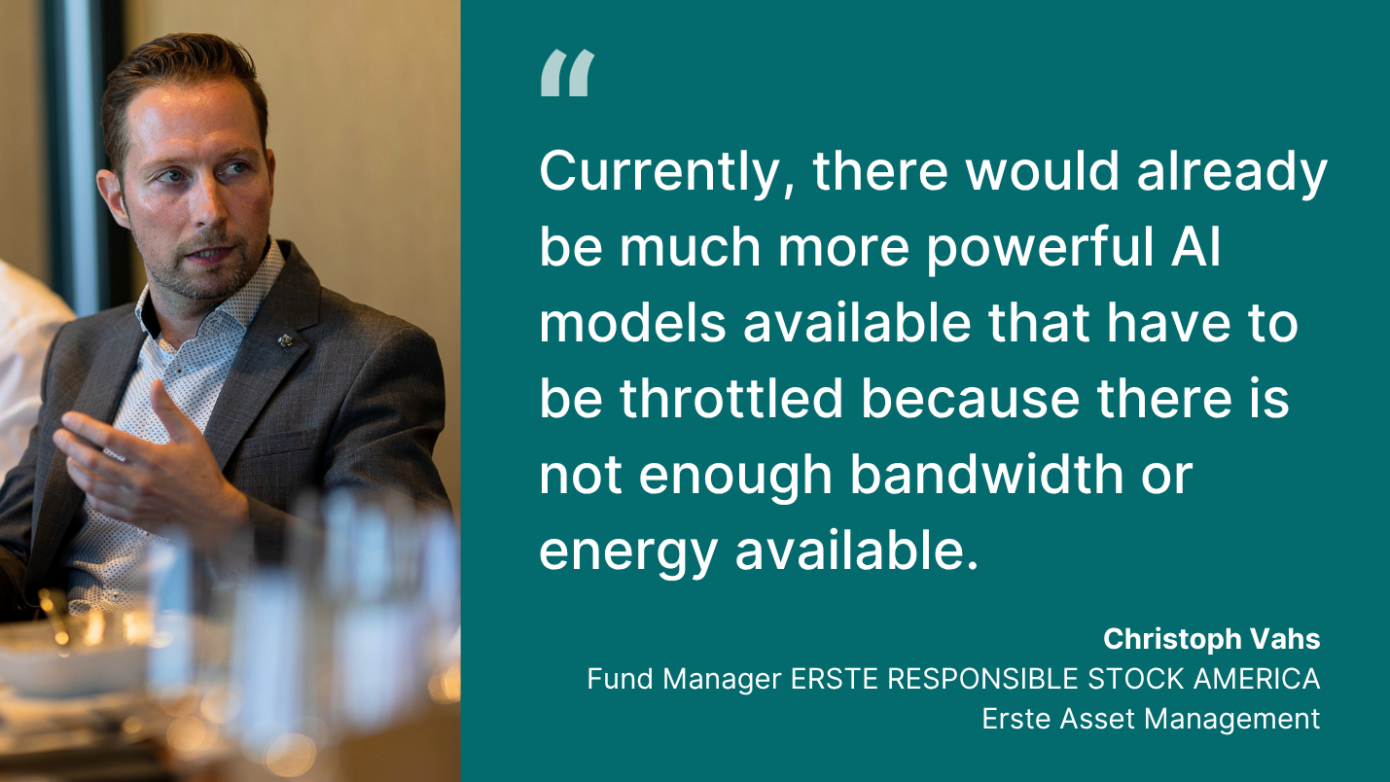
At the same time, a massive demand for storage capacity is expected to continue, a demand that the industry is barely able to meet. The result is a significant increase in storage prices, which is increasingly being felt in all areas of daily life – from smartphones to computers.
Even though artificial intelligence will replace jobs in an increasing number of fields, Vahs also sees a countertrend: “In the U.S., we see that the jobs eliminated by artificial intelligence are more than offset by significantly more new jobs created in the skilled trades, real estate, and infrastructure sectors.” At least for now, therefore, one could speak of a small AI job boom.
In the long run, however, artificial intelligence could also wipe out entire industries, says Vahs, citing the software industry as an example – an industry that is already struggling – with the ever increasing capabilities of artificial intelligence. “With the right AI model, you no longer need graphics programs or web tools to edit an image or build a website,” says Vahs, offering a glimpse of what might be ahead.
Opportunities Beyond the Tech Giants
Anyone wondering about the sustainability of the investment boom in the field of artificial intelligence is directed by the two experts to other market sectors – such as financial stocks, healthcare, biotechnology, industry, and infrastructure. While these sectors also benefit in part from the AI trend, they are often valued more attractively compared to the technology sector.
Traditional value sectors such as energy and banking are receiving strong support at this stage, which is good for European stock indices. Tamas Menyhárt and Christoph Vahs attribute the boom in the banking sector – from which Europe is benefiting in particular – in part to the end of the negative interest rate environment, under which financial stocks had suffered for an entire decade. The current rise in interest rates, which is not accompanied by an increased risk of recession, is providing an additional boost.
Positive Outlook for the Second Half of 2026
When asked about their final assessment for the second half of 2026, the two fund managers are in broad agreement. Reasonable stock valuations combined with very solid corporate growth make them generally optimistic; however, they expect the extremely high earnings growth rate of the past two quarters to slow somewhat.
Risk factors stem primarily from geopolitics. Even though the markets have learned to cope with ongoing geopolitical volatility, oil prices and inflation concerns could still quickly spill over into the stock markets from time to time.
Neither Menyhárt nor Vahs expect the U.S. midterm elections to have an impact on the financial markets. History has shown that the financial markets have always been able to cope with all kinds of majority configurations.
Tip: Stock funds as investment idea
If you don’t have the time or inclination to closely follow the stock markets and build your own portfolio, you can leave the selection of stocks to equity fund managers such as Tamás Menyhárt and Christoph Vahs. Investing in an equity fund allows for broad diversification – something that’s nearly impossible to achieve as an individual investor. This not only opens up a wide range of potential returns but also helps reduce risk.
You can find more information about the two equity funds mentioned here:
Please note: The investment funds have also risks.
Risk notes ERSTE RESPONSIBLE STOCK AMERICA
The fund employs an active investment policy and is not oriented towards a benchmark. The assets are selected on a discretionary basis and the scope of discretion of the management company is not limited.
For further information on the sustainable focus of ERSTE RESPONSIBLE STOCK AMERICA as well as on the disclosures in accordance with the Disclosure Regulation (Regulation (EU) 2019/2088) and the Taxonomy Regulation (Regulation (EU) 2020/852), please refer to the current Prospectus, section 12 and the Annex “Sustainability Principles”. In deciding to invest in ERSTE RESPONSIBLE STOCK AMERICA, consideration should be given to any characteristics or objectives of the ERSTE RESPONSIBLE STOCK AMERICA as described in the Fund Documents.
Risk notes ERSTE RESPONSIBLE STOCK GLOBAL
The fund employs an active investment policy and is not oriented towards a benchmark. The assets are selected on a discretionary basis and the scope of discretion of the management company is not limited.
For further information on the sustainable focus of ERSTE RESPONSIBLE STOCK GLOBAL as well as on the disclosures in accordance with the Disclosure Regulation (Regulation (EU) 2019/2088) and the Taxonomy Regulation (Regulation (EU) 2020/852), please refer to the current Prospectus, section 12 and the Annex “Sustainability Principles”. In deciding to invest in ERSTE RESPONSIBLE STOCK GLOBAL, consideration should be given to any characteristics or objectives of the ERSTE RESPONSIBLE STOCK GLOBAL as described in the Fund Documents.
Legal disclaimer
This document is an advertisement. Unless indicated otherwise, source: Erste Asset Management GmbH. The language of communication of the sales offices is German and the languages of communication of the Management Company also include English.
The prospectus for UCITS funds (including any amendments) is prepared and published in accordance with the provisions of the InvFG 2011 as amended. Information for Investors pursuant to § 21 AIFMG is prepared for the alternative investment funds (AIF) administered by Erste Asset Management GmbH pursuant to the provisions of the AIFMG in conjunction with the InvFG 2011.
The currently valid versions of the prospectus, the Information for Investors pursuant to § 21 AIFMG, and the key information document can be found on the website www.erste-am.com under “Mandatory publications” and can be obtained free of charge by interested investors at the offices of the Management Company and at the offices of the depositary bank. The exact date of the most recent publication of the prospectus, the languages in which the fund prospectus or the Information for Investors pursuant to Art 21 AIFMG and the key information document are available, and any other locations where the documents can be obtained are indicated on the website www.erste-am.com. A summary of the investor rights is available in German and English on the website www.erste-am.com/investor-rights and can also be obtained from the Management Company.
The Management Company can decide to suspend the provisions it has taken for the sale of unit certificates in other countries in accordance with the regulatory requirements.
Note: You are about to purchase a product that may be difficult to understand. We recommend that you read the indicated fund documents before making an investment decision. In addition to the locations listed above, you can obtain these documents free of charge at the offices of the referring Sparkassen bank and the offices of Erste Bank der oesterreichischen Sparkassen AG. You can also access these documents electronically at www.erste-am.com.
Our analyses and conclusions are general in nature and do not take into account the individual characteristics of our investors in terms of earnings, taxation, experience and knowledge, investment objective, financial position, capacity for loss, and risk tolerance. Past performance is not a reliable indicator of the future performance of a fund.
Please note: Investments in securities entail risks in addition to the opportunities presented here. The value of units and their earnings can rise and fall. Changes in exchange rates can also have a positive or negative effect on the value of an investment. For this reason, you may receive less than your originally invested amount when you redeem your units. Persons who are interested in purchasing units in investment funds are advised to read the current fund prospectus(es) and the Information for Investors pursuant to § 21 AIFMG, especially the risk notices they contain, before making an investment decision. If the fund currency is different than the investor’s home currency, changes in the relevant exchange rate can positively or negatively influence the value of the investment and the amount of the costs associated with the fund in the home currency.
We are not permitted to directly or indirectly offer, sell, transfer, or deliver this financial product to natural or legal persons whose place of residence or domicile is located in a country where this is legally prohibited. In this case, we may not provide any product information, either.
Please consult the corresponding information in the fund prospectus and the Information for Investors pursuant to § 21 AIFMG for restrictions on the sale of the fund to American or Russian citizens.
It is expressly noted that this communication does not provide any investment recommendations, but only expresses our current market assessment. Thus, this communication is not a substitute for investment advice.
This document does not represent a sales activity of the Management Company and therefore may not be construed as an offer for the purchase or sale of financial or investment instruments.
Erste Asset Management GmbH is affiliated with the Erste Bank and austrian Sparkassen banks.
Please also read the “Information about us and our securities services” published by your bank.
More on the topic
China’s roadmap for the future: A look at the new five-year plan
Although China’s economy is expected to grow less strongly in the coming years, Beijing is focusing on quality and therefore growth in promising sectors. Read today’s blog post to find out why innovation, technology and key strategic industries are the focus of the new five-year plan and what opportunities this presents for investors.

Best of Charts: The road (in)to the White House
Three weeks before election day, the race for the White House is wide open: While Kamala Harris is ahead in the nationwide polls, Donald Trump is currently likely to be ahead in the crucial “swing states”. In any case, the economic situation and mood in the USA are likely to play an important role in the race for the presidency.

Kyrgyzstan: Strong Growth, Increasing Inclusion, and an Attractive Microfinance Market
In recent years, Kyrgyzstan has emerged as one of the most dynamic economies in Central Asia. Strong growth, rising incomes, and a more professional financial sector are making the country increasingly attractive for responsible microfinance investments.