

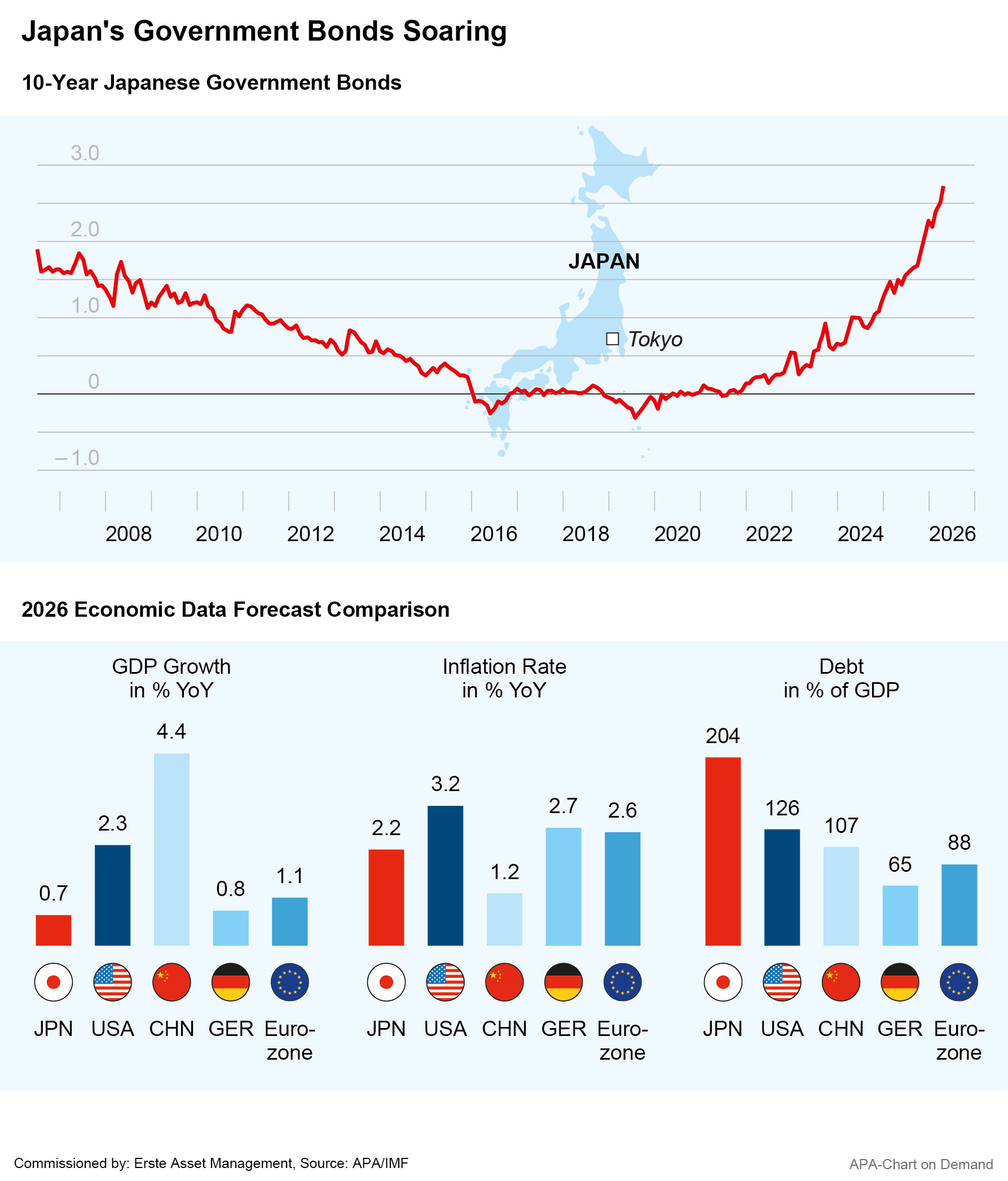
Following the end of its long zero-interest-rate policy, the Bank of Japan has raised interest rates for the first time in a decade this year, bringing an economic era to a close. On the bond market, government bond prices have recently continued to drop. The yield on ten-year bonds has risen to its highest level since the 1990s and is now approaching 3 per cent. This is also affecting the mortgage market: for the government, businesses and private individuals alike. Taking on debt in Japan is currently more expensive than it has been for a long time.
Although Japan’s economic data has recently shown surprisingly positive development, bond prices are likely to come under pressure due to budget concerns stemming from the new Prime Minister Sanae Takaichi’s policy of generous spending, as well as fears of further rising inflation and, consequently, further interest rate hikes by the central bank.
Note: Please note the opportunities and risks when investing in securities.
Japan’s Economy Suffering Particularly Badly From Surging Oil Prices
Although core inflation in Japan fell to 1.4 per cent in April – its lowest level in four years – many experts expect inflation to rise in the coming months given the ongoing increase in energy costs. With Japan’s resource-poor economy heavily dependent on oil imports from the Middle East, and the Strait of Hormuz – a key route for crude oil supplies – being effectively closed due to the war in Iran, oil and energy prices have skyrocketed this year.
Compounding this is the current weakness of the Japanese yen. This makes oil even more expensive for the country. The yen has been losing ground steadily on the foreign exchange market this year. In view of the yen’s weakness, Japan’s Ministry of Finance has already signaled the possibility of direct intervention in the foreign exchange market to bolster the currency. According to market participants, the central bank has in fact already prevented even greater yen losses on several occasions through market interventions.
Note: Forecasts are not a reliable indicator of future performance.
Central Bank Could Respond to High Energy Prices With Further Interest Rate Hikes
Experts also believe the central bank is likely to continue its course of interest rate hikes. While inflation has recently remained below the central bank’s 2.0 per cent target, the prospect of rising inflation rates is also fuelling market expectations of countervailing interest rate hikes by the BoJ.
At its last meeting in April, the central bank left its key interest rate unchanged at 0.75 per cent despite the consequences of the war in Iran. However, pressure for a tighter monetary policy was mounting within the BoJ. Three of the nine board members voted in favor of a hike, citing inflationary pressures resulting from the war and marking the highest number of dissenting votes since January 2016. The central bank also revised its inflation forecasts significantly upwards. They signaled a high probability of an interest rate hike in the coming months.
Japan’s New Prime Minister Is Focusing on Investment Despite High Debt
Concerns about Japan’s national budget are also putting pressure on bond prices. Asia’s second-largest economy after China is more heavily indebted than any other major industrialised nation. According to the International Monetary Fund (IMF), the government’s liabilities amount to nearly 200 per cent of the GDP. By way of comparison: Germany’s public debt-to-GDP ratio currently stands at 65 per cent according to the IMF. That of China and the US is just over 100 per cent. Added to this are rising interest rates on the government bond market, which are driving up the cost of taking on new debt even further for the Japanese government.
Despite the high level of debt, Japan’s new Prime Minister announced a shift away from the previous austerity policy as soon as she took office and is focusing on tax cuts and the positive economic effects of government spending. “My government will break with the long-standing trend of excessive austerity measures and chronic underinvestment in the future,” Takaichi said in February. Japan should not hesitate to increase spending to support private investment. At the same time, the Prime Minister also criticized the central bank’s interest rate hike.
Latest Economic Data Came as a Positive Surprise
The latest economic data in Japan has been a positive surprise. Gross domestic product (GDP) rose by 2.1 per cent in Q1 on an annualized basis. Experts had expected well below 2 per cent on average. Private consumption and investment increased by 0.3 per cent, respectively. In addition, the trade balance – the balance of exports and imports – contributed 0.3 percentage points to growth.
Japan’s exports also increased rather strongly in April, driven by continuing strong demand from China and Europe. Export volume rose by 14.8 per cent year-on-year to JPY 10.5tn (~EUR 57bn), marking a surprising acceleration in export growth. The manufacturing sector has also recently shown a positive trend, with output from Japanese factories increasing by 0.8 per cent month-on-month in April in defiance of Analysts’ expected decline of 0.9 per cent. However, many experts fear that rising energy prices and supply bottlenecks caused by the Iran conflict will continue to dampen Japan’s economy as the year progresses.
Broadly diversified investment in Japanese equities
When you want to participate in the potential upturn in the Japanese economy, you may consider investing in the ERSTE RESPONSIBLE STOCK JAPAN fund. The equity fund offers the opportunity to invest in a wide range of Japanese companies from various sectors. The fund focuses on companies with medium to high market capitalization, attractive dividend yields, and above-average quality. Sustainability aspects are also taken into account when selecting stocks. However, the risks should also be noted. The fund price can fluctuate significantly. The share value may be affected by exchange rate changes due to investments in foreign currencies, particularly the Japanese yen.
👉 You can find out more about the fund on our website
Note: Past performance is not a reliable indicator of the future performance of a fund.
Performance ERSTE RESPONSIBLE STOCK JAPAN
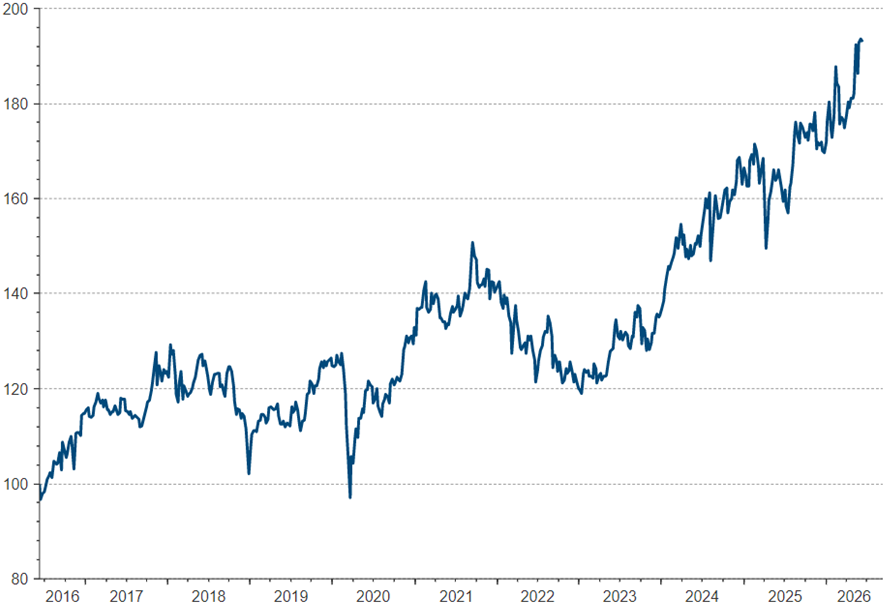
Note: The performance is calculated in accordance with the OeKB method. Management fee as well as any performance-related remuneration is already included. The issue premium which might be applicable on purchase and as well as any individual transaction specific costs or ongoing costs that reduce earnings (e.g. account- and deposit fees) have not been taken into account in this presentation.
The fund employs an active investment policy and is not oriented towards a benchmark. Assets are selected on a discretionary basis and the scope of discretion of the management company is not limited.
For further information on the sustainable focus of ERSTE RESPONSIBLE STOCK JAPAN as well as on the disclosures in accordance with the Disclosure Regulation (Regulation (EU) 2019/2088) and the Taxonomy Regulation (Regulation (EU) 2020/852), please refer to the current Prospectus, section 12 and the Annex “Sustainability Principles”. In deciding to invest in ERSTE RESPONSIBLE STOCK JAPAN, consideration should be given to any characteristics or objectives of the ERSTE RESPONSIBLE STOCK JAPAN as described in the Fund Documents.
Legal disclaimer
This document is an advertisement. Unless indicated otherwise, source: Erste Asset Management GmbH. The language of communication of the sales offices is German and the languages of communication of the Management Company also include English.
The prospectus for UCITS funds (including any amendments) is prepared and published in accordance with the provisions of the InvFG 2011 as amended. Information for Investors pursuant to § 21 AIFMG is prepared for the alternative investment funds (AIF) administered by Erste Asset Management GmbH pursuant to the provisions of the AIFMG in conjunction with the InvFG 2011.
The currently valid versions of the prospectus, the Information for Investors pursuant to § 21 AIFMG, and the key information document can be found on the website www.erste-am.com under “Mandatory publications” and can be obtained free of charge by interested investors at the offices of the Management Company and at the offices of the depositary bank. The exact date of the most recent publication of the prospectus, the languages in which the fund prospectus or the Information for Investors pursuant to Art 21 AIFMG and the key information document are available, and any other locations where the documents can be obtained are indicated on the website www.erste-am.com. A summary of the investor rights is available in German and English on the website www.erste-am.com/investor-rights and can also be obtained from the Management Company.
The Management Company can decide to suspend the provisions it has taken for the sale of unit certificates in other countries in accordance with the regulatory requirements.
Note: You are about to purchase a product that may be difficult to understand. We recommend that you read the indicated fund documents before making an investment decision. In addition to the locations listed above, you can obtain these documents free of charge at the offices of the referring Sparkassen bank and the offices of Erste Bank der oesterreichischen Sparkassen AG. You can also access these documents electronically at www.erste-am.com.
Our analyses and conclusions are general in nature and do not take into account the individual characteristics of our investors in terms of earnings, taxation, experience and knowledge, investment objective, financial position, capacity for loss, and risk tolerance. Past performance is not a reliable indicator of the future performance of a fund.
Please note: Investments in securities entail risks in addition to the opportunities presented here. The value of units and their earnings can rise and fall. Changes in exchange rates can also have a positive or negative effect on the value of an investment. For this reason, you may receive less than your originally invested amount when you redeem your units. Persons who are interested in purchasing units in investment funds are advised to read the current fund prospectus(es) and the Information for Investors pursuant to § 21 AIFMG, especially the risk notices they contain, before making an investment decision. If the fund currency is different than the investor’s home currency, changes in the relevant exchange rate can positively or negatively influence the value of the investment and the amount of the costs associated with the fund in the home currency.
We are not permitted to directly or indirectly offer, sell, transfer, or deliver this financial product to natural or legal persons whose place of residence or domicile is located in a country where this is legally prohibited. In this case, we may not provide any product information, either.
Please consult the corresponding information in the fund prospectus and the Information for Investors pursuant to § 21 AIFMG for restrictions on the sale of the fund to American or Russian citizens.
It is expressly noted that this communication does not provide any investment recommendations, but only expresses our current market assessment. Thus, this communication is not a substitute for investment advice.
This document does not represent a sales activity of the Management Company and therefore may not be construed as an offer for the purchase or sale of financial or investment instruments.
Erste Asset Management GmbH is affiliated with the Erste Bank and austrian Sparkassen banks.
Please also read the “Information about us and our securities services” published by your bank.
More on the topic

New momentum for environmental stocks?
The stock market year to date has been volatile. Tariffs, geopolitical uncertainties and the new US tax law have dominated the headlines. The latter turned out better than expected for the environmental technology sector. Many companies have recently taken a more positive view of the future and the sector could also be worth a look from a valuation perspective.

Trump’s tariff plans: a game with no winners?
On 20 January, the world will once again look to Washington with anticipation as Donald Trump is sworn in as US President for the second time in front of the Capitol. In any case, his statements and plans are already the focus of attention on the financial markets.
Trump is planning high import tariffs for goods, for example from Mexico and China. The possible consequences range from the threat of a trade war to a comeback of inflation. In the end, will no one benefit from the planned tariff measures?