
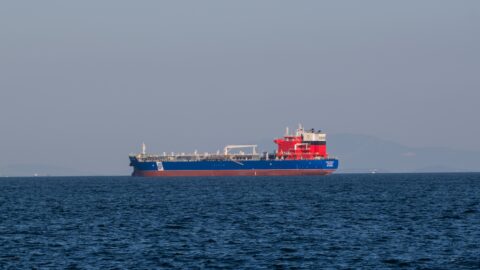
On the oil market, all eyes remain fixed on the war in Iran and the Strait of Hormuz. Iran’s peace talks with the US appear to have reached an impasse, and there is still no sign of an end to the war.
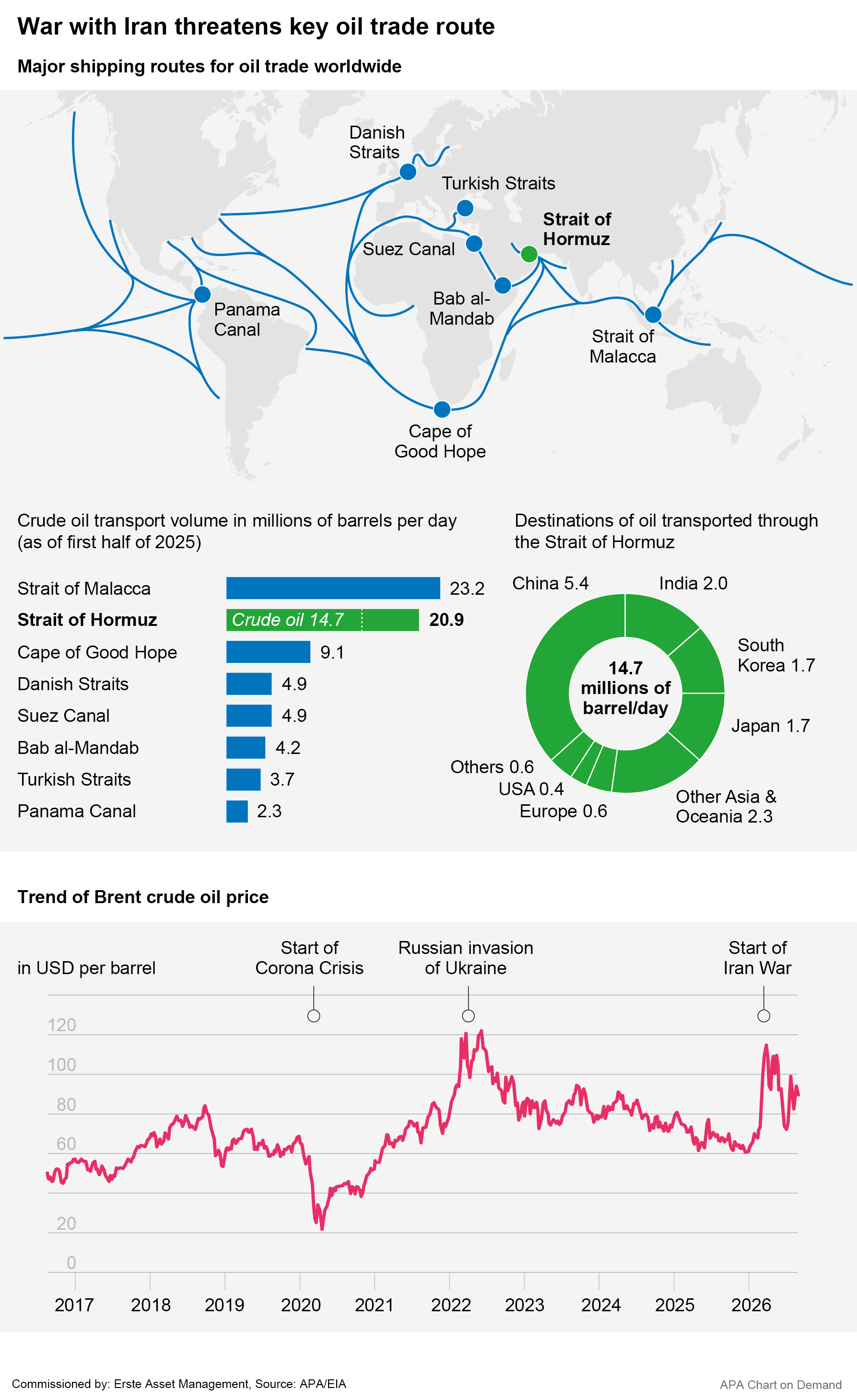
The prospect that the Strait of Hormuz, the vital transport route for oil shipments from the Persian Gulf, will remain blocked for the time being caused oil prices to rise sharply again last week. The price of Brent crude, the benchmark grade, climbed at times to over 90 dollars per barrel (159 litres) and has recently stabilised at this level in view of the deadlocked negotiations. Since the start of the year, the price of Brent has thus risen by around 50 per cent.
With the outbreak of war between the US, Israel and Iran, this vital transport route for oil tankers was blocked for the first time, which in turn had sent oil prices soaring. As a result, the price of the benchmark Brent crude rose from levels below 70 dollars per barrel to as high as 120 dollars at times.
Consequently, oil prices have fluctuated significantly depending on the news situation. Signs of a negotiated solution have at times led to an easing of oil prices, whilst contrary signals have then triggered further rises. By now, most market participants are likely to have come to terms with a prolonged stalemate and, consequently, an effective closure of the Strait of Hormuz.
At present, only a small proportion of the usual volumes of oil are still being transported via this vital trade route. The strait, through which a fifth of global oil and liquefied natural gas (LNG) supplies used to pass, is now considered to be largely blocked due to the risk of attacks and mines during the war between the US, Israel and Iran. Iranian controls on shipping traffic and the US military’s naval blockade of Iranian ports make reliable oil trade virtually impossible.
Note: Past performance is not a reliable indicator for future performance. Data as of 27/08/2026
Oil shipments via the Strait of Hormuz have plummeted, though unofficial figures are higher
According to data from the US Energy Information Administration (EIA), over 20 million barrels of oil were transported through the Strait of Hormuz every day in recent years. Most recently, according to calculations by Bloomberg, only around 300,000 barrels per day were officially allowed to pass openly through the strait.
The unofficial figures, however, could be significantly higher. According to the latest figures from US Energy Secretary Chris Wright, around eight million barrels of oil were recently passing through the Strait of Hormuz every day. According to independent analysts, the figure could be around half that.
It is not only Iran itself, but also small transport companies and even major energy conglomerates that are currently finding ways to ship oil through the strait despite the risks of war. The French oil company TotalEnergies, for example, is profitably transporting crude oil through the Strait of Hormuz despite the risks, as Chief Executive Patrick Pouyanne explained at the start of the week at an energy conference in Norway. “We are probably the largest trader of oil from Iraq or Qatar today,” said Pouyanne. “And I can tell you that crude oil is currently moving very quietly and not publicly through the Strait of Hormuz.”
Note: The companies mentioned in this article have been selected as examples and do not constitute investment recommendations.
Substantial price discounts from crude oil producers more than offset the increased transport costs, Pouyanne explained: “Crude oil is being sold for 50 to 60 dollars per barrel, not at the Brent price, as producers are desperately trying to bring their oil to market.” Transporting a supertanker through the Strait of Hormuz and back costs around 20 million dollars. Divided by the volume of 2 million barrels of oil transported, this results in a surcharge of 10 dollars per barrel. The purchase price and transport costs are therefore below the Brent oil price of 90 dollars.
Smaller oil traders and shipping companies are also continuing to transport oil through the strait despite Iran’s threats. They use smaller vessels that traverse the waterway several times to transfer oil from a large merchant ship on one side of the waterway to an oil tanker on the other side in open waters. This so-called ‘ship-to-ship’ system spreads the risk; moreover, smaller vessels are more difficult to detect.
US seeks to halt Iranian oil sales with economic sanctions
Iran itself also uses back channels and continues to sell crude oil despite US efforts to prevent this. Accordingly, the US now intends to target buyers of Iranian oil with far-reaching economic sanctions and cut the country off from this source of income. The new sanctions under Operation ‘Economic Outcast’ are aimed at cutting off every potential source of revenue for the Iranian Revolutionary Guards, US Treasury Secretary Scott Bessent said at a press conference on Monday.
Should this succeed, it would reduce the global oil supply and could drive oil prices up again. However, Chinese banks suspected of supporting the Iranian oil trade have, for the time being, been spared from the US sanctions. Countries that continue to trade with Iran, however, run the risk of being excluded from the dollar-based financial system, Bessent explained. He intends to give the affected states time to adapt to the new requirements.
Iran has already threatened retaliation against the US following the announcement of the sanctions. The country is fully prepared for the US punitive measures, said Economy Minister Ali Madanizadeh on Tuesday. Chinese officials also criticised the threatened sanctions against Iran and its trading partners. An economic war would not lead to a solution but would instead exacerbate conflicts and disrupt the global financial order, said China’s foreign ministry spokesperson Lin Jian.
Legal disclaimer
This document is an advertisement. Unless indicated otherwise, source: Erste Asset Management GmbH. The language of communication of the sales offices is German and the languages of communication of the Management Company also include English.
The prospectus for UCITS funds (including any amendments) is prepared and published in accordance with the provisions of the InvFG 2011 as amended. Information for Investors pursuant to § 21 AIFMG is prepared for the alternative investment funds (AIF) administered by Erste Asset Management GmbH pursuant to the provisions of the AIFMG in conjunction with the InvFG 2011.
The currently valid versions of the prospectus, the Information for Investors pursuant to § 21 AIFMG, and the key information document can be found on the website www.erste-am.com under “Mandatory publications” and can be obtained free of charge by interested investors at the offices of the Management Company and at the offices of the depositary bank. The exact date of the most recent publication of the prospectus, the languages in which the fund prospectus or the Information for Investors pursuant to Art 21 AIFMG and the key information document are available, and any other locations where the documents can be obtained are indicated on the website www.erste-am.com. A summary of the investor rights is available in German and English on the website www.erste-am.com/investor-rights and can also be obtained from the Management Company.
The Management Company can decide to suspend the provisions it has taken for the sale of unit certificates in other countries in accordance with the regulatory requirements.
Note: You are about to purchase a product that may be difficult to understand. We recommend that you read the indicated fund documents before making an investment decision. In addition to the locations listed above, you can obtain these documents free of charge at the offices of the referring Sparkassen bank and the offices of Erste Bank der oesterreichischen Sparkassen AG. You can also access these documents electronically at www.erste-am.com.
Our analyses and conclusions are general in nature and do not take into account the individual characteristics of our investors in terms of earnings, taxation, experience and knowledge, investment objective, financial position, capacity for loss, and risk tolerance. Past performance is not a reliable indicator of the future performance of a fund.
Please note: Investments in securities entail risks in addition to the opportunities presented here. The value of units and their earnings can rise and fall. Changes in exchange rates can also have a positive or negative effect on the value of an investment. For this reason, you may receive less than your originally invested amount when you redeem your units. Persons who are interested in purchasing units in investment funds are advised to read the current fund prospectus(es) and the Information for Investors pursuant to § 21 AIFMG, especially the risk notices they contain, before making an investment decision. If the fund currency is different than the investor’s home currency, changes in the relevant exchange rate can positively or negatively influence the value of the investment and the amount of the costs associated with the fund in the home currency.
We are not permitted to directly or indirectly offer, sell, transfer, or deliver this financial product to natural or legal persons whose place of residence or domicile is located in a country where this is legally prohibited. In this case, we may not provide any product information, either.
Please consult the corresponding information in the fund prospectus and the Information for Investors pursuant to § 21 AIFMG for restrictions on the sale of the fund to American or Russian citizens.
It is expressly noted that this communication does not provide any investment recommendations, but only expresses our current market assessment. Thus, this communication is not a substitute for investment advice.
This document does not represent a sales activity of the Management Company and therefore may not be construed as an offer for the purchase or sale of financial or investment instruments.
Erste Asset Management GmbH is affiliated with the Erste Bank and austrian Sparkassen banks.
Please also read the “Information about us and our securities services” published by your bank.
More on the topic
Trump’s tariff plans: a game with no winners?
On 20 January, the world will once again look to Washington with anticipation as Donald Trump is sworn in as US President for the second time in front of the Capitol. In any case, his statements and plans are already the focus of attention on the financial markets.
Trump is planning high import tariffs for goods, for example from Mexico and China. The possible consequences range from the threat of a trade war to a comeback of inflation. In the end, will no one benefit from the planned tariff measures?