

It wasn’t all that long ago that investors were complaining that no interest was being paid on either savings accounts or the bond market. Those times now seem astonishingly far away, as the tide has turned remarkably quickly since 2022.
In recent weeks, the situation has become even more acute, and we have now reached interest rate levels in some cases that we haven’t seen for decades. For instance, ten-year US government bonds reached 5.3 per cent – the same level as in 2002 – whilst in Japan one has to go back 30 years to find similarly high interest rates.
Note: Past performance is not a reliable indicator of future results.
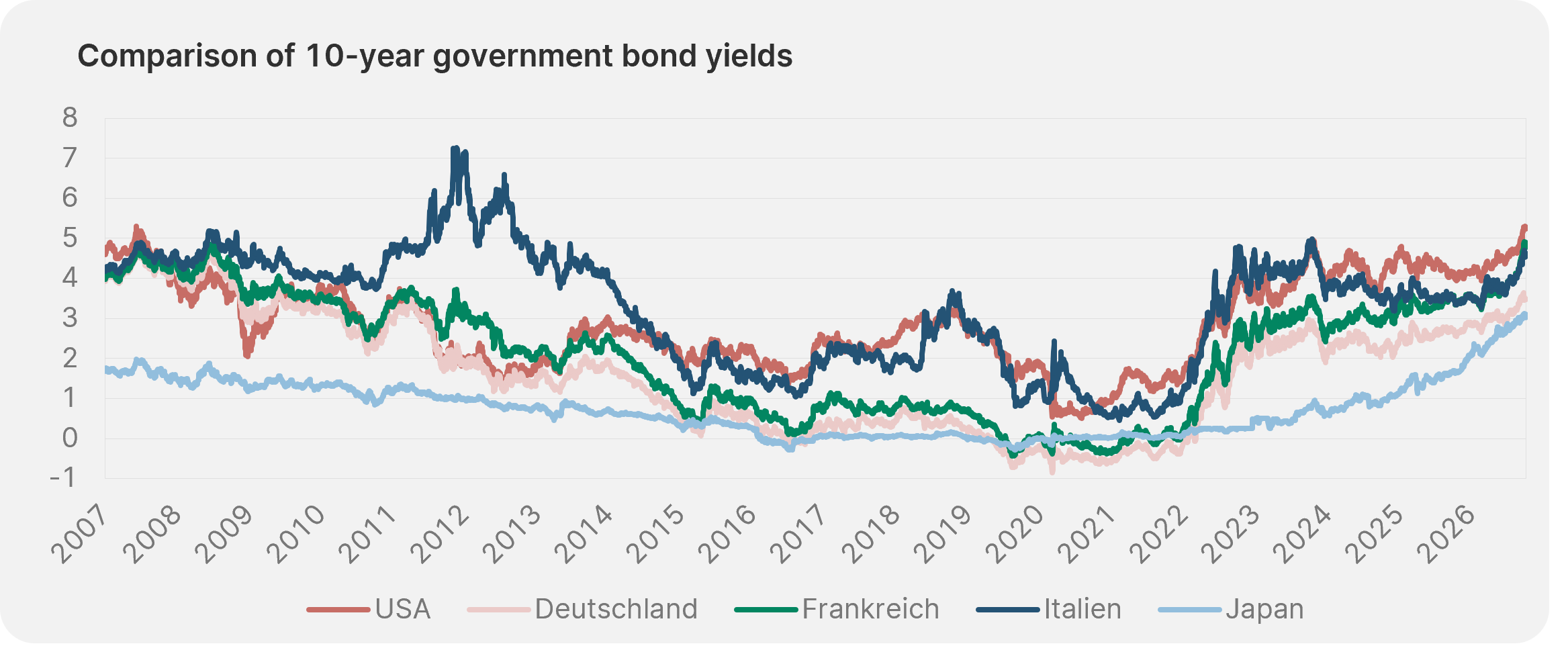
Source: Bloomberg, data as of October 9, 2026
This development is particularly problematic for the US. The country’s mountain of debt has now exceeded the US$ 40 trillion mark and must be continuously refinanced at ever-higher interest rates. The currently robust economic data, the renewed energy price shock and the associated inflation risks have also led Kevin Warsh to return to a course of monetary tightening. At the same time, investors are increasingly concerned about how long US fiscal policy can continue in its current form. It is also particularly noteworthy that international investors now hold only around 30 per cent of outstanding US government bonds, whereas around ten years ago this figure stood at approximately 50 per cent.
However, a systemic crisis would require more than this, as the US Treasury market is, after all, the deepest and most liquid in the world, the dollar remains the key reserve currency, and the US economy is growing exceptionally strongly. Recent auctions also show that buyers are returning to the market when yields become more attractive.
“Whatever it takes”
The situation in Europe, however, may be different, where memories of the sovereign debt crisis are naturally being rekindled. Back then, the relatively small country of Greece was enough to raise doubts about the survival of the single currency. In some respects, the current situation is even more challenging, as sovereign debt levels have, in some cases, risen significantly since then.
France, a European heavyweight, is also at the centre of the current crisis. As outlined in the special commentary, the so-called “Grande Nation” has lost its lustre in many areas, and, above all, fiscal paralysis and political uncertainty are significant sources of strain. The fact that France now has to pay higher interest rates than Italy and Greece is ultimately the price it is paying for its lack of willingness to reform in recent years. Nevertheless, there is one crucial difference compared with the euro crisis: Europe now has experience of this situation. Whilst Mario Draghi’s “Whatever it takes” was uttered under the greatest possible pressure, the ECB now has a comprehensive toolkit at its disposal to intervene if necessary. The banks, too, are now much better capitalised. The downside is that French politicians are also aware of this situation, and so the pain will likely have to intensify for the time being before a helping hand is extended.
Mid-term elections so far less relevant than expected
The US mid-term elections are due to take place on 3 November, and the situation for Donald Trump could be considerably more favourable. His approval ratings are at an all-time low, and, above all, the significant rise in the cost of living is weighing on the mood of the American public. Despite an exceptionally strong US economy, the economic upturn is therefore barely being felt by many voters. This is particularly evident at the petrol pump – the ongoing conflict with Iran has driven the oil price back above the US$ 100 mark, thereby exacerbating one of those issues that traditionally has a particularly strong influence on American elections.
We, too, had assumed that Trump would have a strong interest in a geopolitical de-escalation so that he could sell a supposed easing of energy prices as a domestic political success. As we now know, this has not happened, which is presumably also due to the fact that Washington lost control of the Iran conflict long ago.
As the chart below shows, in the wake of high energy prices, the Democrats not only have the chance to recapture the House of Representatives, but potentially the Senate as well. A sweeping electoral victory – a ‘blue wave’ – was still highly unlikely at the start of the year.
Note: Past performance is not a reliable indicator of future results.
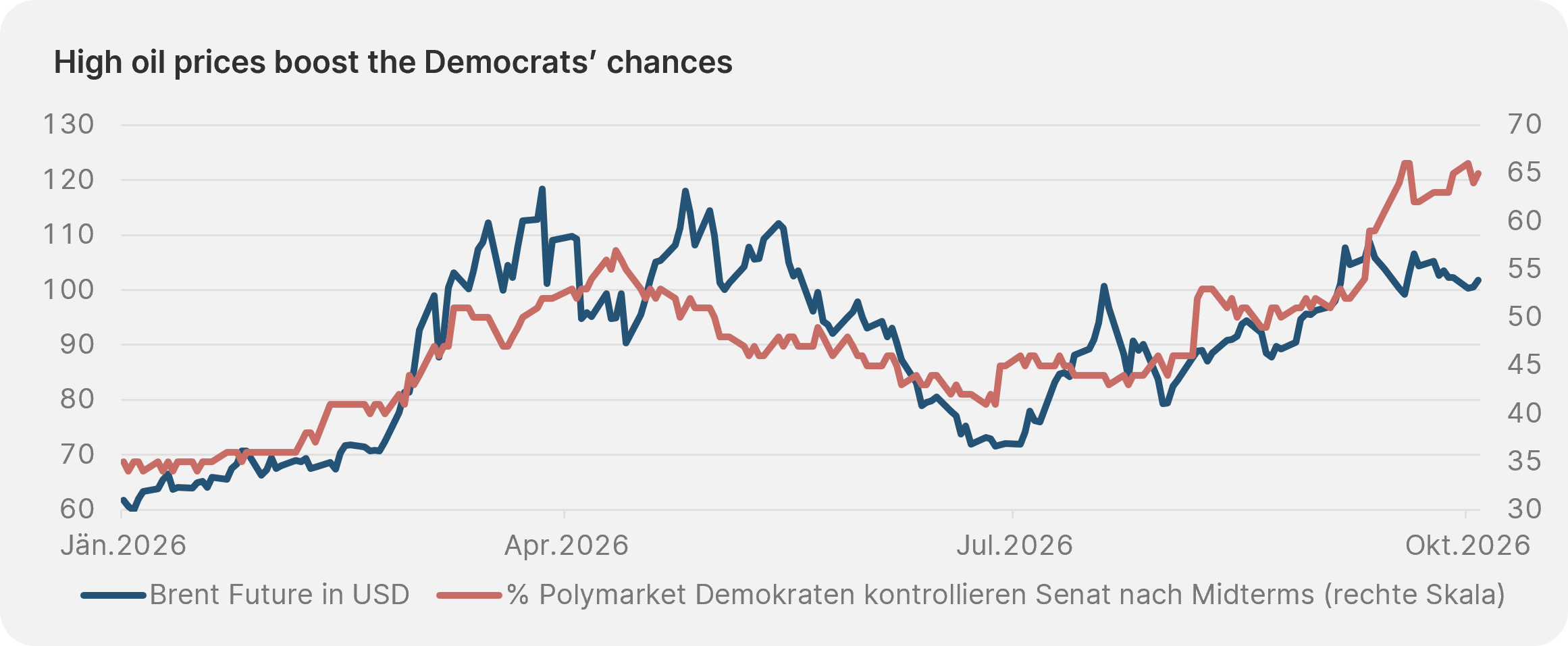
Source: Bloomberg, data as of October 8, 2026
Even though Trump himself is not standing for election, the mid-term elections are nonetheless seen as a verdict on his performance to date – and, at least for the moment, that verdict is likely to be “unsatisfactory”. Trump, however, is a born campaigner, and perhaps his latest election pledge – to give every adult US citizen US$ 5,000 in the event of an election victory – might turn the tide once again. Ultimately, a “blue wave” would tend to slow Trump down rather than render him incapable of acting. In terms of fiscal policy, a divided Congress would certainly be a positive development, whilst Trump would still have considerable scope for action, particularly in foreign and trade policy, through his executive powers.
Things are simmering beneath the surface
For the stock markets, therefore, what happens to oil prices and interest rates after 3 November could prove more interesting than the immediate election result. The latest labour market and inflation data have recently eased the pressure on the Fed somewhat, meaning the market is currently anticipating “only” one interest rate hike in December. Particular attention will also be focused on the upcoming earnings season in the coming weeks – the last two quarters have already shown extremely strong earnings growth in the S&P 500, and current analyst forecasts, pointing to more than 30 per cent earnings growth, also suggest an exceptionally strong earnings season. What is particularly noteworthy about the current situation is the fact that, historically, such strong profit increases have mostly occurred during recovery phases following previous crises. This is not currently the case, which therefore also highlights the extraordinary boost provided by the AI boom – at least in certain sectors of the economy.
Buoyed by these profits, the S&P 500 and Nasdaq continue to trade close to their all-time highs. The situation is different, however, for second-tier stocks. As the chart below shows, more than 50 per cent of companies in the particularly broad Russell 3000 have currently lost more than 20 per cent of their 52-week high and are therefore, by definition, in a bear market.
Note: Past performance is not a reliable indicator of future results.
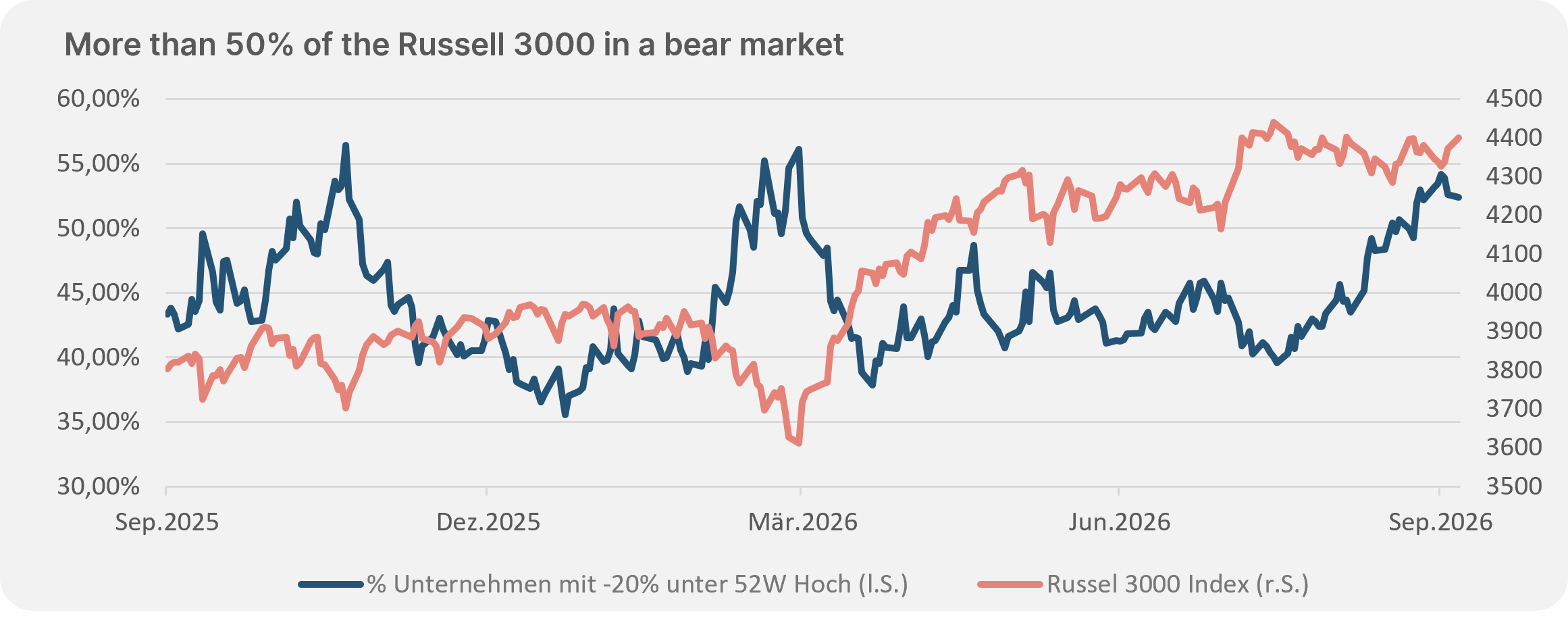
Source: Bloomberg, data as of October 8, 2026
The market therefore continues to draw a clear distinction between the supposed winners and losers of the AI disruption. The current reliance on a handful of stocks or sectors therefore carries a high concentration risk – any setbacks in the AI transformation, a reduction in planned capital expenditure or a significant decline in profits would weigh heavily on the market as a whole. On the other hand, the current picture also reveals considerable potential for the coming months – the new technology should, in fact, deliver productivity gains across the entire economy, meaning that numerous companies should also have scope to catch up.
Is the year-end rally on the cards?
Historically speaking, the end of the year has usually been a good time on the stock markets, and markets have generally trended positively in the wake of US mid-term elections as well. The economy is also proving surprisingly resilient, so the signs are generally in place for a promising autumn – though, as has so often been the case in recent history, the numerous peripheral disruptions argue against an even more aggressive stance. We are therefore maintaining our high level of portfolio diversification with a slight overweight in equities.
Please note: investing in securities involves risks as well as opportunities.
Legal disclaimer
This document is an advertisement. Unless indicated otherwise, source: Erste Asset Management GmbH. The language of communication of the sales offices is German and the languages of communication of the Management Company also include English.
The prospectus for UCITS funds (including any amendments) is prepared and published in accordance with the provisions of the InvFG 2011 as amended. Information for Investors pursuant to § 21 AIFMG is prepared for the alternative investment funds (AIF) administered by Erste Asset Management GmbH pursuant to the provisions of the AIFMG in conjunction with the InvFG 2011.
The currently valid versions of the prospectus, the Information for Investors pursuant to § 21 AIFMG, and the key information document can be found on the website www.erste-am.com under “Mandatory publications” and can be obtained free of charge by interested investors at the offices of the Management Company and at the offices of the depositary bank. The exact date of the most recent publication of the prospectus, the languages in which the fund prospectus or the Information for Investors pursuant to Art 21 AIFMG and the key information document are available, and any other locations where the documents can be obtained are indicated on the website www.erste-am.com. A summary of the investor rights is available in German and English on the website www.erste-am.com/investor-rights and can also be obtained from the Management Company.
The Management Company can decide to suspend the provisions it has taken for the sale of unit certificates in other countries in accordance with the regulatory requirements.
Note: You are about to purchase a product that may be difficult to understand. We recommend that you read the indicated fund documents before making an investment decision. In addition to the locations listed above, you can obtain these documents free of charge at the offices of the referring Sparkassen bank and the offices of Erste Bank der oesterreichischen Sparkassen AG. You can also access these documents electronically at www.erste-am.com.
Our analyses and conclusions are general in nature and do not take into account the individual characteristics of our investors in terms of earnings, taxation, experience and knowledge, investment objective, financial position, capacity for loss, and risk tolerance. Past performance is not a reliable indicator of the future performance of a fund.
Please note: Investments in securities entail risks in addition to the opportunities presented here. The value of units and their earnings can rise and fall. Changes in exchange rates can also have a positive or negative effect on the value of an investment. For this reason, you may receive less than your originally invested amount when you redeem your units. Persons who are interested in purchasing units in investment funds are advised to read the current fund prospectus(es) and the Information for Investors pursuant to § 21 AIFMG, especially the risk notices they contain, before making an investment decision. If the fund currency is different than the investor’s home currency, changes in the relevant exchange rate can positively or negatively influence the value of the investment and the amount of the costs associated with the fund in the home currency.
We are not permitted to directly or indirectly offer, sell, transfer, or deliver this financial product to natural or legal persons whose place of residence or domicile is located in a country where this is legally prohibited. In this case, we may not provide any product information, either.
Please consult the corresponding information in the fund prospectus and the Information for Investors pursuant to § 21 AIFMG for restrictions on the sale of the fund to American or Russian citizens.
It is expressly noted that this communication does not provide any investment recommendations, but only expresses our current market assessment. Thus, this communication is not a substitute for investment advice.
This document does not represent a sales activity of the Management Company and therefore may not be construed as an offer for the purchase or sale of financial or investment instruments.
Erste Asset Management GmbH is affiliated with the Erste Bank and austrian Sparkassen banks.
Please also read the “Information about us and our securities services” published by your bank.
More on the topic

Turkish financial markets temporarily under pressure following political turbulence
The Turkish stock market has been turbulent recently: the arrest of Istanbul mayor Ekrem Imamoglu caused massive uncertainty. What does the political unrest mean for the Turkish economy and the Istanbul stock exchange?