

The Corporate Sustainability Reporting Directive (CSRD) is intended to fundamentally revolutionize European sustainability reporting and ensure maximum comparability. In practice, however, the reality is quite different: The volume of information is growing faster than its actual analytical value. More data does not automatically lead to better investment decisions. Why professional interpretation, specialized analyses, and human judgment remain indispensable even in the age of standardization and artificial intelligence.
The latest reform also illustrates just how challenging implementation is: In July 2026, the European Commission significantly simplified the European Sustainability Reporting Standards (ESRS), which companies use to report under the CSRD. The number of mandatory data points is set to decrease by more than 60 percent. The new standards are thus intended to be shorter, clearer, and more practical. However, they are currently still undergoing the review process by the European Parliament and the Council.
It sounds like the perfect tool for the green capital market: a Europe-wide standardized framework that requires companies to disclose their sustainability data in accordance with the European Sustainability Reporting Standards (ESRS). The ESRS essentially serve as the “rulebook” for the Corporate Sustainability Reporting Directive (CSRD) and specify what information companies must report on environmental, social, and governance issues.
Anyone reading a company’s CSRD reports should be able to see at a glance what the future holds for that corporation. Combined with increasingly powerful AI systems, the vision of a largely automated sustainability analysis seems within reach.
But anyone who thinks this makes ESG integration a piece of cake for investors is mistaken. In practice, the new transparency leads to a paradox: More data does not automatically mean more insights.
In a Nutshell: What Is the CSRD?
The Corporate Sustainability Reporting Directive (CSRD) is an EU directive on corporate sustainability reporting. It aims to ensure that relevant information on environmental, social, and governance issues is disclosed in a more structured, transparent, and comparable manner.
The European Sustainability Reporting Standards (ESRS) specify the information that companies are required to report.
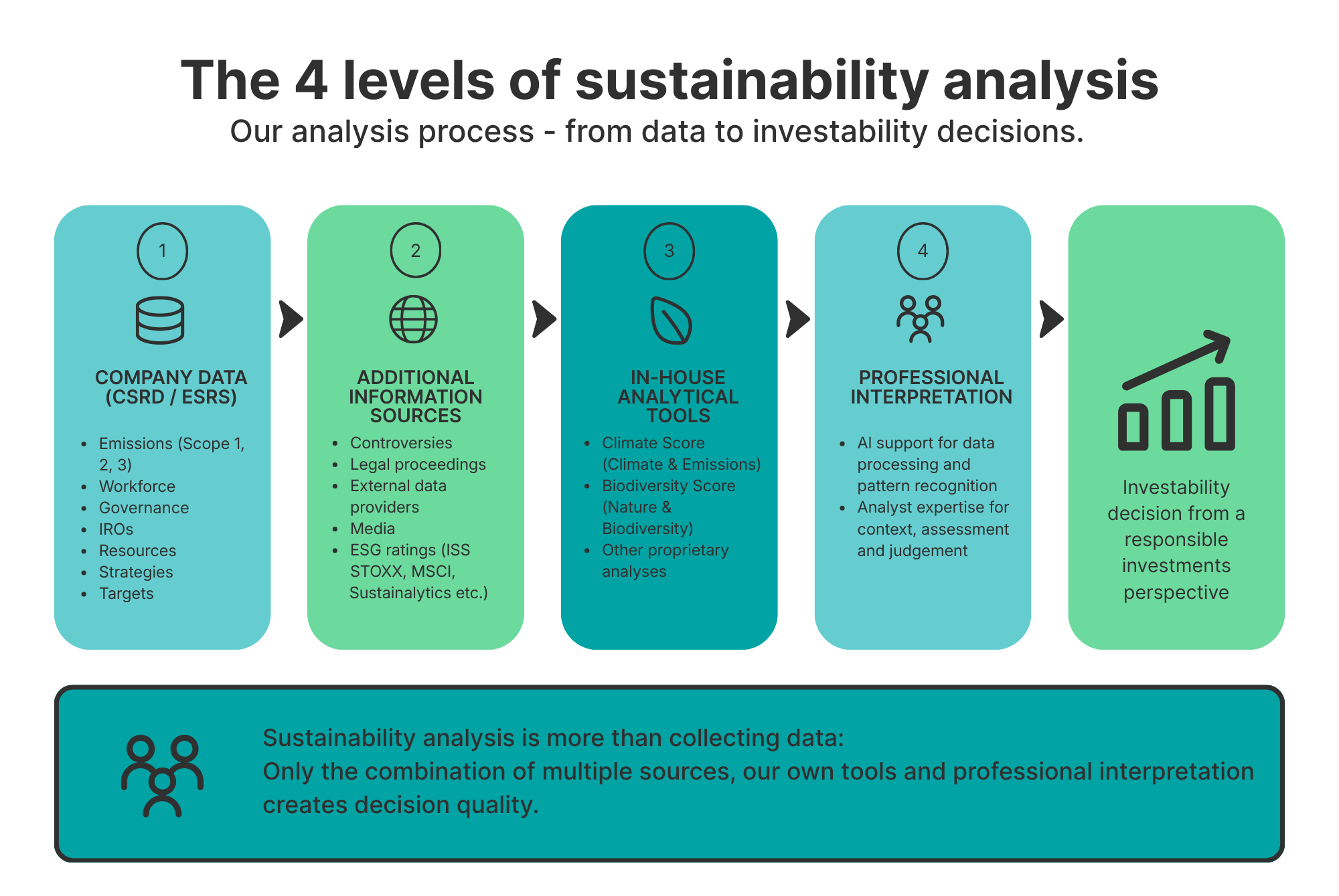
360-Degree Analysis
In the work of sustainability analysts, sustainability reports have long since become an important source of information. They provide insight into how a company manages its resources (both natural resources and human capital), what risks and opportunities arise from its business model, and how well-positioned its corporate governance is for the future.
The focus is on those sustainability factors that are of particular financial materiality for the respective sector – that is, factors that could have a significant impact on a company’s future business performance, profitability, or risk profile. In addition, the sustainability impacts of the companies themselves are also analyzed.
The Responsible Investments team at Erste Asset Management uses this information to develop an overall assessment of a company’s investment suitability from a sustainability perspective. Together with traditional financial analysis, this forms the basis for a well-founded assessment of a company’s attractiveness for a fund investment. The final investment decision is then made by the fund management team, taking into account
additional financial analyses.
While the CSRD provides a broader data set for this analysis, the real work doesn’t begin until after the data has been downloaded.
Overview of Technical Terms
ESRS (European Sustainability Reporting Standards)
The reporting standards for the CSRD. They specify what sustainability information companies must report on environmental, social, and governance issues.
Financial Materiality
Describes sustainability issues that can have a significant impact on a company’s business performance, profitability, or risk profile.
IROs (Impacts, Risks & Opportunities)
Impacts, risks, and opportunities that companies identify and assess as part of their materiality analysis.
Scope 1, 2, and 3
Scope 1 covers a company’s direct emissions; Scope 2 covers indirect emissions from purchased energy; and Scope 3 covers additional indirect emissions along the value chain.
The Illusion of Perfect Comparability
The biggest weakness of the new regulatory framework is the assumption that standardizing the reporting structure automatically leads to a standardization of economic reality.
A direct peer comparison between competitors in the same industry remains difficult even with CSRD reports. The reason for this continues to lie in the considerable discretion involved in the so-called materiality analysis. Even the latest simplifications by the ESRS do nothing to change the fact that companies can assess and prioritize material impacts, risks, and opportunities – IROs for short – in different ways.
The first CSRD reporting years have shown how differently companies interpret and apply materiality (source: Datamaran). Even where reporting requirements are standardized, there remains considerable discretion in the assessment of risks, opportunities, and impacts.
While the ESRS’s most recent simplifications do reduce the reporting burden, they do not eliminate these ambiguities. The business community is in a constant process of reorientation. The fact that the European Commission has already simplified the regulatory framework once again and eliminated data points through its “Omnibus Initiative” does not exactly foster long-term predictability in the market.
In addition, the CSRD has a structural shortcoming: it primarily provides information about a company’s current situation and past performance. However, to make an informed investment decision, analysts also need to look ahead – for example, at the credibility of climate strategies, decarbonization pathways, and transformation plans.
Where the flood of data runs dry
While standard metrics such as Scope 1 and Scope 2 emissions, as well as workforce statistics, are now readily usable, the reports reach their limits in other areas. When it comes to the highly complex Scope 3 emissions along the supply chain, companies still have to rely on estimates.
When it comes to critical information beyond the raw numbers – such as the analysis of controversies, ongoing legal proceedings, or the actual quality of management – the CSRD also provides only part of the overall picture. In these cases, investors must continue to rely on additional external sources.
The Evolution of ESG Rating Providers
The hope that the CSRD would render commercial ESG rating providers such as ISS STOXX, MSCI, or Sustainalytics obsolete will therefore likely not be realized. Their role, however, will continue to evolve. Whereas the focus used to be on the laborious collection and compilation of data, the emphasis in the future will be on interpreting, benchmarking, and validating the flood of data.
As long as the CSRD is viewed primarily as a burdensome compliance exercise by many companies, the strategic added value for corporate management will fall by the wayside. For the capital markets, this means that while the CSRD closes the data availability gap, the interpretation gap remains open.
Even standardized data sets cannot automatically determine which issues are actually relevant to decision-making, how to weigh conflicting objectives, or how to assess the credibility of transformation plans. Even the most recent simplifications to the European Sustainability Reporting Standards (ESRS) do not change the fact that these decisions continue to be based on professional judgment.
Tools developed by the Responsible Investments team at Erste Asset Management – such as the Climate Score and the Biodiversity Score – support this process. The Climate Score takes into account not only a company’s current greenhouse gas emissions, but also their trends over time and the ambition of its climate targets.
The Biodiversity Score, on the other hand, assesses a company’s impact on nature – for example, through emissions, land use, resource consumption, or environmental pollution. This provides a much more nuanced picture of a company’s sustainability performance than a simple yes-or-no assessment.
However, they do not replace the analyst’s judgment.
Conclusion
With the help of modern AI systems, data can be processed more efficiently, reports can be analyzed, and patterns can be identified. However, when it comes to evaluating information in the proper context, making complex judgments, or taking company-specific factors into account, even AI has its limits.
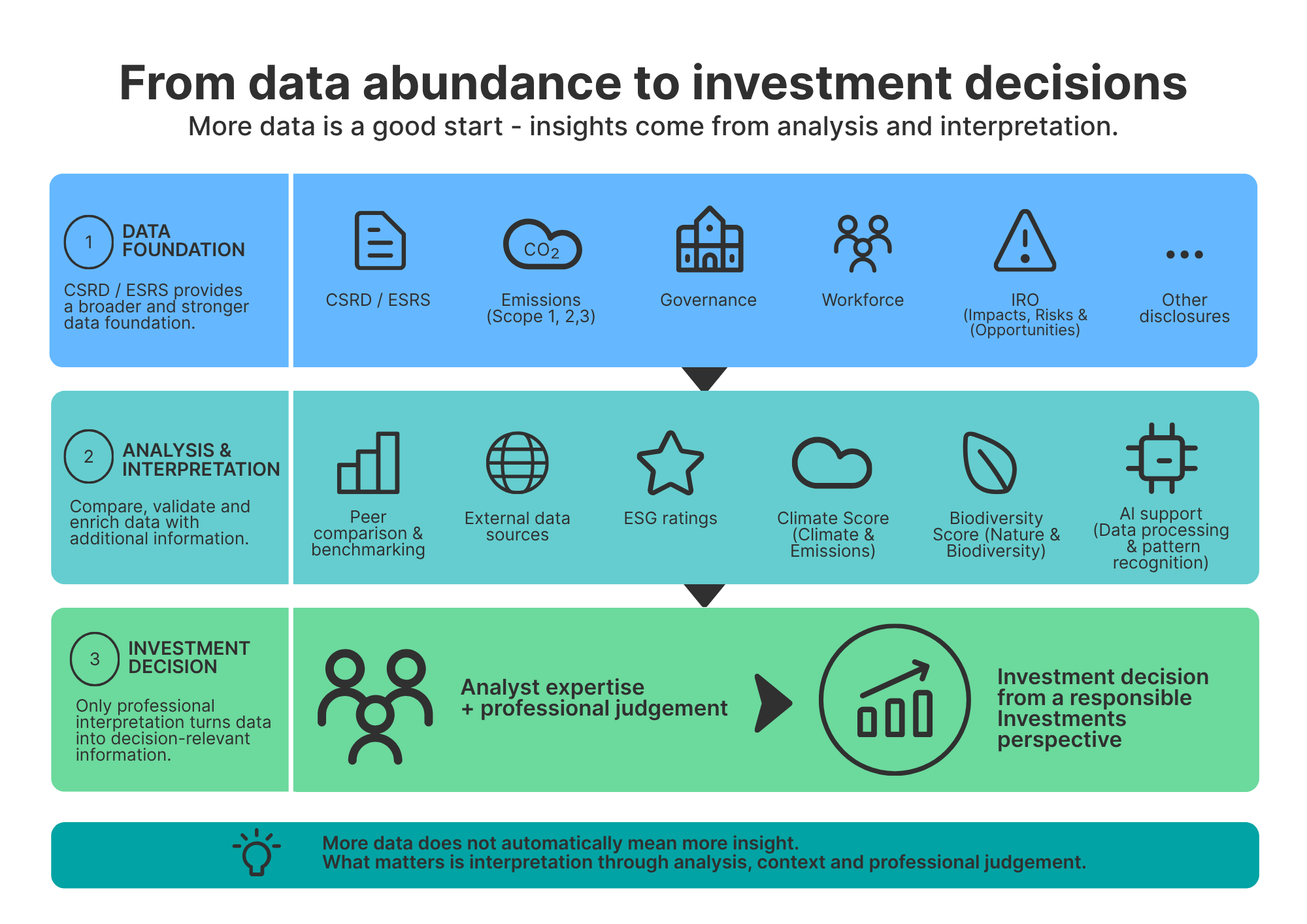
That is precisely why specialized analytical expertise will continue to be necessary in the future to make the final sustainability assessment and investment-eligibility decision at Erste Asset Management from a responsible investment perspective.
Legal disclaimer
This document is an advertisement. Unless indicated otherwise, source: Erste Asset Management GmbH. The language of communication of the sales offices is German and the languages of communication of the Management Company also include English.
The prospectus for UCITS funds (including any amendments) is prepared and published in accordance with the provisions of the InvFG 2011 as amended. Information for Investors pursuant to § 21 AIFMG is prepared for the alternative investment funds (AIF) administered by Erste Asset Management GmbH pursuant to the provisions of the AIFMG in conjunction with the InvFG 2011.
The currently valid versions of the prospectus, the Information for Investors pursuant to § 21 AIFMG, and the key information document can be found on the website www.erste-am.com under “Mandatory publications” and can be obtained free of charge by interested investors at the offices of the Management Company and at the offices of the depositary bank. The exact date of the most recent publication of the prospectus, the languages in which the fund prospectus or the Information for Investors pursuant to Art 21 AIFMG and the key information document are available, and any other locations where the documents can be obtained are indicated on the website www.erste-am.com. A summary of the investor rights is available in German and English on the website www.erste-am.com/investor-rights and can also be obtained from the Management Company.
The Management Company can decide to suspend the provisions it has taken for the sale of unit certificates in other countries in accordance with the regulatory requirements.
Note: You are about to purchase a product that may be difficult to understand. We recommend that you read the indicated fund documents before making an investment decision. In addition to the locations listed above, you can obtain these documents free of charge at the offices of the referring Sparkassen bank and the offices of Erste Bank der oesterreichischen Sparkassen AG. You can also access these documents electronically at www.erste-am.com.
Our analyses and conclusions are general in nature and do not take into account the individual characteristics of our investors in terms of earnings, taxation, experience and knowledge, investment objective, financial position, capacity for loss, and risk tolerance. Past performance is not a reliable indicator of the future performance of a fund.
Please note: Investments in securities entail risks in addition to the opportunities presented here. The value of units and their earnings can rise and fall. Changes in exchange rates can also have a positive or negative effect on the value of an investment. For this reason, you may receive less than your originally invested amount when you redeem your units. Persons who are interested in purchasing units in investment funds are advised to read the current fund prospectus(es) and the Information for Investors pursuant to § 21 AIFMG, especially the risk notices they contain, before making an investment decision. If the fund currency is different than the investor’s home currency, changes in the relevant exchange rate can positively or negatively influence the value of the investment and the amount of the costs associated with the fund in the home currency.
We are not permitted to directly or indirectly offer, sell, transfer, or deliver this financial product to natural or legal persons whose place of residence or domicile is located in a country where this is legally prohibited. In this case, we may not provide any product information, either.
Please consult the corresponding information in the fund prospectus and the Information for Investors pursuant to § 21 AIFMG for restrictions on the sale of the fund to American or Russian citizens.
It is expressly noted that this communication does not provide any investment recommendations, but only expresses our current market assessment. Thus, this communication is not a substitute for investment advice.
This document does not represent a sales activity of the Management Company and therefore may not be construed as an offer for the purchase or sale of financial or investment instruments.
Erste Asset Management GmbH is affiliated with the Erste Bank and austrian Sparkassen banks.
Please also read the “Information about us and our securities services” published by your bank.