

Once again, the eyes of the world will be on the USA in the coming days and weeks. This is not a novelty in itself, as a steady stream of news – much of it unexpected – has reached the globe since the start of Donald J. Trump’s second term. However, on November 3, the American people will have the opportunity to adjust the country’s political direction in the midterm elections.
In addition to a multitude of elections at the state level (including governors, legislatures, and attorneys general), global attention will focus on the outcome of the US Congressional elections and the future composition of the Senate and House of Representatives. While political power has been concentrated in the hands of the Republican Party since the 2024 presidential election, this could change once the new Congress is seated on January 3 of next year. All 435 seats in the US House of Representatives and approximately one-third of the seats in the 100-member US Senate are up for election.
The current sentiment
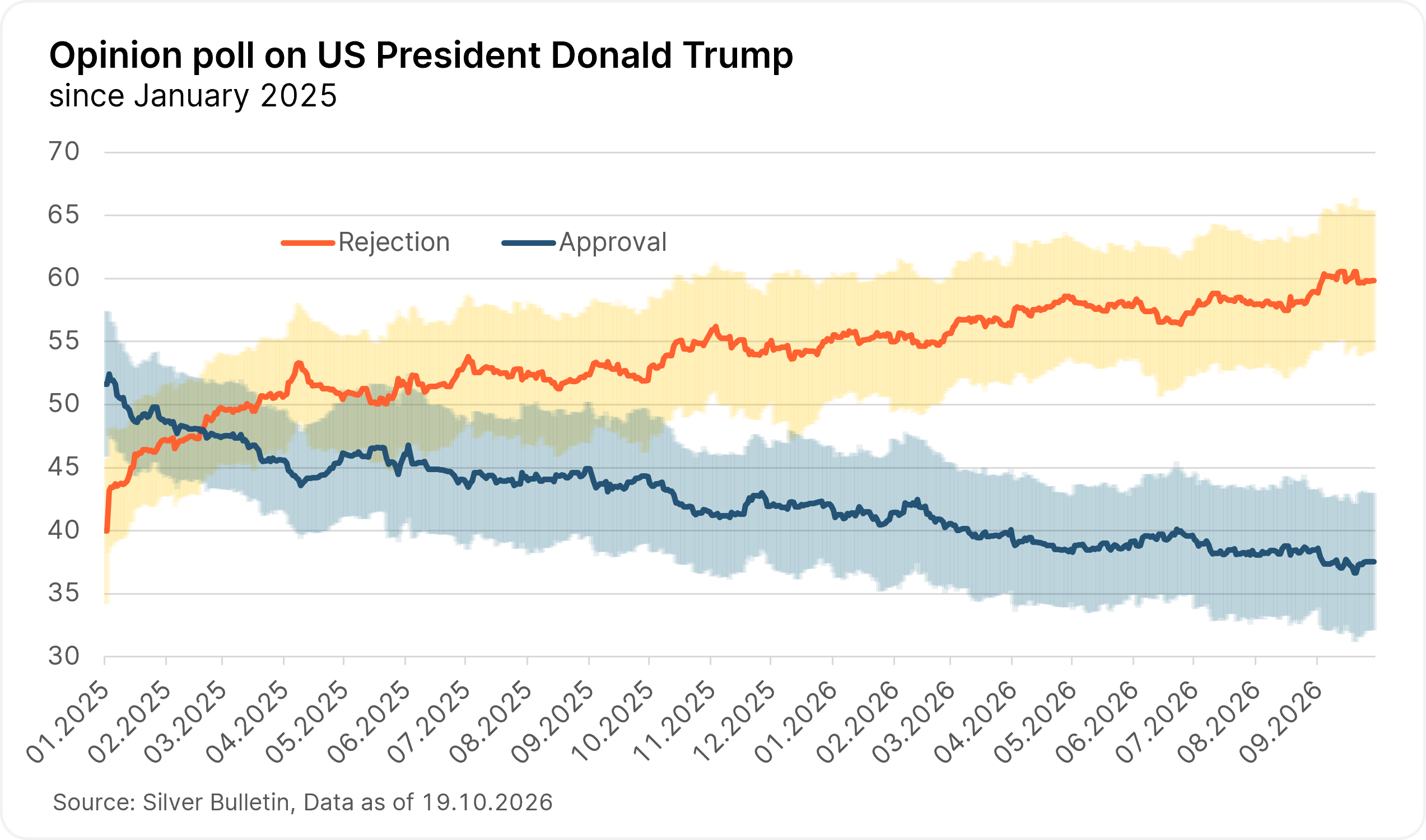
The sentiment barometer for the US President’s second term shows a sustained downward trend. While approval initially stood at over 50%, it has fallen significantly to around 37% in recent polls. This decline is partly attributed to the introduction of tariff policies in the first half of 2025, as well as the outbreak of war in the Middle East in late February 2026 and the resulting price hikes in the energy sector. Other factors, such as immigration policy measures and individual statements by the President, have also influenced this development.
Voter Motives
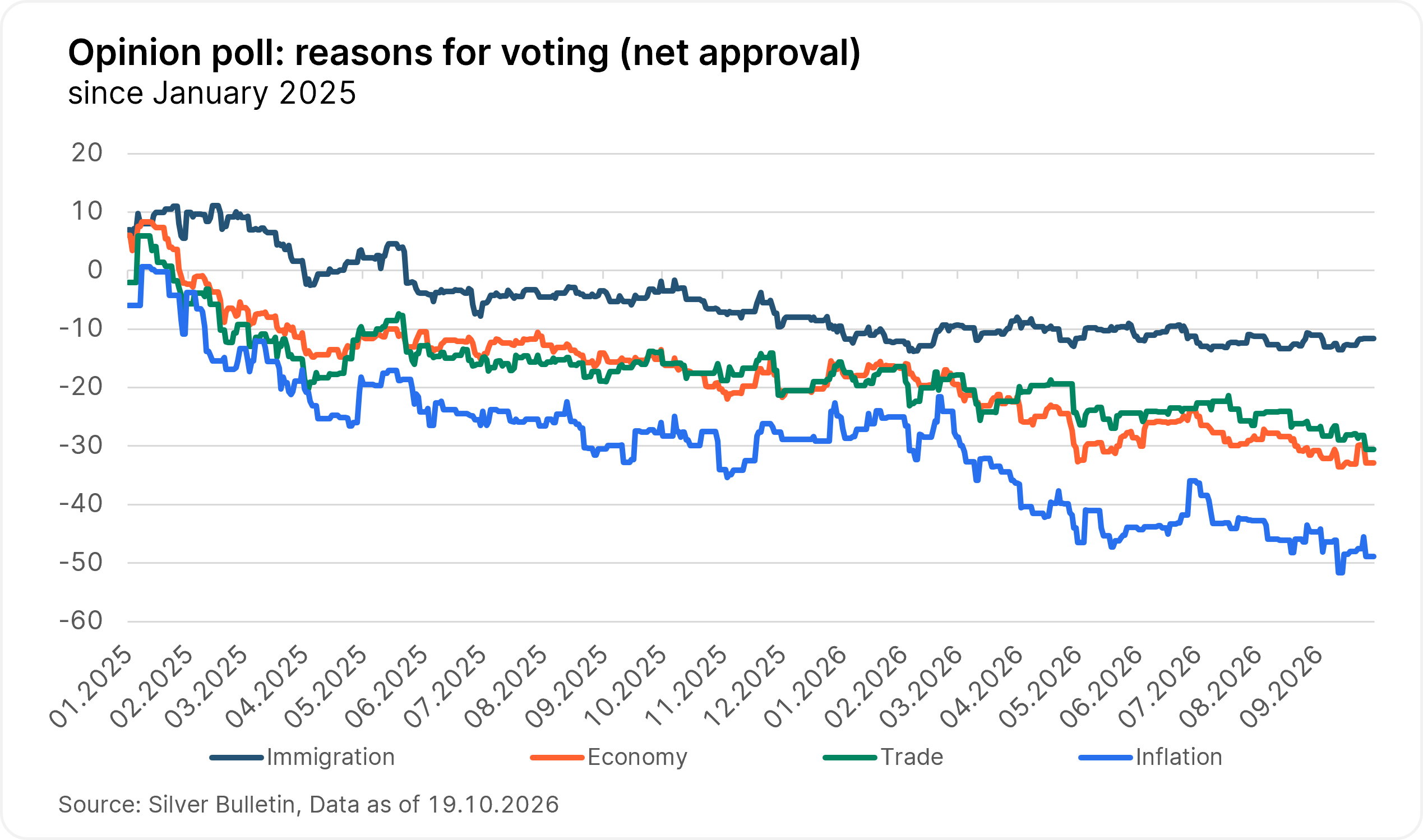
A look at the detailed analysis reveals significant low approval ratings, particularly regarding the cost of living (-50%) and economic policy (-30%). According to an October survey by AP-NORC these are the primary voting motives for 8 out of 10 respondents, followed by healthcare. Another factor creating uncertainty regarding inflation is resource-intensive data center projects. This visible form of AI expansion is facing increasing public opposition, partly due to growing concerns over energy prices and water supply. Furthermore, around 80% of respondents want to see a substantial change in how things are going in the USA, though this sentiment is naturally lower among Republican voters.
Donald Trump recently announced plans to spend several hundred million dollars in the final two weeks of the campaign. From the perspective of campaign strategists, this appears necessary. On the one hand, recent internal divisions (including the Epstein Files) within the loyal MAGA base must be smoothed over or overcome. On the other hand, the list of issues viewed skeptically by the majority of the population – and for which the current administration has yet to provide answers – is growing steadily.
Some of these points include:
- Foreign Policy – Iran, Russia-Ukraine
- Trade and Tariff Policy
- Healthcare
- National Debt and Budget Deficit
- Artificial Intelligence – Data Centers
Whether the President’s hundreds of millions will serve their purpose—true to the motto “money talks”—and significantly shift sentiment before the election remains to be seen.
How Expensive Can a Campaign Get?
This year’s US Supreme Court ruling has removed limits on campaign donations and spending. According to the Federal Election Commission (FEC), over $7.5 billion may have already been spent in the current election cycle (January 1, 2025 – September 30, 2026). The recent trend is rising sharply, potentially making these the most expensive midterm elections in US history. However, the FEC itself, which is tasked with monitoring campaign finance, has been paralyzed since April 2025 following Donald Trump’s dismissal of the chairman and the resignation of two Republican members.
In a poll by the Washington Post, ABC News, and Ipsos, about two-thirds of respondents expressed confidence in the election and the vote count. However, 7 out of 10 respondents lacked confidence that Donald Trump would definitely accept the result. Recent measures (including redistricting, the legality of mail-in ballots, and voter rolls) hint at how important the outcome is in general, and for the incumbent President in particular.
Potential Impacts
According to polls, the probability of the Democratic Party winning a majority of the 435 seats in the US House of Representatives is currently over 80%, depending on the model. The Democrats’ chances of winning a Senate majority have also risen recently. Since the President is not up for re-election in early November, the USA appears to be heading toward a division of political power, which would have various implications.
Through its oversight authority, the US House of Representatives has the power to launch investigations and schedule hearings, which – as seen during Donald Trump’s first term – could lead to impeachment proceedings. The US Senate, meanwhile, votes on government appointments (including cabinet members, judges, and Fed governors); a Democratic majority could make it harder to place loyalists in influential positions. The Senate also acts as the deciding body in impeachment trials, though a conviction currently seems unlikely given the required two-thirds majority.
The Budget
In recent weeks and months, financial markets have increasingly focused on the debt levels and budget deficits of individual countries, driven by high yield levels and the significant capital requirements of governments and corporations.
Note: Prognoses are not a reliable indicator of future performance.
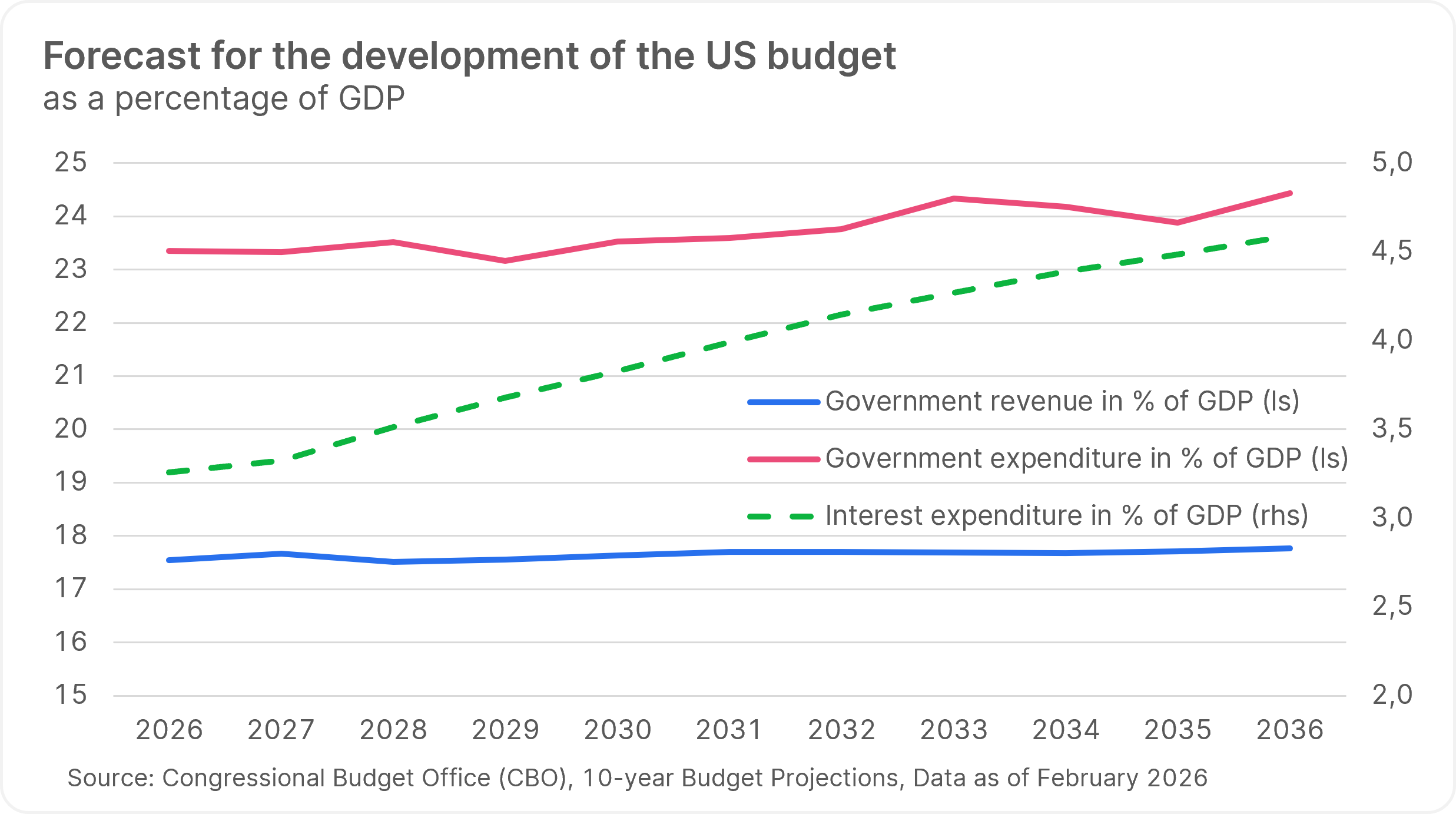
A look at the USA, where debt reached the $40 trillion mark in August, shows no sustainable improvement in the fiscal situation over the past period. In the current CBO estimate (Oct. 2026), the budget deficit for 2026 (October 2025 – September 2026) is projected to be around $2 trillion, or 6% of economic output, slightly exceeding the assumptions from February. If yield levels remain persistently high, interest expenses may need to be revised upward, as they currently exceed the assumptions used in the estimate.
According to the forecast, spending on major social programs has increased by an average of 7% year-on-year, with total spending still up by 6%. At the same time, revenues increased by an average of only 3% due to lower corporate taxes (higher depreciation options) and tariff revenues. This follows the US Supreme Court’s ruling in February 2026, which invalidated significant parts of the IEEPA, necessitating refunds of these revenues and the re-issuance of tariffs based on alternative legal grounds.
Despite currently strong economic performance and low unemployment, a more restrictive fiscal policy is not immediately expected after the elections. Recent budget negotiations resulted only in a stopgap funding agreement until mid-December, meaning further negotiations will fall under the jurisdiction of the current Congress. If no agreement or further stopgap funding is reached, a government shutdown looms before the Christmas holidays.
The newly elected Congress will also soon face familiar issues such as the debt ceiling – which was raised by $5 trillion in July 2025 – and, in the medium term, a solution for the Social Security trust fund. Current projections suggest its reserves could be exhausted by 2032, necessitating benefit cuts.
Outlook
Whether and how strongly the “winds of change” will blow in Washington remains to be seen. Politically, it is likely that Donald Trump will continue to test the limits of presidential power and seek to strengthen his influence. The extent to which Congress can or should exercise its oversight role within the system of “checks and balances” now rests in the hands of the voters.
Debt and the budget deficit were hardly mentioned during the campaign and would likely find little support given that inflation is the dominant voter motive. Recent campaign promises by the US President, such as a $5,000 dividend for American adults should both chambers of Congress remain in Republican hands (contrary to current polls), would significantly increase government spending, ethical considerations aside.
Post-election budget negotiations will reveal whether sustainable adjustments will be made. In the event of new majorities, Donald Trump retains the power to veto legislative proposals. Presidential executive orders can only be overridden by an act of Congress. Historically, divided political power has often resulted in the maintenance of the status quo. Thus, November 3 promises to be significant not only for the election results but also for the events in the weeks and months that follow.
Legal disclaimer
This document is an advertisement. Unless indicated otherwise, source: Erste Asset Management GmbH. The language of communication of the sales offices is German and the languages of communication of the Management Company also include English.
The prospectus for UCITS funds (including any amendments) is prepared and published in accordance with the provisions of the InvFG 2011 as amended. Information for Investors pursuant to § 21 AIFMG is prepared for the alternative investment funds (AIF) administered by Erste Asset Management GmbH pursuant to the provisions of the AIFMG in conjunction with the InvFG 2011.
The currently valid versions of the prospectus, the Information for Investors pursuant to § 21 AIFMG, and the key information document can be found on the website www.erste-am.com under “Mandatory publications” and can be obtained free of charge by interested investors at the offices of the Management Company and at the offices of the depositary bank. The exact date of the most recent publication of the prospectus, the languages in which the fund prospectus or the Information for Investors pursuant to Art 21 AIFMG and the key information document are available, and any other locations where the documents can be obtained are indicated on the website www.erste-am.com. A summary of the investor rights is available in German and English on the website www.erste-am.com/investor-rights and can also be obtained from the Management Company.
The Management Company can decide to suspend the provisions it has taken for the sale of unit certificates in other countries in accordance with the regulatory requirements.
Note: You are about to purchase a product that may be difficult to understand. We recommend that you read the indicated fund documents before making an investment decision. In addition to the locations listed above, you can obtain these documents free of charge at the offices of the referring Sparkassen bank and the offices of Erste Bank der oesterreichischen Sparkassen AG. You can also access these documents electronically at www.erste-am.com.
Our analyses and conclusions are general in nature and do not take into account the individual characteristics of our investors in terms of earnings, taxation, experience and knowledge, investment objective, financial position, capacity for loss, and risk tolerance. Past performance is not a reliable indicator of the future performance of a fund.
Please note: Investments in securities entail risks in addition to the opportunities presented here. The value of units and their earnings can rise and fall. Changes in exchange rates can also have a positive or negative effect on the value of an investment. For this reason, you may receive less than your originally invested amount when you redeem your units. Persons who are interested in purchasing units in investment funds are advised to read the current fund prospectus(es) and the Information for Investors pursuant to § 21 AIFMG, especially the risk notices they contain, before making an investment decision. If the fund currency is different than the investor’s home currency, changes in the relevant exchange rate can positively or negatively influence the value of the investment and the amount of the costs associated with the fund in the home currency.
We are not permitted to directly or indirectly offer, sell, transfer, or deliver this financial product to natural or legal persons whose place of residence or domicile is located in a country where this is legally prohibited. In this case, we may not provide any product information, either.
Please consult the corresponding information in the fund prospectus and the Information for Investors pursuant to § 21 AIFMG for restrictions on the sale of the fund to American or Russian citizens.
It is expressly noted that this communication does not provide any investment recommendations, but only expresses our current market assessment. Thus, this communication is not a substitute for investment advice.
This document does not represent a sales activity of the Management Company and therefore may not be construed as an offer for the purchase or sale of financial or investment instruments.
Erste Asset Management GmbH is affiliated with the Erste Bank and austrian Sparkassen banks.
Please also read the “Information about us and our securities services” published by your bank.
More on the topic

Trade conflict & Ukraine war: How structural change could affect the markets
In the global world order, much seems to be in a state of upheaval. The changes brought about by the new US administration are a structural change that is also affecting the financial markets. In our view, this scenario is currently the most likely 👉