

Geopolitical tensions, monetary policy decisions, and the AI investment boom shaped the first six months of the year. Despite an environment marked by uncertainty, the economy and capital markets proved remarkably resilient. Here is an overview of the key developments, opportunities, and risks of the first half of 2026.
Open or closed?
The first half of the year went significantly better than expected. A look at the performance of the broad stock indices would suggest an economic boom rather than what the International Energy Agency (IEA) has called the worst energy crisis in history. The US stock market has even posted its best quarter in six years, impressively demonstrating that while the Iran conflict dominates the daily news, it no longer dictates global stock prices. (Note: Past performance is not a reliable indicator of future results.)
Even though the direct impact on the capital markets has subsided significantly, the conflict (much like the one in Ukraine) will likely continue to affect us for some time to come. The recent escalation over the past few days, with mutual attacks, has once again pushed the potential end of the war far into the distance. As the chart below shows, shipping traffic in the crucial Strait of Hormuz has also come to a complete standstill again following its temporary “reopening.”
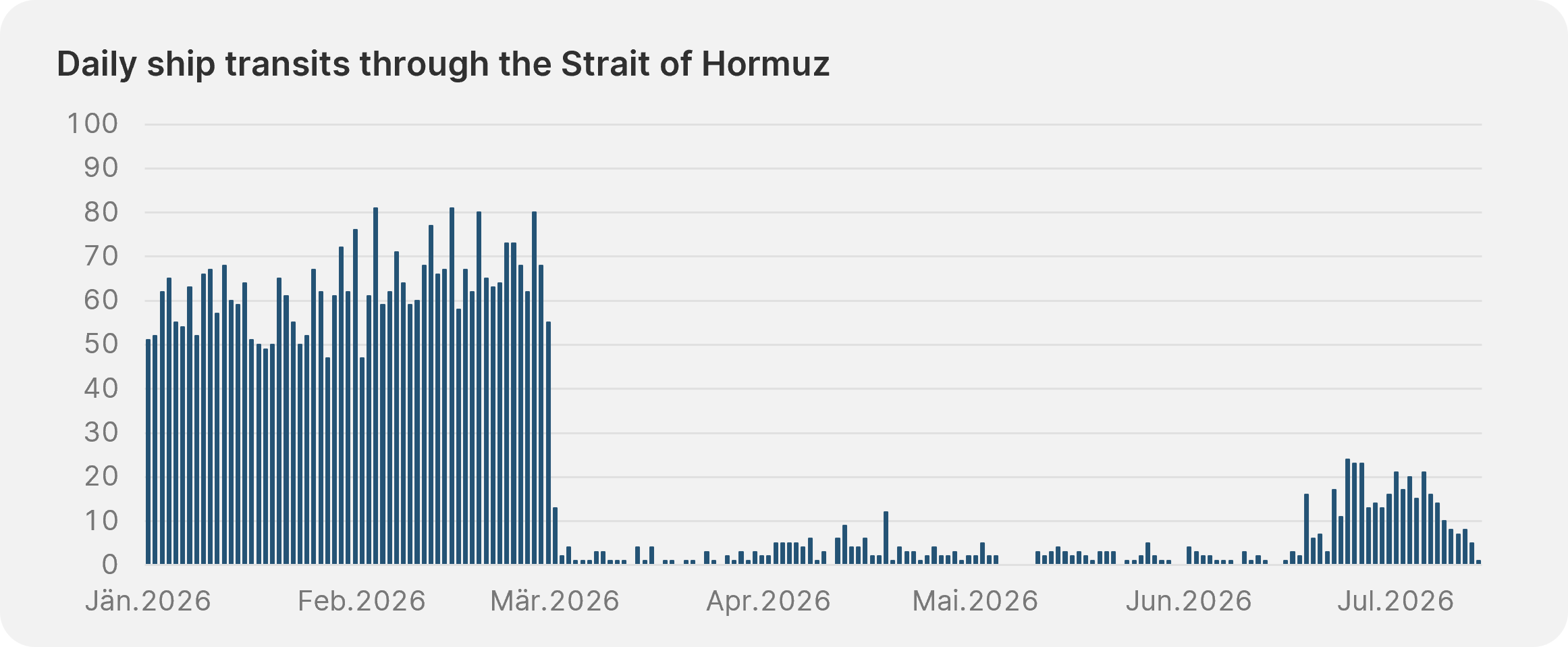
Source: Bloomberg, data as of July 13, 2026
Although the oil market is likely to remain disrupted in the longer term, the reaction of the oil price – which had even fallen back to pre-war levels at one point – has been exceptionally moderate, rising to $78 per barrel of crude oil (Brent). The muted price reaction is likely due to the fact that market participants once again expect shipping operations to be suspended only briefly. In addition, market participants have adapted incredibly quickly to the new situation in the oil market. For example, China – by far the world’s largest oil importer – has recently scaled back its demand to its lowest level in over 10 years. Massive oil reserves in China make this possible, but this situation can only be sustained temporarily. Furthermore, the supply side has stabilized much more quickly than originally feared. Despite war-related damage to local infrastructure, both Saudi Arabia and the United Arab Emirates, for example, have been able to significantly increase their production capacities from the war-induced low. According to estimates, daily production is even approaching pre-war levels, leading some analysts to expect a supply surplus in the oil market in the coming quarters. (Note: Forecasts are not a reliable indicator of future performance.)
Even if this outlook seems overly optimistic, the response on both the demand and supply sides is yet another indication that the resilience of the global economy has increased significantly in recent years.
AI Drives Stock Prices and the Economy
While the war in Iran has thrown growth in Europe and some emerging markets off track, the U.S. economy continues to grow robustly. Even though the U.S. job market cooled noticeably in June (with only 57,000 new jobs created instead of 110,000), the current unemployment rate of 4.2% is a testament to the economy’s tremendous strength. This strength will also further fuel the debate over future monetary policy. As precarious as the starting point may be for Warsh, it is likely to be of little significance to the real economy whether the Fed raises key interest rates once or twice. Even at a slightly higher level, interest rates would hardly be restrictive enough to put a noticeable strain on the economy. Politically, however, the situation is different, as Donald Trump will condemn any interest rate hike ahead of the midterm elections. Accordingly, the Fed’s visible distancing from the president could become more important than the specific level of the key interest rate. The situation is different in Europe, where – despite economic weakness – the first interest rate hike was already implemented in June in response to the Middle East conflict.
In addition to expansionary fiscal policy, US growth appears to be well supported, primarily by the massive AI investment cycle. The high levels of investment by the major hyperscalers—which are now viewed critically by the market—have since become the most important driver of growth in the U.S. As the chart below shows, the investment volume of Meta, Google, Microsoft, and Amazon already exceeds Austria’s economic output from last year. (Note: The companies mentioned in this text are selected as examples and do not constitute an investment recommendation.)
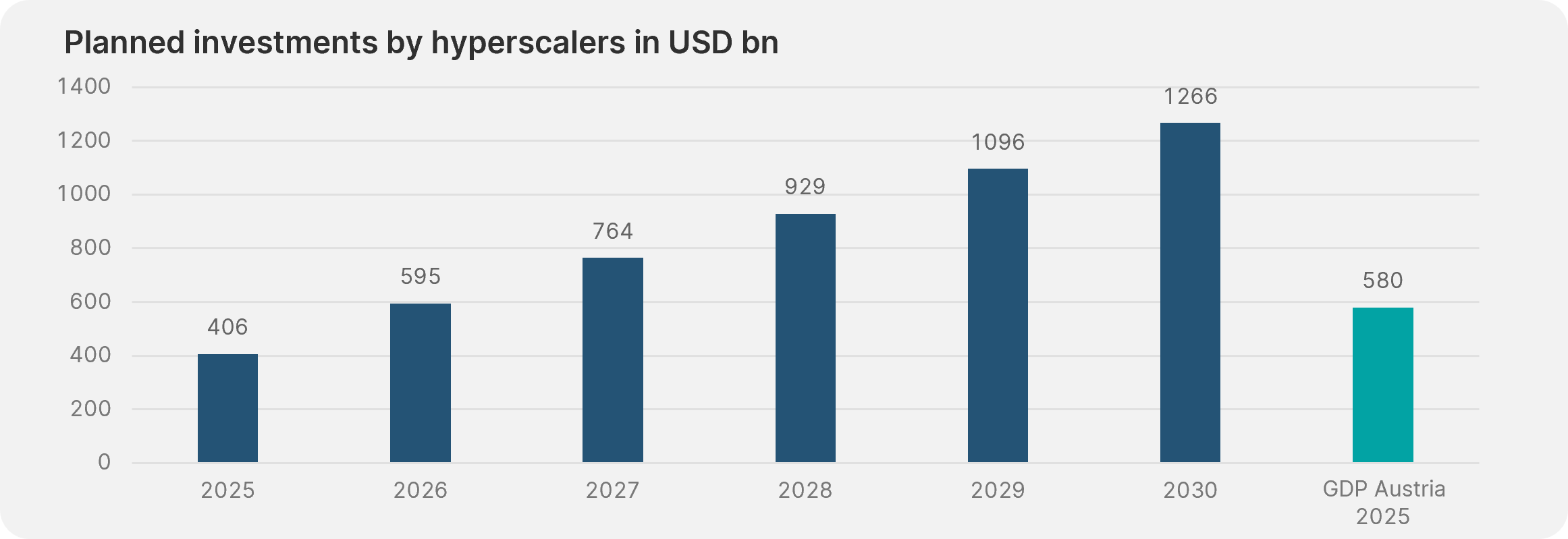
Source: Bloomberg, data as of April 8, 2026
The substantial investments in AI infrastructure have so far primarily benefited the semiconductor industry and led to massive stock price increases for individual companies. This disproportionately strong performance in the technology sector has now led to significant market concentration, thereby distorting the view of overall market trends.
For example, just under 40% of S&P 500 companies have posted negative year-to-date returns, and since February, the index’s overall performance has been driven almost entirely by the technology sector. Even in the MSCI World Index – which, with 1,384 companies, is considered a prime example of diversification – nearly 60% of the index’s total performance has recently been attributable to just ten technology stocks. This trend is even more pronounced in emerging markets: Although the MSCI Emerging Markets Index comprises 1,178 companies, due to the sharp price increases in the semiconductor sector, Samsung Electronics, TSMC, and SK Hynix now account for around 30% of the index’s total weight. Even if this high concentration of performance had been beneficial, we nevertheless seek to participate across the entire AI value chain. This value chain encompasses far more than just chip manufacturers; as a result, companies in sectors such as raw materials, construction, energy, cooling, cloud computing, and even the much-maligned software sector are also gaining momentum in the long term.
Airy heights
SpaceX’s initial public offering (IPO) sparked a veritable frenzy, becoming the largest IPO in history with an incredible valuation of USD 1.77 trillion and, at the same time, making Elon Musk the world’s first trillionaire. One month later, the hype seems to have already faded, and disillusionment is setting in – the stock price has plummeted by more than 30% since its peak in the first few trading days and is rapidly approaching its IPO price of $135. Given the extraordinarily high valuations, this development is not really all that surprising, even though the unusually rapid inclusion in the Nasdaq 100 should have created artificial demand. A look at historical data shows, however, that very large IPOs in particular have tended to underperform the broader market in the three years following their debut. One reason for this is that companies naturally choose a favorable market environment, high growth prospects, and thus ambitious valuations for their IPO. Especially in the case of very large companies – which go public very late – a significant portion of the stock’s price appreciation has already taken place in the private markets.
The current positive market environment – and, above all, the excitement surrounding AI – is likely to usher in the largest IPO cycle in history; according to estimates, IPOs totaling USD 4,000 billion – including SpaceX – are set to hit the market in the coming months. With Anthropic and OpenAI, two more heavyweights are already in the pipeline, both of which are expected to go public in the fall or early 2027, respectively. This naturally raises the legitimate question of whether the market can absorb this additional volume of IPOs. However, given that the companies are offering only a small portion of their equity, these concerns are unfounded. Regardless, an increase in the volume of new offerings is certainly a warning sign – and here, too, history provides at least some guidance, showing that such phases are often accompanied by positive but slightly weaker price and valuation trends.
Compact setup
Even though the news landscape seems to change every minute, the overall situation in the markets has remained unchanged for months. Buoyed by solid economic growth and positive corporate earnings, the stock markets are trading near their all-time highs. However, the investment boom surrounding artificial intelligence is driving the economy – and, in particular, stock prices in various sub-sectors. Beneath the surface, this is certainly creating risks, as expectations for corporate earnings continue to rise, and the aforementioned concentration risks must not be overlooked. At the same time, the market environment remains shaped by a number of factors that are difficult to predict – the war in the Middle East, geopolitical tensions, tariffs, central bank policy, inflation, and political uncertainty could all trigger significant market volatility at any time.
As mentioned in the foreword, we believe the current environment calls for neither a fully offensive nor a fully defensive strategy. We therefore remain committed to broad portfolio diversification and continue to focus on high-quality growth and value companies in the equity segment, while seeking to complement these with various thematic investments. Given the solid fundamentals and the at least slight easing of tensions in the Middle East conflict, we have recently moderately overweighted our equity allocation. On the bond side, we also maintain a very broad diversification, view emerging market bonds as attractive, and keep cash on hand for potential opportunities. In the interest of portfolio diversification, we continue to hold commodities and view gold as structurally well-supported despite its recent weak performance.
Just like in football, we try to play compactly and wait for the right moments to transition so we can be even more aggressive on offense.
Note: Please note that investing in securities involves risks as well as opportunities.
Legal disclaimer
This document is an advertisement. Unless indicated otherwise, source: Erste Asset Management GmbH. The language of communication of the sales offices is German and the languages of communication of the Management Company also include English.
The prospectus for UCITS funds (including any amendments) is prepared and published in accordance with the provisions of the InvFG 2011 as amended. Information for Investors pursuant to § 21 AIFMG is prepared for the alternative investment funds (AIF) administered by Erste Asset Management GmbH pursuant to the provisions of the AIFMG in conjunction with the InvFG 2011.
The currently valid versions of the prospectus, the Information for Investors pursuant to § 21 AIFMG, and the key information document can be found on the website www.erste-am.com under “Mandatory publications” and can be obtained free of charge by interested investors at the offices of the Management Company and at the offices of the depositary bank. The exact date of the most recent publication of the prospectus, the languages in which the fund prospectus or the Information for Investors pursuant to Art 21 AIFMG and the key information document are available, and any other locations where the documents can be obtained are indicated on the website www.erste-am.com. A summary of the investor rights is available in German and English on the website www.erste-am.com/investor-rights and can also be obtained from the Management Company.
The Management Company can decide to suspend the provisions it has taken for the sale of unit certificates in other countries in accordance with the regulatory requirements.
Note: You are about to purchase a product that may be difficult to understand. We recommend that you read the indicated fund documents before making an investment decision. In addition to the locations listed above, you can obtain these documents free of charge at the offices of the referring Sparkassen bank and the offices of Erste Bank der oesterreichischen Sparkassen AG. You can also access these documents electronically at www.erste-am.com.
Our analyses and conclusions are general in nature and do not take into account the individual characteristics of our investors in terms of earnings, taxation, experience and knowledge, investment objective, financial position, capacity for loss, and risk tolerance. Past performance is not a reliable indicator of the future performance of a fund.
Please note: Investments in securities entail risks in addition to the opportunities presented here. The value of units and their earnings can rise and fall. Changes in exchange rates can also have a positive or negative effect on the value of an investment. For this reason, you may receive less than your originally invested amount when you redeem your units. Persons who are interested in purchasing units in investment funds are advised to read the current fund prospectus(es) and the Information for Investors pursuant to § 21 AIFMG, especially the risk notices they contain, before making an investment decision. If the fund currency is different than the investor’s home currency, changes in the relevant exchange rate can positively or negatively influence the value of the investment and the amount of the costs associated with the fund in the home currency.
We are not permitted to directly or indirectly offer, sell, transfer, or deliver this financial product to natural or legal persons whose place of residence or domicile is located in a country where this is legally prohibited. In this case, we may not provide any product information, either.
Please consult the corresponding information in the fund prospectus and the Information for Investors pursuant to § 21 AIFMG for restrictions on the sale of the fund to American or Russian citizens.
It is expressly noted that this communication does not provide any investment recommendations, but only expresses our current market assessment. Thus, this communication is not a substitute for investment advice.
This document does not represent a sales activity of the Management Company and therefore may not be construed as an offer for the purchase or sale of financial or investment instruments.
Erste Asset Management GmbH is affiliated with the Erste Bank and austrian Sparkassen banks.
Please also read the “Information about us and our securities services” published by your bank.