
Artificial intelligence is consuming ever more electricity. That is filling order books at many companies in renewable energy and power infrastructure. Yet renewable stocks have recently fallen. How does that add up? And what does it mean for investors?
The rapid development of artificial intelligence is not only changing the technology industry, but increasingly the energy sector as well. Billions are being invested worldwide in new data centers that require enormous amounts of electricity. At the same time, the electrification of industry, transport and buildings is progressing.
For companies that generate electricity, expand power grids or develop technologies for more efficient energy use, this is fundamentally good news. Yet this trend has not recently been reflected in share prices. On the contrary, many companies in the environmental technology sector had to absorb significant price losses in the third quarter.
Our environmental equity funds ERSTE GREEN INVEST and ERSTE WWF STOCK ENVIRONMENT were not able to escape this challenging market environment either. But why are share prices performing so weakly even though demand for many companies’ products and services is rising?
Note: Investment in securities entail risks in addition to the opportunities described.
Full order books, falling share prices
A look at the latest company results shows just how wide the gap currently is between business performance and market sentiment. For example, US energy technology group GE Vernova reported an 88% increase in orders in the second quarter to USD 24.2 billion. Wind turbine manufacturer Vestas also reported a high order backlog and raised its full-year guidance.
Please note: The companies mentioned in this article have been selected as examples and do not constitute investment recommendations.
The trend was particularly striking among solar companies. Although numerous companies posted revenue and earnings results that were better than expected, the corresponding solar stock index lost almost 27% in the third quarter. For the index, it was the weakest quarter in more than ten years.
These examples illustrate a phenomenon we are currently observing across many areas of environmental technology: demand is there, but the stock market is increasingly pricing the outlook more cautiously. How does that add up?
Why rising interest rates hit environmental stocks particularly hard
A key reason is interest rate trends. Building wind farms, solar plants or power grids requires high upfront investment. These projects are often financed with loans, while revenues are generated only over many years. When interest rates rise, financing becomes more expensive. At the same time, future profits are worth less from investors’ perspective.
In addition, expectations for many companies were already very high after the strong price gains of recent years. Even good results are then not always enough to push share prices higher.
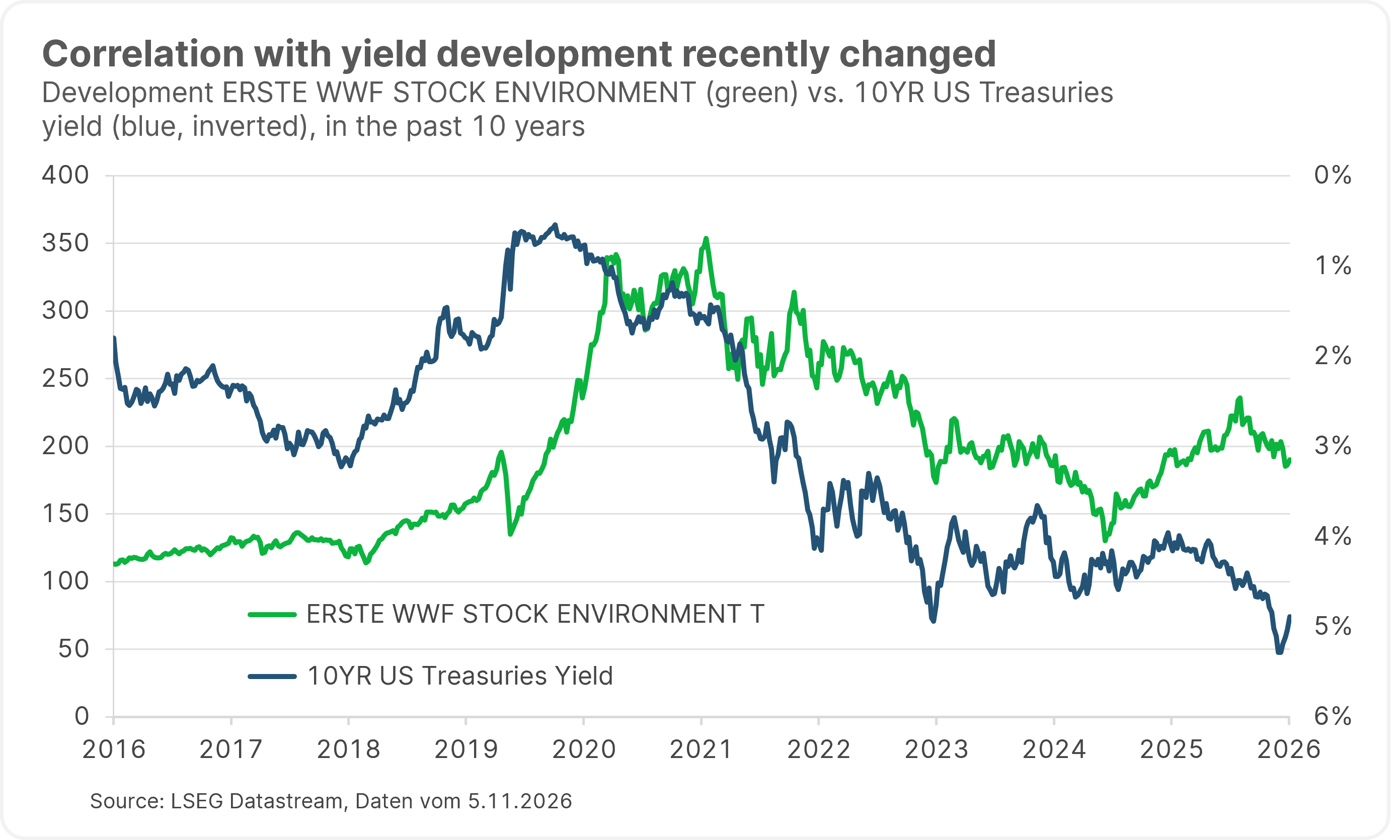
During the 2022 rate-hiking cycle, both funds had suffered from rising interest rates – as can be seen in Chart 1 using ERSTE GREEN INVEST as an example, this negative correlation has recently diminished, however.
Note: Past performance is not a reliable indicator of future performance. Performance is calculated in accordance with the OeKB method. Performance assumes full reinvestment of distributions and takes the management fee and any performance-related fee into account. Any one-off front-end load that may be charged on purchase and any individual transaction-related or ongoing costs that reduce returns (e.g., account and custody fees) are not included in the presentation.
The difference compared with then is that environmental technology companies have since further developed their business models. Today they generate more stable profits and have a stronger financial base. In addition, the environmental technology sector is now much broader and no longer consists solely of the solar and wind industries. The investment story ranges from grid infrastructure and power generation to energy efficiency and building technology as well as recycling, water, mobility and industrial transformation.
AI needs electricity – but also the right infrastructure
Even if the market is currently cautious on renewable stocks, electricity demand continues to grow rapidly – and with it the role of renewable energy. This is particularly evident in the expansion of artificial intelligence. New data centers need not only powerful computer chips, but also large amounts of reliably available electricity. This is exactly where bottlenecks are increasingly emerging.
Because while new data centers can be built relatively quickly, expanding power grids, transformers and additional generation capacity often takes much longer. In some US states, there is already discussion about how new data centers can be connected to the existing energy infrastructure and who will pay for the necessary investments. After the midterm elections, this debate is likely to gain further momentum.
For us, this is a crucial development. The AI boom is no longer just a question of computing power, but increasingly also of energy supply. The key bottleneck is more and more often the availability of electricity and grid connections. For our investment case, this is fundamentally positive, as demand for power generation, storage, grid technology, transformers, cables and energy management is rising.
Not all environmental technologies are developing equally
Despite the positive long-term demand outlook, it is worth taking a closer look at the individual segments. While companies involved in grid expansion and energy infrastructure are currently seeing strong demand, the market environment is significantly more challenging, for example, for providers of solar systems for private households in the US.
The shares of these companies were again among the weaker performers last quarter. Positive contributions, by contrast, came from areas such as grid expansion and energy infrastructure. This is where the increasing breadth of the environmental technology sector benefits us. Especially in phases when individual themes fluctuate sharply on the stock market, this diversification becomes more important.
Company in focus: Fastned – charging infrastructure for tomorrow’s mobility
Rising fuel prices and geopolitical crises are making electric cars increasingly attractive. In many countries, new registrations are rising significantly. This also increases the need for a well-developed charging infrastructure.
The Dutch company Fastned could benefit from this. It operates fast-charging stations along key transport routes in Europe and enables convenient charging on the go. Its own app makes route planning and the charging process easier.
Fastned shows how companies can benefit from the growing shift to e-mobility by providing the necessary infrastructure. In ERSTE WWF STOCK ENVIRONMENT, the company is among the largest holdings. In the third quarter of 2026, the share price rose by around 70%.
Note: Please note that investments in securities involve risks as well as opportunities.
Outlook: Why energy infrastructure is becoming ever more important
Our long-term assessment has not changed as a result of the recent price losses. However, it is becoming increasingly clear what will matter in future as electricity demand rises due to artificial intelligence: it is not only necessary to have enough electricity available, it must also be available in the right place at the right time.
This is precisely where one of the biggest challenges lies. While new data centers can be built relatively quickly, expanding power grids, power plants and other key facilities often takes significantly longer. In the US, some regions have therefore already introduced temporary restrictions on new data centers. We expect that there will increasingly be debate about the conditions under which new projects may be developed and who will finance the infrastructure required. This should benefit companies in areas such as power generation, power grids, energy storage and energy efficiency.
At the same time, recent price performance shows that high growth expectations alone are not enough. For investors, it is becoming increasingly important which companies actually benefit from rising demand, have a solid financial footing and can convert their orders into higher profits. We pay particular attention to these factors when selecting our investments.
We therefore continue to place a clear focus on the energy sector in our environmental technology funds. In addition, we invest in companies in water management and recycling. In ERSTE GREEN INVEST, these themes are complemented by industrial transformation and adaptation to climate change.
We are convinced that these technologies will provide important long-term solutions to the growing challenges in energy supply and environmental protection. In the short term, however, price volatility and further setbacks remain possible.
Conclusion
Rising electricity demand driven by artificial intelligence is a long-term growth driver for numerous environmental technologies. However, the recent price losses show that even attractive future trends do not play out on the stock market without setbacks. This makes it all the more important to distinguish between short-term market fluctuations and companies’ actual business performance.
Risk disclosures ERSTE WWF STOCK ENVIRONMENT
The fund pursues an active investment policy and is not benchmarked against a reference index. The assets are selected on a discretionary basis and the management company’s discretion is not restricted.
For further information on the sustainable focus of ERSTE WWF STOCK ENVIRONMENT as well as on the disclosures in accordance with the Disclosure Regulation (Regulation (EU) 2019/2088) and the Taxonomy Regulation (Regulation (EU) 2020/852), please refer to the current Prospectus, section 12 and the Annex “Sustainability Principles”. In deciding to invest in ERSTE WWF STOCK ENVIRONMENT, consideration should be given to any characteristics or objectives of the ERSTE WWF STOCK ENVIRONMENT as described in the Fund Documents.
Risk disclosures ERSTE GREEN INVEST
The fund pursues an active investment policy and is not benchmarked against a reference index. The assets are selected on a discretionary basis and the management company’s discretion is not restricted.
For further information on the sustainable focus of ERSTE GREEN INVEST as well as on the disclosures in accordance with the Disclosure Regulation (Regulation (EU) 2019/2088) and the Taxonomy Regulation (Regulation (EU) 2020/852), please refer to the current Prospectus, section 12 and the Annex “Sustainability Principles”. In deciding to invest in ERSTE GREEN INVEST, consideration should be given to any characteristics or objectives of the ERSTE GREEN INVEST as described in the Fund Documents.
Legal disclaimer
This document is an advertisement. Unless indicated otherwise, source: Erste Asset Management GmbH. The language of communication of the sales offices is German and the languages of communication of the Management Company also include English.
The prospectus for UCITS funds (including any amendments) is prepared and published in accordance with the provisions of the InvFG 2011 as amended. Information for Investors pursuant to § 21 AIFMG is prepared for the alternative investment funds (AIF) administered by Erste Asset Management GmbH pursuant to the provisions of the AIFMG in conjunction with the InvFG 2011.
The currently valid versions of the prospectus, the Information for Investors pursuant to § 21 AIFMG, and the key information document can be found on the website www.erste-am.com under “Mandatory publications” and can be obtained free of charge by interested investors at the offices of the Management Company and at the offices of the depositary bank. The exact date of the most recent publication of the prospectus, the languages in which the fund prospectus or the Information for Investors pursuant to Art 21 AIFMG and the key information document are available, and any other locations where the documents can be obtained are indicated on the website www.erste-am.com. A summary of the investor rights is available in German and English on the website www.erste-am.com/investor-rights and can also be obtained from the Management Company.
The Management Company can decide to suspend the provisions it has taken for the sale of unit certificates in other countries in accordance with the regulatory requirements.
Note: You are about to purchase a product that may be difficult to understand. We recommend that you read the indicated fund documents before making an investment decision. In addition to the locations listed above, you can obtain these documents free of charge at the offices of the referring Sparkassen bank and the offices of Erste Bank der oesterreichischen Sparkassen AG. You can also access these documents electronically at www.erste-am.com.
Our analyses and conclusions are general in nature and do not take into account the individual characteristics of our investors in terms of earnings, taxation, experience and knowledge, investment objective, financial position, capacity for loss, and risk tolerance. Past performance is not a reliable indicator of the future performance of a fund.
Please note: Investments in securities entail risks in addition to the opportunities presented here. The value of units and their earnings can rise and fall. Changes in exchange rates can also have a positive or negative effect on the value of an investment. For this reason, you may receive less than your originally invested amount when you redeem your units. Persons who are interested in purchasing units in investment funds are advised to read the current fund prospectus(es) and the Information for Investors pursuant to § 21 AIFMG, especially the risk notices they contain, before making an investment decision. If the fund currency is different than the investor’s home currency, changes in the relevant exchange rate can positively or negatively influence the value of the investment and the amount of the costs associated with the fund in the home currency.
We are not permitted to directly or indirectly offer, sell, transfer, or deliver this financial product to natural or legal persons whose place of residence or domicile is located in a country where this is legally prohibited. In this case, we may not provide any product information, either.
Please consult the corresponding information in the fund prospectus and the Information for Investors pursuant to § 21 AIFMG for restrictions on the sale of the fund to American or Russian citizens.
It is expressly noted that this communication does not provide any investment recommendations, but only expresses our current market assessment. Thus, this communication is not a substitute for investment advice.
This document does not represent a sales activity of the Management Company and therefore may not be construed as an offer for the purchase or sale of financial or investment instruments.
Erste Asset Management GmbH is affiliated with the Erste Bank and austrian Sparkassen banks.
Please also read the “Information about us and our securities services” published by your bank.
More on the topic

Kyrgyzstan: Strong Growth, Increasing Inclusion, and an Attractive Microfinance Market
In recent years, Kyrgyzstan has emerged as one of the most dynamic economies in Central Asia. Strong growth, rising incomes, and a more professional financial sector are making the country increasingly attractive for responsible microfinance investments.