
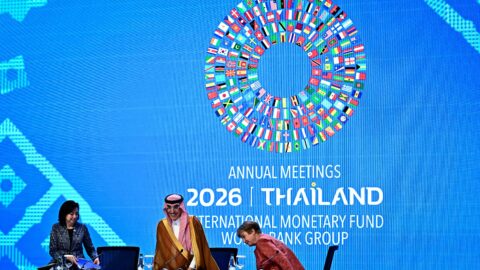
Last week, the International Monetary Fund/World Bank Group Annual Meetings 2026 took place in Bangkok and I participated on behalf of Erste Asset Management. Thanks to a wide range of high-ranking representatives from various emerging market countries’ governments and central banks, financial institutions, think tanks and academics, the meetings offer highly valuable insights into current and upcoming global challenges in both economics and politics.
Outlook on emerging market economies
In Argentina, annual inflation has been stuck above 30% for more than a year and the peso’s real appreciation underpinning the disinflation trend will be hard to sustain. Sovereign bond spreads have widened to almost 700 basis points as markets grow anxious about a looming 2027 debt wall. The IMF is pressing for structural tax reforms including on VAT exemptions and fuel taxes that President Milei has yet to deliver. A US trade deal signed earlier this year is now in jeopardy, given the lack of congressional votes to ratify it. A second straight year of falling formal employment despite positive GDP remains the government’s most acute political vulnerability heading into next year’s presidential election.
Note: Investments in securities entail risks in addition to the opportunities described. Prognoses are not a reliable indicator of future performance.
Brazil heads into a presidential runoff with incumbent Lula and challenger Flávio Bolsonaro essentially tied in polls. Markets have responded positively to Bolsonaro’s lead, trimming year-end Selic forecasts to 13.25%, on the assumption that a change of government would bring tighter fiscal policy. The central bank has cut rates four times this year to 14%, but year-end inflation is now projected above target at 5.2% and the bank itself has cut its growth forecast to 1.8%, acknowledging that tight monetary policy is crimping activity.
Trade talks between Mexico and the USA hit an impasse this week over steel and aluminium tariffs, dashing earlier optimism for an imminent deal and likely delaying progress until after the US midterm elections. The USMCA was not renewed in July, shifting to annual reviews which adds uncertainty for manufacturers and undermines the nearshoring narrative. Domestic risks such as crime, judicial reform uncertainty, and tighter tax enforcement weigh more heavily on local businesses’ investment decisions than the trade dispute itself. GDP growth is forecast at just 1.5% for 2026, and the fiscal deficit could approach 5% of GDP due to energy price pressures from the Middle East conflict.
Moody’s downgraded Poland‘s credit rating to A3 in September as the budget deficit is expected to reach approximately 7.1% of GDP in both 2026 and 2027. President Nawrocki’s veto of a windfall tax on oil companies removed a key revenue measure, which illustrates the structural legislative blockage between the president and the governing coalition. The finance minister has ruled out pre-election spending increases, but fiscal consolidation to EU-compliant levels by 2028 looks increasingly difficult.
Romania approved a new government, ending months of political deadlock that had brought the country to the brink of a junk rating downgrade, with Fitch having explicitly warned that its January review would be decisive. The new prime minister faces a difficult task: the full-year deficit target stands at 6.2% of GDP and the economy stagnated in Q2 2026, with the consensus pointing to a full-year contraction of 0.5% and inflation still running at 8.2%. Political stability is a necessary but far from sufficient condition for restoring fiscal credibility.
The war between Russia and Ukraine continues with no resolution in sight. Russia suffers heavy casualties yet continues to advance with no decisive breakthrough. President Putin proposed a meeting with US president Trump at APEC next month, but the gap between the parties’ positions remains vast. Meanwhile, the EU is planning to sanction a record 1,600 firms for helping Russia circumvent export controls. A US congressional bill granting new powers to impose tariffs on buyers of Russian petroleum was passed in September, tightening the sanctions noose further. The Russian economy is expected to grow just 0.8% in 2026.
Turkish inflation has decelerated for a fourth consecutive month to 29.7% in September, but the Central Bank governor Karahan acknowledged that the improvement in inflation expectations projected at the start of the year hasn’t been achieved. The year-end inflation target was revised sharply upward to 24% from 16% in May, and the lira is being allowed to depreciate at a faster pace to reduce the risk of a sharper devaluation later. The EBRD has cut its 2026 growth forecast to 3%.
Egypt‘s credit rating has been upgraded by Moody’s to B3 in October. However, core inflation remains elevated at 14.1% in September, and the IMF’s final program review, expected to conclude by December, will be followed immediately by discussions on whether Egypt needs yet another program which suggests that the country is not yet self-sustaining without external support. The EU disbursed a second EUR 1.5 billion tranche under its macro-financial assistance program, but structural reform progress has been described by the IMF itself as uneven.
South Africa’s finance minister confirmed that government debt peaked at 78.4% of GDP and unveiled a new fiscal anchor framework. A potential credit rating upgrade next month could follow. However, GDP growth has been revised down to 1.2% for 2026 due to the Iran war shock, and the current account swung to a seven-year deficit of 2.6% of GDP in Q2.
China‘s Q3 GDP came in at 4.5%, getting back into the target range, but the rebound was powered almost entirely by factory output and AI-related exports rather than domestic demand. This imbalance has been repeatedly flagged by the IMF which trimmed its 2026 forecast to 4.5% and warned that the yuan remains undervalued, a symptom of weak domestic consumption that stimulus measures have so far failed to address. Exports surged 36% year-on-year in September, pushing the trade surplus toward a fresh record above $1.2 trillion which deepens trade tensions with both the US and the EU. A 16-point trade consensus with the EU covers hybrid vehicle exports but has little immediate prospect of reshaping the broader relationship.
India‘s central bank executed a sharp policy reversal in October, raising the repo rate by 25 basis points to 5.5% for the first time in nearly four years. Inflation reached 5.5% in September, near the top of the 2-6% tolerance band. The weakest monsoon since 2015 adds food price risk, and the IMF has urged the RBI to allow greater currency flexibility rather than defending the rupee through intervention.
Bank Indonesia held its benchmark rate at 5.75% today, opting for a policy mix rather than an outright rate hike despite a threatened MSCI double-downgrade that has triggered capital outflows and rupiah pressure. The central bank raised its deposit facility rate and cut reserve requirements, but the market reaction was muted. Fitch assesses that Indonesia’s growth will remain well below the government’s 8% target, projecting 5.2% for 2026.
The Iran war has exposed the limits of Saudi Arabia’s Vision 2030 ambitions. The economy is expected to contract by 1.8% in 2026, the projected budget deficit has widened to 4.9% of GDP and the Vision 2030 agenda is being scaled back amid budget shortfalls and impractical project designs. While higher oil prices have provided some revenue relief, the Hormuz closure forced Saudi Arabia to reduce production as storage filled. Houthi attacks continue to threaten the Red Sea logistics infrastructure that Saudi Arabia is relying on as an alternative export route.
Investor sentiment
The following views have been shared by fellow investors in an on-site sentiment survey conducted by J.P. Morgan Strategic Research. The majority sees a resilient growth for the global economy over the next year which differs across regions, with geopolitical conflicts and higher commodity price levels regarded as the major risks, followed by a high interest rate environment and restrictive financial conditions.
Concerning the Fed, almost all participating investors believe that some other central banks might also reduce the forward guidance but that it will not become the norm. At the same time, they see the Fed funds target range 35 basis points higher over the course of the next 12 months. Linked to that, the average opinion is that the US 10-year Treasury yield will be just slightly below the 5% mark. Concerns about fiscal sustainability and higher levels of sovereign debt are regarded as the most important causes for a potential rise in in longer-dated bond yields. In this context, half of the investment houses remain neutral in their fixed income exposure despite globally rising yield levels, with the rest being almost evenly distributed between an overweight and underweight positioning with a slight tendency to the latter.
In relation to other asset classes, the following average views exist: For the end of 2027, the S&P 500 index is expected to rise to a level of 7.800 points, Brent crude oil is seen lower at around USD 92 per barrel, Gold is anticipated higher at a level slightly below USD 5.000 per troy ounce and the USDJPY cross is viewed to remain almost unchanged at a level of 154. Against a basket of major world currencies, the mean opinion is that the USD will remain relatively stable over the next year. The asset classes expected to outperform next year are emerging markets securities in general, followed by developed markets equities and real assets. Interestingly, half of the participating investors are neither invested in China nor in private credit.
On the political side, every second respondent expects that both the US Senate and the House of Representatives will be Democratic after the US midterm elections, with a third seeing the Senate remaining with the Republicans. For the time after the elections, most anticipate that bilateral trade agreements will replace the US’s broad tariffs policy. Regarding the US-Iran conflict, the majority anticipates that shipping through the Strait of Hormuz will resume whilst persistent disruptions in global energy markets will keep energy prices structurally elevated. Half of the respondents also assess that the conflict increases the risk of a potential conflict in the Indo-Pacific region. Lastly, with respect to AI, most assume a 0.5 to 2 percent increase per year in labour productivity going forward, with the software sector and data centres expected to attract the most investments.
Note: Prognoses are not a reliable indicator of future performance.
Legal disclaimer
This document is an advertisement. Unless indicated otherwise, source: Erste Asset Management GmbH. The language of communication of the sales offices is German and the languages of communication of the Management Company also include English.
The prospectus for UCITS funds (including any amendments) is prepared and published in accordance with the provisions of the InvFG 2011 as amended. Information for Investors pursuant to § 21 AIFMG is prepared for the alternative investment funds (AIF) administered by Erste Asset Management GmbH pursuant to the provisions of the AIFMG in conjunction with the InvFG 2011.
The currently valid versions of the prospectus, the Information for Investors pursuant to § 21 AIFMG, and the key information document can be found on the website www.erste-am.com under “Mandatory publications” and can be obtained free of charge by interested investors at the offices of the Management Company and at the offices of the depositary bank. The exact date of the most recent publication of the prospectus, the languages in which the fund prospectus or the Information for Investors pursuant to Art 21 AIFMG and the key information document are available, and any other locations where the documents can be obtained are indicated on the website www.erste-am.com. A summary of the investor rights is available in German and English on the website www.erste-am.com/investor-rights and can also be obtained from the Management Company.
The Management Company can decide to suspend the provisions it has taken for the sale of unit certificates in other countries in accordance with the regulatory requirements.
Note: You are about to purchase a product that may be difficult to understand. We recommend that you read the indicated fund documents before making an investment decision. In addition to the locations listed above, you can obtain these documents free of charge at the offices of the referring Sparkassen bank and the offices of Erste Bank der oesterreichischen Sparkassen AG. You can also access these documents electronically at www.erste-am.com.
Our analyses and conclusions are general in nature and do not take into account the individual characteristics of our investors in terms of earnings, taxation, experience and knowledge, investment objective, financial position, capacity for loss, and risk tolerance. Past performance is not a reliable indicator of the future performance of a fund.
Please note: Investments in securities entail risks in addition to the opportunities presented here. The value of units and their earnings can rise and fall. Changes in exchange rates can also have a positive or negative effect on the value of an investment. For this reason, you may receive less than your originally invested amount when you redeem your units. Persons who are interested in purchasing units in investment funds are advised to read the current fund prospectus(es) and the Information for Investors pursuant to § 21 AIFMG, especially the risk notices they contain, before making an investment decision. If the fund currency is different than the investor’s home currency, changes in the relevant exchange rate can positively or negatively influence the value of the investment and the amount of the costs associated with the fund in the home currency.
We are not permitted to directly or indirectly offer, sell, transfer, or deliver this financial product to natural or legal persons whose place of residence or domicile is located in a country where this is legally prohibited. In this case, we may not provide any product information, either.
Please consult the corresponding information in the fund prospectus and the Information for Investors pursuant to § 21 AIFMG for restrictions on the sale of the fund to American or Russian citizens.
It is expressly noted that this communication does not provide any investment recommendations, but only expresses our current market assessment. Thus, this communication is not a substitute for investment advice.
This document does not represent a sales activity of the Management Company and therefore may not be construed as an offer for the purchase or sale of financial or investment instruments.
Erste Asset Management GmbH is affiliated with the Erste Bank and austrian Sparkassen banks.
Please also read the “Information about us and our securities services” published by your bank.
More on the topic

Traffic light coalition stop – fast lane or reform logjam in Germany?
First, Donald Trump’s victory in the US presidential election, and then the end of the coalition government: What does the German economy have to look forward to? Experts see major challenges ahead for the world’s fourth-largest economy. However, the upcoming elections also offer the potential for a fresh start. In today’s blog post, we discuss what this could look like.