

The phase when we were just getting to know bonds is over
An entire generation of investors became familiar with bonds during a period when they failed to deliver the very thing they were designed to provide: a return. Between March 2019 and December 2021, German government bonds – including those with maturities as long as ten years – yielded negative returns. Globally, at times Bonds with a total value of over 15 trillion euros below zero (source: BNYDMVU Index). The Eurosystem’s bond purchases had drastically reduced the freely tradable supply of German government bonds. For some issues, the free float (i.e., the portion of bonds freely available for trading on the exchange) fell to just 30 to 40 percent of the outstanding volume. Anyone holding duration in this environment was betting on yields to continue falling (Source: Central Banks, Debt Managers, and the Unique Characteristics of the Bund Repo Market).
Note: Investments in securities involve both opportunities and risks. Past performance is not a reliable indicator of future results.
This was not a normal state of affairs, but rather a historical anomaly: key interest rates near zero, forward guidance, a price-inelastic buyer in the form of the central bank, and an inflation rate that had been structurally below the target of just under 2% for over a decade.
This situation has come to an end – not cyclically, but structurally. The ECB’s balance sheet is shrinking rather than growing. The underlying fiscal stance in Europe has shifted: Germany’s infrastructure and defense package, increased NATO commitments, and joint EU bond issuance mean a sustained increase in duration in the market. This means there are more long-term bonds on the market, with a correspondingly higher interest rate risk. These additional bonds must be purchased by investors. Because many of these investors pay close attention to price and yield, this can lead to a situation where long-term interest rates must tend to remain higher in order to generate sufficient demand.
And inflation has not only risen but has also become more volatile – energy, supply chain fragmentation, demographics, and geopolitics are all pushing in the same direction.
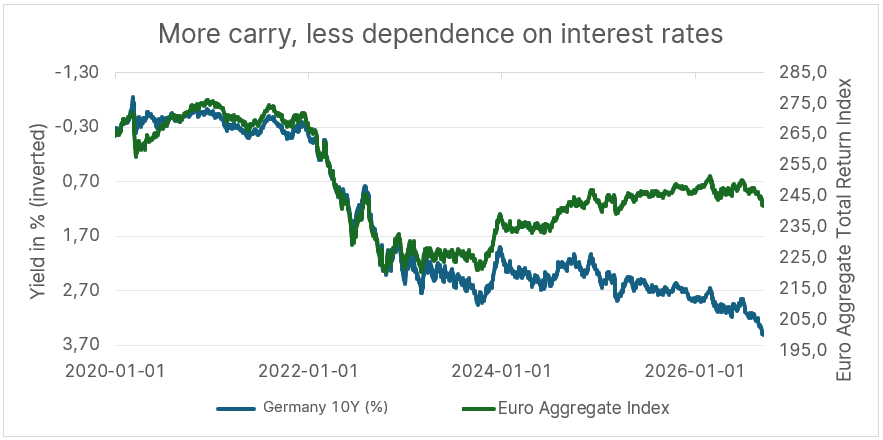
The result: The yield on 10-year Bunds stands at 3.52%, while the Euro Aggregate Index yields around 3.92% (as of September 15, 2026, yield to worst). The real yield on 10-year Bunds (German government bonds) stands at 1.28%, the highest level since February 2010. Anyone who had spent the past fifteen years on a deserted island would not consider this yield level a sign of a crisis, but rather a return to normalcy.
That is precisely the point that gets lost in the debate: For bond investors, this isn’t bad news. It’s the prerequisite for bonds to once again do what they’re supposed to do in a portfolio.
Bonds Are Still Bonds
A bond’s total return comes from two sources: current income and price changes. During the period of extremely low benchmark interest rates, only the second source was at work. Investors weren’t compensated for holding long-term bonds – they were compensated for yields continuing to fall. This is a momentum trade disguised as a bond investment, not a fixed-income investment.
The coupon is back in effect today. And that fundamentally changes the math behind risk.
First: The carry acts as a buffer
Over a 12-month horizon, a bond’s total return can be roughly broken down into

If we simplify this further and equate the current income with the current yield, the break-even point for a parallel rise in interest rates is:
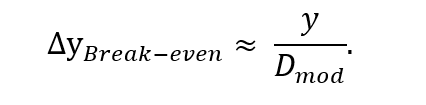
With an index yield of 3.92% and a modified duration of just under five years, this roughly corresponds to an interest rate increase of about 80 basis points over twelve months before the positive current income is eroded by the duration effect.
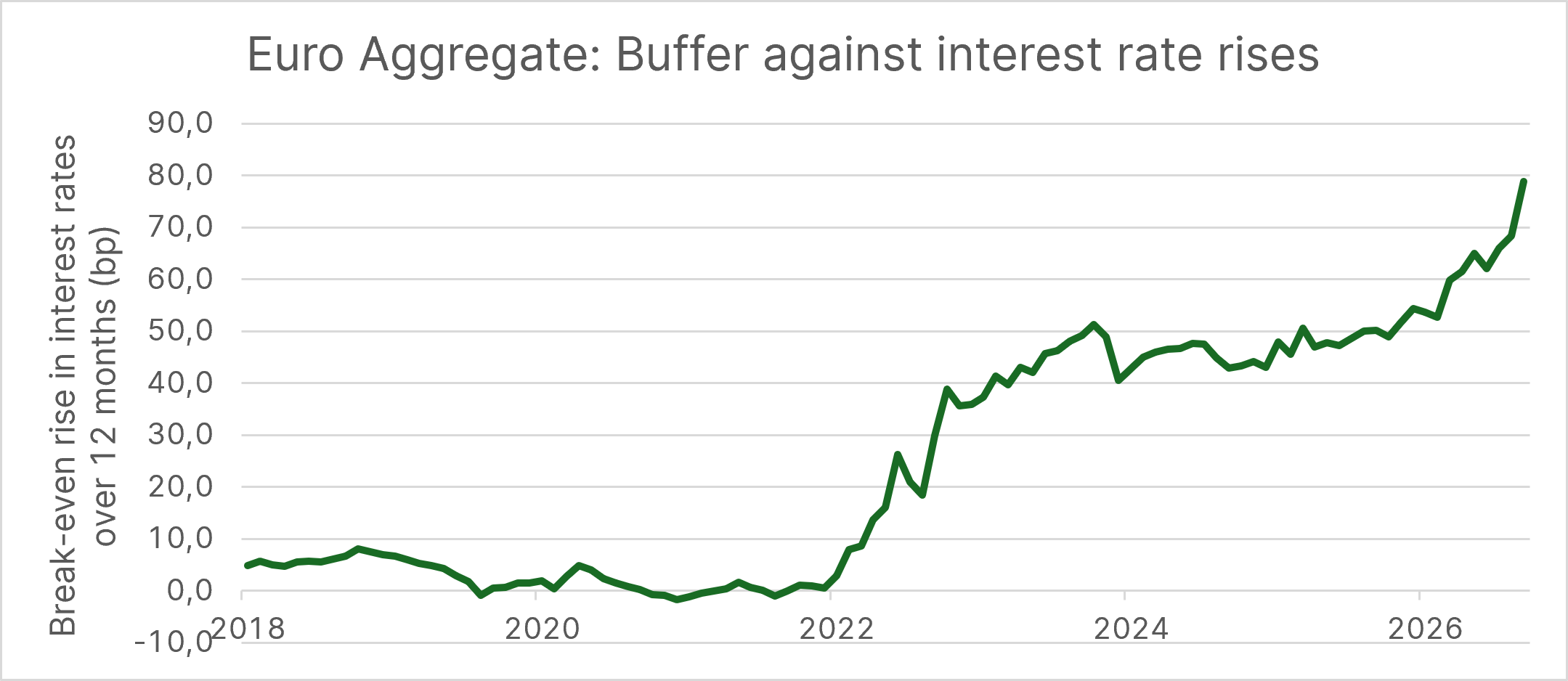
For the 10-year federal bond, the break-even rate – factoring in the roll-down effect – stands at around 47 basis points on an annualized basis. By comparison: At the end of 2021, when the Bund yield was around minus 0.19%, the same break-even rate was negative – yields would have had to fall for investors to break even at all. Back then, a normal interest rate movement was enough to wipe out a decade’s worth of returns. Today, bonds are once again offering current income that can cushion a certain rise in interest rates. At the end of 2021, this buffer was minimal or nonexistent.
Second: Higher yields and coupons reduce interest rate sensitivity
Duration is not a constant; rather, it depends on a bond’s yield level and cash flow structure. A direct comparison of two 10-year German government bonds illustrates just how much the market environment has changed.
The new German government bond issued in June 2021, maturing in August 2031, carried a 0% coupon and was issued with a yield of -0.19%. Virtually the entire value of the bond was therefore tied up in the principal repayment at maturity. As a result, its price reacted particularly strongly to changes in market interest rates. As a zero-coupon bond, its modified duration at issuance was approximately ten years.
In contrast, the most recent 10-year federal bond issued in July 2026, maturing in August 2036, pays a coupon of 3.0%. This means investors receive regular payments back during the term of the bond. Put simply, this shortens the average time it takes for investors to recoup their investment – and thus reduces the so-called duration. With a current yield of around 3.5%, its modified duration is approximately 8.4 years.
Investors today not only receive significantly more current income; the interest rate sensitivity of a newly issued 10-year German government bond is also noticeably lower than it was during the zero-interest-rate environment.
Note: Past performance is not a reliable indicator of future results.
Third: The initial yield is a strong anchor for medium-term returns
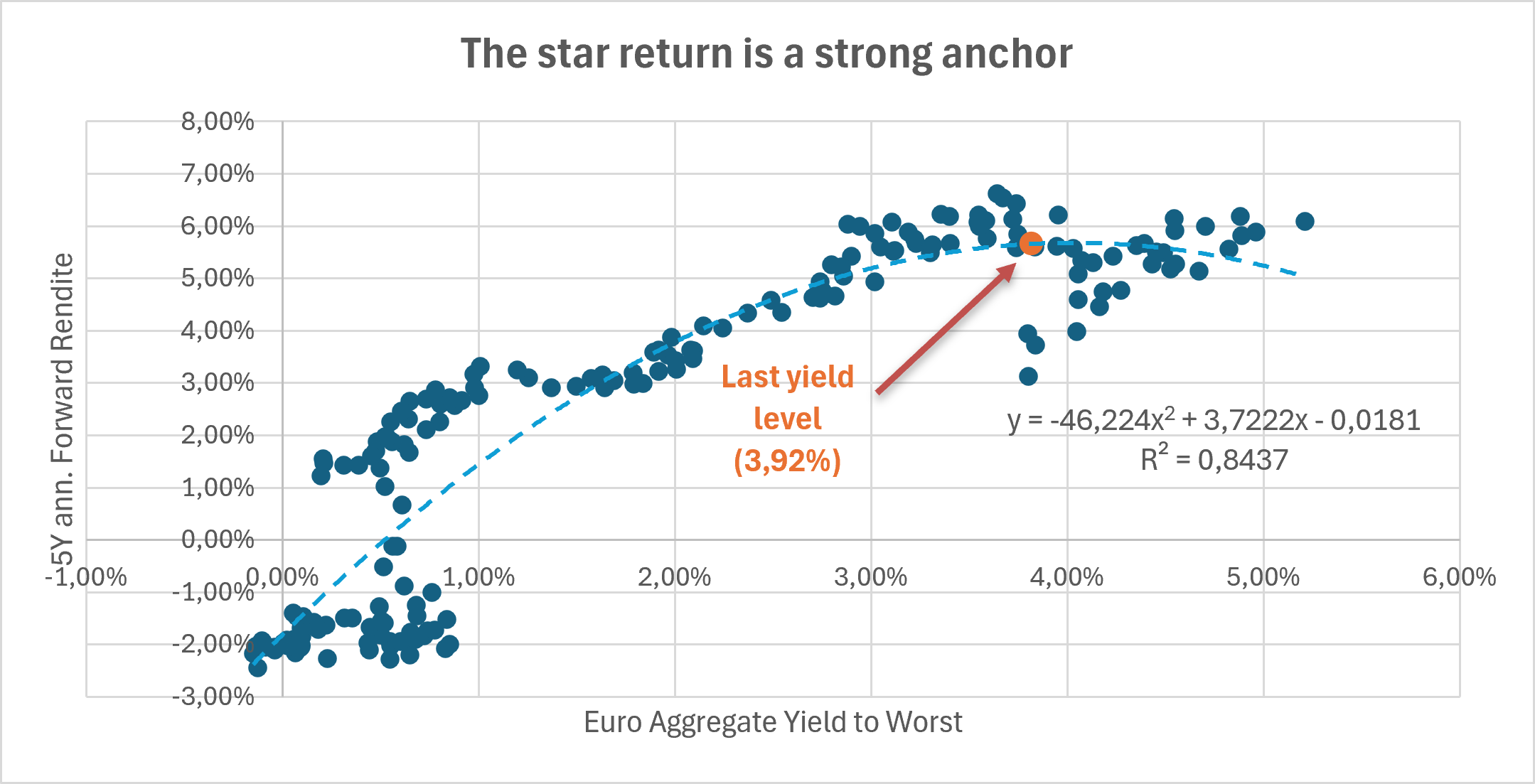
For high-quality bonds, the initial yield has historically accounted for a large portion of the annualized five-year return. This is less a short-term forecast than a consequence of bond mathematics: Investors receive regular coupon payments, can reinvest them, and at maturity, the bond is typically redeemed at 100. This ensures that the initial yield level determines a significant portion of the total return over longer time horizons.
And that is why 2022 is only comparable to today to a limited extent. 2022 was not proof that bonds no longer work – it was the unwinding of the anomaly. The nominal yield was close to zero, the real yield was deep in negative territory, and the term premium had to be rebuilt from scratch.
So there was hardly any current income to cushion price losses. A portfolio without an income cushion entering an inflation shock is defenseless against losses. A portfolio with a 3.92% star return is not. A repeat of 2022 is possible – but it would have to start from a completely different baseline, and that significantly changes the distribution of outcomes.
Note: Past performance is not a reliable indicator of future results.
The Multi-Asset Context
So, let’s get to the real question: What role does this asset class play in a diversified portfolio?
Duration is a conditional hedge – with a positive carry today
A common objection is that bonds have lost their diversifying effect. This objection is usually based on two measurement errors.
The first mistake is the average correlation. Bonds are generally considered a relatively safe haven and less volatile than stocks. Therefore, a hedging instrument should not be evaluated based on how it performs on average across all market conditions, but rather on how it performs when the risk event actually occurs. Historically, there has been virtually no correlation between European government bonds and stocks during quarters when stocks have posted gains. However, in quarters when stocks have lost more than 5%, the relationship turns distinctly negative. Thus, when stocks fall significantly, bonds help stabilize the portfolio.
Note: Past performance is not a reliable indicator of future results.
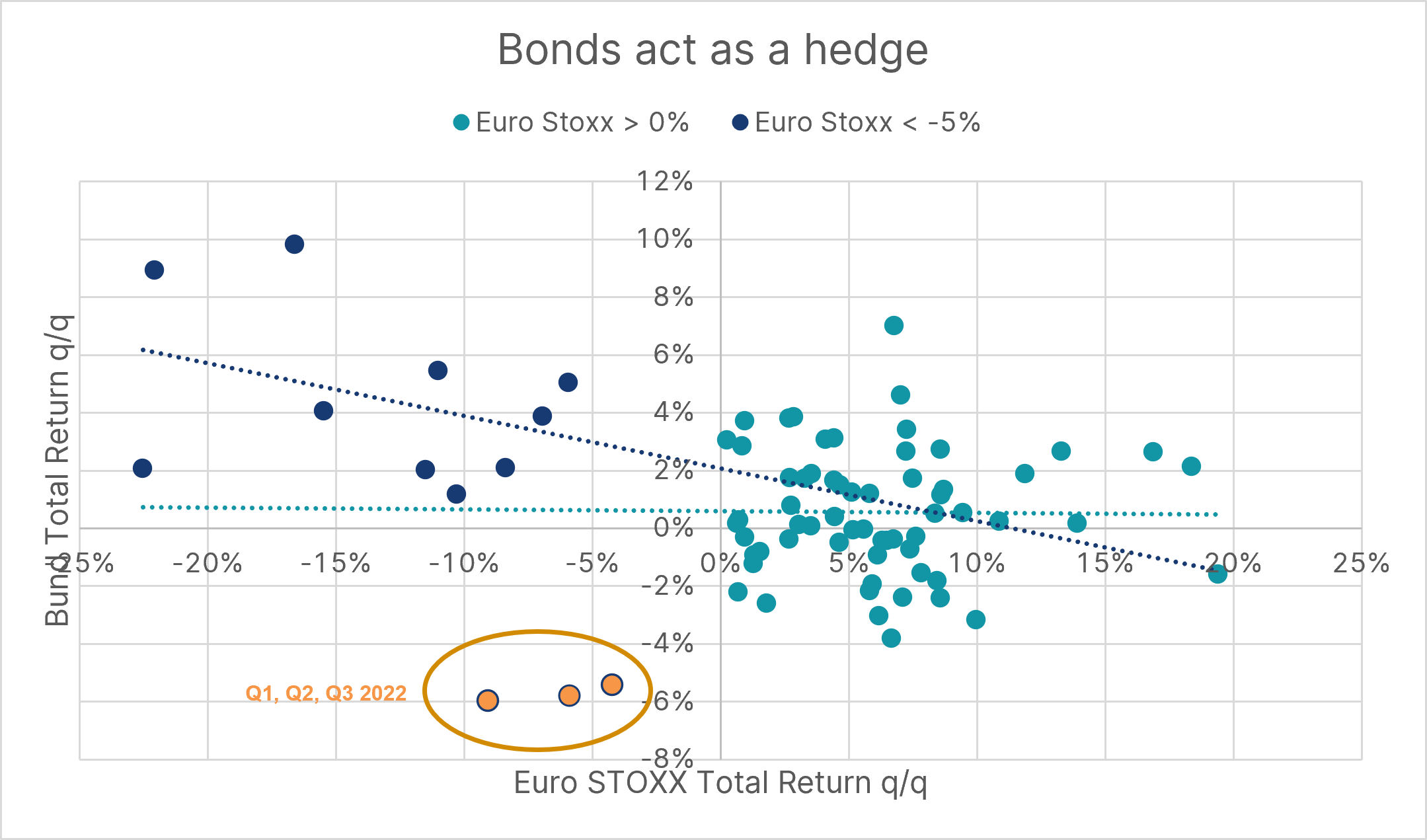
It is also true that this hedge is conditional – bonds do not always fulfill their stabilizing function. Duration provides protection against growth and monetary policy shocks because interest rate expectations fall under such conditions. It does not protect against supply-side and inflation shocks. That was precisely the case in 2022. However, this does not mean that bonds no longer function as a hedge in principle – only that they provide better protection against certain risks than against others.
The second mistake is confusing bonds with duration. Anyone who invests in a broad bond index is also exposed to credit risk – corporate bonds are a risky asset. The yield on a euro-denominated investment-grade bond is divided into a government bond component and a spread component – that is, the yield level of government bonds and the premium that the respective corporate bonds command over them. The first component helps when growth slows; the second component widens precisely at that time.
For Europe, there is an additional nuance: Euro-duration is not homogeneous. German Bund duration is (still) the purest example of this growth/disinflation hedge in Europe. Government bonds from other eurozone countries with weaker credit ratings carry a spread component that widens in a risk-off environment and, during periods of stress, behave like a risk asset themselves. When people in Europe talk about using duration as a hedge, they are referring to core government bonds. The BCEG9T Index was used to calculate the German Bund yield.
Another objection warrants a serious response: If higher fiscal deficits and rising issuance volumes structurally raise yield levels, will bonds still be able to deliver returns at all during the next downturn? The answer involves two distinct levels. Structural forces raise the level of yields and the term premium; they do not prevent cyclical movements during a recession.
In the U.S., deficits widened steadily from the 1970s through 1983 – yet government bonds still delivered attractive risk-adjusted returns during the downturns of 1980 and 1981–82 because recession, disinflation, and expectations of falling key interest rates dominated. Both can be true at the same time: higher average yields over the decade and significantly falling yields during the recession.
And this is where the key difference lies compared to the zero-interest-rate regime: The hedge now once again offers a positive carry. During the zero-interest-rate phase, holding duration was associated with a negative current yield and an expected real return below zero. Investors thus accepted ongoing opportunity costs in order to hedge against growth and monetary policy shocks. Today, the situation is different: With yields at around 3.5%, Bund duration once again offers a positive current yield. This does not guarantee a positive total return, but it does create a buffer against moderate interest rate hikes. For portfolio construction, this is a qualitative difference: A hedge with negative carry is costly if you have to wait a long time to recoup your investment. A hedge with positive carry is much easier to hold in the portfolio over the long term.
Stocks are relatively expensive – and the cushion is getting thinner
The second half of the argument lies on the other side of the portfolio.
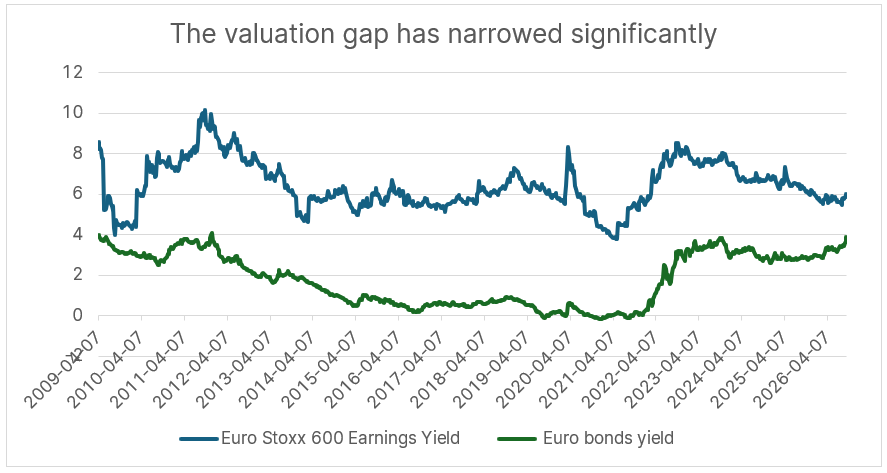
If we compare the earnings yield of European stocks (5.9% based on expected 12-month earnings in the STOXX Europe 600) with the return of the Euro Aggregate Index (3.92%), there remains a relative valuation gap of about 2%. For a globally diversified equity portfolio – whose weighting is effectively determined by U.S. stocks – the comparison is even less favorable: In the U.S. market, the gap has narrowed to 0 basis points.
The point isn’t that stocks will fall. The point is that the buffer has become thin. Stock investors can lose money in two ways: through a revaluation – where the multiple compresses without any change in earnings – and through a slowdown in growth that directly affects earnings. Investors bear the full brunt of both risks. As a result, the earnings yield on European stocks is currently only about two percentage points above the yield of the Euro Aggregate Index.
Note: Please be aware of the opportunities and risks associated with investing in securities. Past performance is not a reliable indicator of future results.
Conclusion: Fixed income is once again an integral part
The argument is explicitly not that bonds will outperform stocks. Rather, it is that bonds are once again fulfilling two functions simultaneously – functions they had lost for a decade: When the global economy is healthy, they provide a sufficient, predictable return – and when conditions deteriorate, as growth and monetary policy take a turn for the worse, they offer protection for the equity side of the portfolio. The star yield provides the current income while also creating a buffer that makes it easier to maintain duration as a permanent hedge in the portfolio.
However, portfolio allocations have not yet reflected this shift in market conditions. Equity allocations in both institutional and retail portfolios remain near historic highs, and there is a clear reason for this: Investors who have faced increasingly low – and at times negative – bond yields for many years and experienced one of the steepest drawdowns in broad bond indices in decades in 2022 are not going to change their behavior over a few basis points. But portfolio construction should be guided by the current market regime, not the one in which one grew up.
Bonds are yielding a bit again. This isn’t a forecast, but rather a characteristic of the current situation – and the current situation is the only thing you can actually be sure of in this business.
Legal disclaimer
This document is an advertisement. Unless indicated otherwise, source: Erste Asset Management GmbH. The language of communication of the sales offices is German and the languages of communication of the Management Company also include English.
The prospectus for UCITS funds (including any amendments) is prepared and published in accordance with the provisions of the InvFG 2011 as amended. Information for Investors pursuant to § 21 AIFMG is prepared for the alternative investment funds (AIF) administered by Erste Asset Management GmbH pursuant to the provisions of the AIFMG in conjunction with the InvFG 2011.
The currently valid versions of the prospectus, the Information for Investors pursuant to § 21 AIFMG, and the key information document can be found on the website www.erste-am.com under “Mandatory publications” and can be obtained free of charge by interested investors at the offices of the Management Company and at the offices of the depositary bank. The exact date of the most recent publication of the prospectus, the languages in which the fund prospectus or the Information for Investors pursuant to Art 21 AIFMG and the key information document are available, and any other locations where the documents can be obtained are indicated on the website www.erste-am.com. A summary of the investor rights is available in German and English on the website www.erste-am.com/investor-rights and can also be obtained from the Management Company.
The Management Company can decide to suspend the provisions it has taken for the sale of unit certificates in other countries in accordance with the regulatory requirements.
Note: You are about to purchase a product that may be difficult to understand. We recommend that you read the indicated fund documents before making an investment decision. In addition to the locations listed above, you can obtain these documents free of charge at the offices of the referring Sparkassen bank and the offices of Erste Bank der oesterreichischen Sparkassen AG. You can also access these documents electronically at www.erste-am.com.
Our analyses and conclusions are general in nature and do not take into account the individual characteristics of our investors in terms of earnings, taxation, experience and knowledge, investment objective, financial position, capacity for loss, and risk tolerance. Past performance is not a reliable indicator of the future performance of a fund.
Please note: Investments in securities entail risks in addition to the opportunities presented here. The value of units and their earnings can rise and fall. Changes in exchange rates can also have a positive or negative effect on the value of an investment. For this reason, you may receive less than your originally invested amount when you redeem your units. Persons who are interested in purchasing units in investment funds are advised to read the current fund prospectus(es) and the Information for Investors pursuant to § 21 AIFMG, especially the risk notices they contain, before making an investment decision. If the fund currency is different than the investor’s home currency, changes in the relevant exchange rate can positively or negatively influence the value of the investment and the amount of the costs associated with the fund in the home currency.
We are not permitted to directly or indirectly offer, sell, transfer, or deliver this financial product to natural or legal persons whose place of residence or domicile is located in a country where this is legally prohibited. In this case, we may not provide any product information, either.
Please consult the corresponding information in the fund prospectus and the Information for Investors pursuant to § 21 AIFMG for restrictions on the sale of the fund to American or Russian citizens.
It is expressly noted that this communication does not provide any investment recommendations, but only expresses our current market assessment. Thus, this communication is not a substitute for investment advice.
This document does not represent a sales activity of the Management Company and therefore may not be construed as an offer for the purchase or sale of financial or investment instruments.
Erste Asset Management GmbH is affiliated with the Erste Bank and austrian Sparkassen banks.
Please also read the “Information about us and our securities services” published by your bank.
More on the topic

China’s roadmap for the future: A look at the new five-year plan
Although China’s economy is expected to grow less strongly in the coming years, Beijing is focusing on quality and therefore growth in promising sectors. Read today’s blog post to find out why innovation, technology and key strategic industries are the focus of the new five-year plan and what opportunities this presents for investors.