
Canada and the EU are aiming for closer cooperation, with a joint goal of becoming less dependent on the major economic blocs of the US and China. What role does US President Trump’s tariff policy play in this? And what decisions might be made at the EU-Canada summit at the end of October?
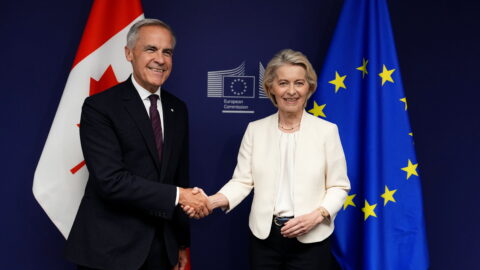
To this end, Canada is seeking associate membership of the EU, Canadian Prime Minister Mark Carney explained last week in a speech to the European Parliament in Strasbourg. In doing so, he welcomed a corresponding proposal from European Commission President Ursula von der Leyen. Europe and Canada are stronger together, said Carney.
Carney’s push for closer cooperation with the EU provoked a sharp reaction from Washington whilst he was still in Strasbourg. US President Donald Trump described the idea of Canada’s associate membership of the EU as “ridiculous” but, in the same breath, threatened Europe with further tariffs should the US regard the planned rapprochement as “hostile”. Von der Leyen said that the proposed partnership was not directed against others but was intended to enhance the combined strength of Europe and Canada.
Carney, too, presents his policy as one of diversification rather than a shift away from the US. An alliance between Canada and the EU could become a “beacon for other democracies”. For Carney, this is about more than just closer trade relations. He emphasised that both partners should secure their strategic autonomy through intensive cooperation in key areas.
This applies, for example, to payment systems dominated by US corporations such as Visa and Mastercard, and to critical raw materials, where China plays a central role. Carney’s proposal: Canada and the EU should work together to develop their own alternatives. “We all have significant gaps in these strategic capabilities,” said Carney. This makes Canada and the EU vulnerable. These gaps cannot be closed alone, “but together, they certainly can”.
Please note: The companies listed here have been selected by way of example only and do not constitute investment advice. Past performance and forecasts are not reliable indicators of future performance.
Greater cooperation on AI, technology, payment systems and energy
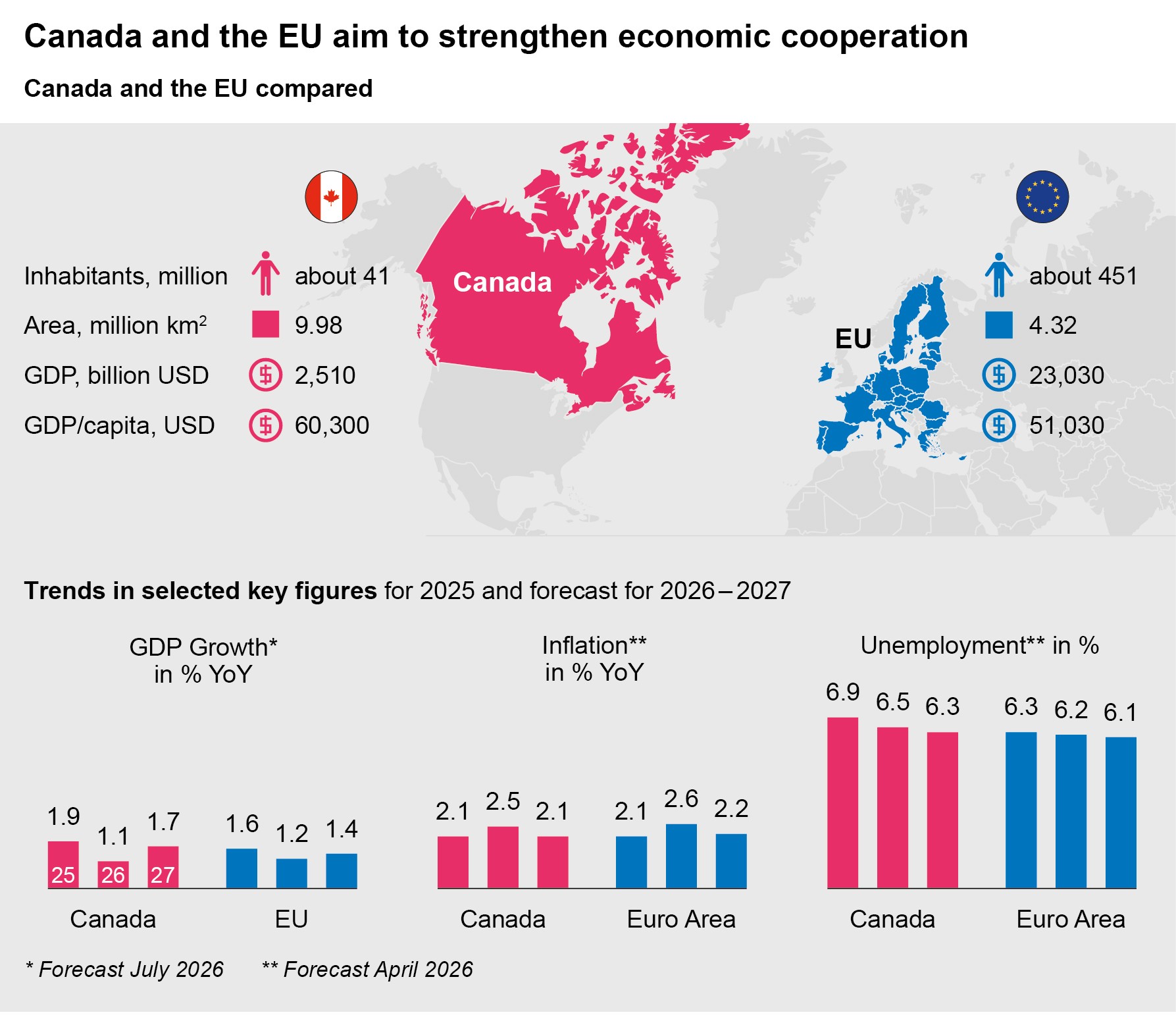
According to Carney and von der Leyen, the EU and Canada intend to cooperate more closely on industrial production, artificial intelligence (AI), semiconductors, critical raw materials, payment systems, vaccines, space communications and clean energy. Canada could, for example, make a major contribution to European energy security by supplying liquefied natural gas (LNG) and hydrogen on a large scale. New port facilities could be developed for this purpose. Canada, in turn, could benefit from Europe’s lead in clean energy technologies.
Carney also proposed exploring an integrated market for financial services and making it easier for young people to live, work and study in each other’s regions. This includes Canada’s intention to join the European student exchange programme Erasmus+.
Escalation of the US trade dispute accelerates Canada’s search for new partners
Canada is also being driven in this by the recent escalation of the trade dispute with the US. Following the collapse of trade talks between the US and Canada, the US imposed 50 per cent tariffs in August on Canadian goods worth around 20 billion US dollars (around 17 billion euros). These include items such as ice hockey sticks, furniture, honey and wine. Canada has responded with retaliatory tariffs on US imports. According to earlier reports, the measures affect products in the steel and aluminium sectors, household appliances, agricultural equipment, pulp and paper, and electronics. The tariffs are set to be as high as 50 per cent on imports from the United States worth 27.6 billion Canadian dollars (also around 17 billion euros).
This has recently been compounded by fresh political provocations from the US. In the week following the collapse of the trade talks, US President Trump issued an executive order renaming Lake Ontario, which is one of the five Great Lakes of North America and named after the Canadian province of the same name, to “Lake America”. Trump has repeatedly mocked Canada, a long-standing ally, and threatened to annex it as the 51st US state.
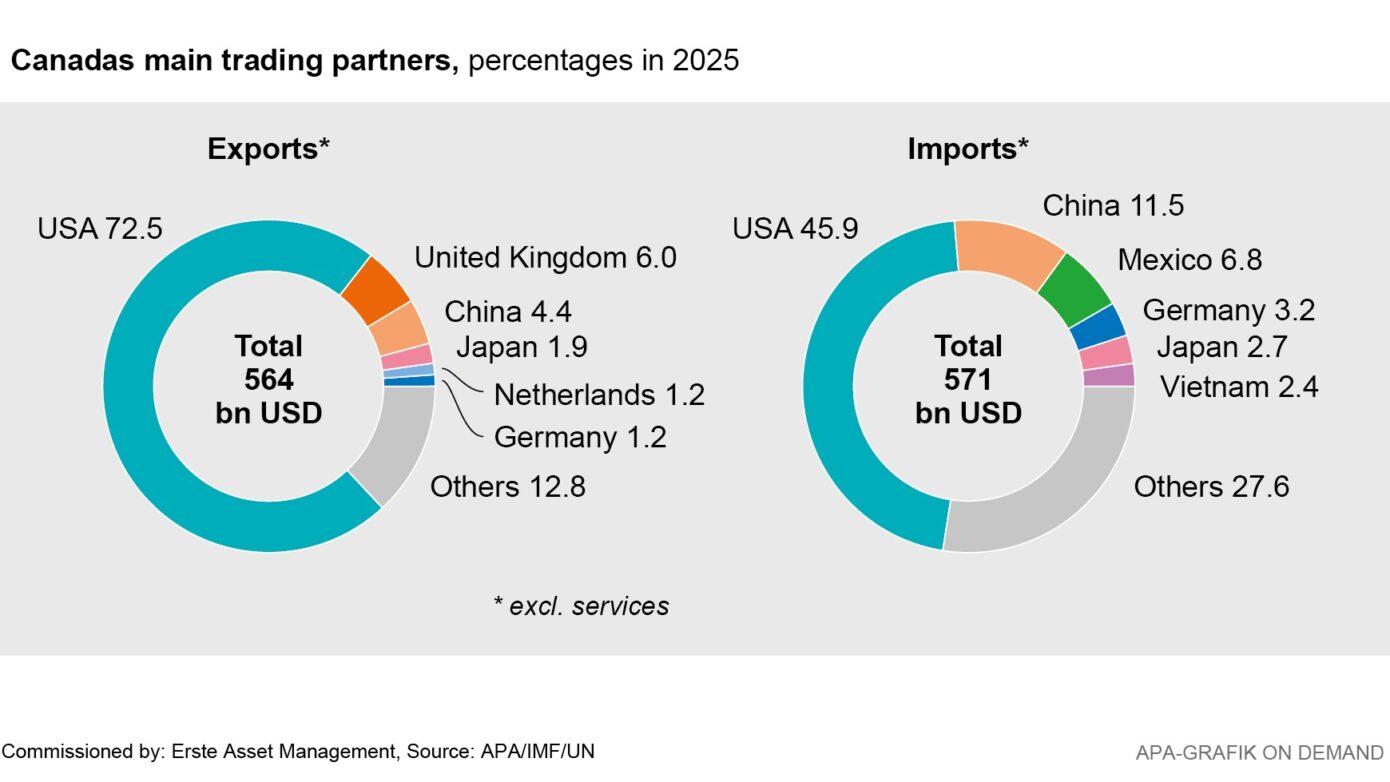
The US is currently by far Canada’s most important trading partner
Presently, Canada’ s most valuable trading partner is the US and by a wide margin. The economies of the two countries are closely intertwined. Around 70 per cent of all Canadian exports go to the United States. The neighbours are also closely linked in the energy sector. Bilateral energy trade reached around 216.8 billion Canadian dollars in 2024. Energy exports accounted for around 29 per cent of Canada’s goods exports to the US.
Carney now wants to break free from this dependence, at least in part, and diversify his country’s trade relations. The first signs of this shift are already visible: in 2025, Canada’s exports to the US fell by 3.7 per cent, whilst exports to other countries rose by 11.1 per cent. The share of non-US markets in Canadian exports thus rose to its highest level in more than four decades, according to Statistics Canada.
Ceta free trade agreement as an accelerator?
But Canada already has close ties with the EU as well. The CETA free trade agreement between the two economic blocs has been provisionally applied since 2017. Canada has also been participating in a key part of the EU’s Horizon Europe research programme since 2024. Furthermore, both sides concluded a comprehensive security and defence partnership in 2025. Since June this year, Canada has also been the first non-European country to participate in the EU’s SAFE defence instrument. This means that Canadian companies and products can be considered for joint procurement under simplified conditions.
EU-Canada summit at the end of October with key decisions?
The European Commission and Canada must now clarify how the political proposal can be turned into a concrete model. This involves defining the areas of cooperation, as well as Canada’s rights to have a say and its obligations. The question of the legal basis must also be clarified. The next EU–Canada summit on 29 and 30 October is likely to be an important first milestone. This will also raise the key question of what the 27 EU Member States make of von der Leyen’s initiative. A new special member status is unlikely to be adopted without unanimity. Several EU Member States have recently made it clear time and again that, for them, EU enlargement towards the Western Balkans or Ukraine is a priority.
Legal disclaimer
This document is an advertisement. Unless indicated otherwise, source: Erste Asset Management GmbH. The language of communication of the sales offices is German and the languages of communication of the Management Company also include English.
The prospectus for UCITS funds (including any amendments) is prepared and published in accordance with the provisions of the InvFG 2011 as amended. Information for Investors pursuant to § 21 AIFMG is prepared for the alternative investment funds (AIF) administered by Erste Asset Management GmbH pursuant to the provisions of the AIFMG in conjunction with the InvFG 2011.
The currently valid versions of the prospectus, the Information for Investors pursuant to § 21 AIFMG, and the key information document can be found on the website www.erste-am.com under “Mandatory publications” and can be obtained free of charge by interested investors at the offices of the Management Company and at the offices of the depositary bank. The exact date of the most recent publication of the prospectus, the languages in which the fund prospectus or the Information for Investors pursuant to Art 21 AIFMG and the key information document are available, and any other locations where the documents can be obtained are indicated on the website www.erste-am.com. A summary of the investor rights is available in German and English on the website www.erste-am.com/investor-rights and can also be obtained from the Management Company.
The Management Company can decide to suspend the provisions it has taken for the sale of unit certificates in other countries in accordance with the regulatory requirements.
Note: You are about to purchase a product that may be difficult to understand. We recommend that you read the indicated fund documents before making an investment decision. In addition to the locations listed above, you can obtain these documents free of charge at the offices of the referring Sparkassen bank and the offices of Erste Bank der oesterreichischen Sparkassen AG. You can also access these documents electronically at www.erste-am.com.
Our analyses and conclusions are general in nature and do not take into account the individual characteristics of our investors in terms of earnings, taxation, experience and knowledge, investment objective, financial position, capacity for loss, and risk tolerance. Past performance is not a reliable indicator of the future performance of a fund.
Please note: Investments in securities entail risks in addition to the opportunities presented here. The value of units and their earnings can rise and fall. Changes in exchange rates can also have a positive or negative effect on the value of an investment. For this reason, you may receive less than your originally invested amount when you redeem your units. Persons who are interested in purchasing units in investment funds are advised to read the current fund prospectus(es) and the Information for Investors pursuant to § 21 AIFMG, especially the risk notices they contain, before making an investment decision. If the fund currency is different than the investor’s home currency, changes in the relevant exchange rate can positively or negatively influence the value of the investment and the amount of the costs associated with the fund in the home currency.
We are not permitted to directly or indirectly offer, sell, transfer, or deliver this financial product to natural or legal persons whose place of residence or domicile is located in a country where this is legally prohibited. In this case, we may not provide any product information, either.
Please consult the corresponding information in the fund prospectus and the Information for Investors pursuant to § 21 AIFMG for restrictions on the sale of the fund to American or Russian citizens.
It is expressly noted that this communication does not provide any investment recommendations, but only expresses our current market assessment. Thus, this communication is not a substitute for investment advice.
This document does not represent a sales activity of the Management Company and therefore may not be construed as an offer for the purchase or sale of financial or investment instruments.
Erste Asset Management GmbH is affiliated with the Erste Bank and austrian Sparkassen banks.
Please also read the “Information about us and our securities services” published by your bank.
More on the topic

US Economy: Growth Is Robust, but Sentiment Could Be Better
As World Cup host, the US is in the spotlight. While economic growth and the job market remain robust, inflation and high energy prices are weighing on consumer sentiment. Learn more about the latest economic data for the World Cup host countries in our new blog post.