

The US is currently in the spotlight as the host country of the World Cup, but domestic sentiment is mixed. Consumer sentiment in the U.S. fell to a new low this spring amid rising energy prices and fears of inflation. However, the prospect of a resolution to the Middle East conflict could now bring about a turnaround; recent sentiment data has already shown signs of recovery.
While the ball keeps rolling in these three countries leading up to the final on July 19, we take a look at the latest sentiment and economic data from the World Cup host countries.
Inflation Well Above Target
As recently as May, the University of Michigan’s consumer sentiment index had fallen to a record low of 44.8 points. According to survey director Joanne Hsu, the main reason for the plunge was the sharp rise in gasoline prices caused by supply bottlenecks in the vital Strait of Hormuz shipping route.
The rise in oil and energy prices in the wake of the Iran war and the Hormuz blockade was also clearly reflected in inflation data this spring. In May, the inflation rate stood at 4.2 percent, the highest level since April 2023. Energy prices in May were 23.5 percent higher than in the previous year, and gasoline prices were up as much as 40 percent. Inflation thus remains well above the Federal Reserve’s target and has also fueled fears in financial markets of countermeasures in the form of Fed interest rate hikes.
Data as of 16 June 2026
Prospects for an end to the Middle East conflict bring a sigh of relief
However, the latest signs of an impending resolution to the Middle East conflict have already brought about a measurable improvement in sentiment. After weeks of negotiations, the U.S. and Iran reached an agreement last weekend. As part of the deal, the Strait of Hormuz is also set to reopen by the end of the week, according to U.S. President Trump. Many observers viewed the deal as an intermediate step in a diplomatic process that still faces many hurdles. Chief Economist Gerhard Winzer has already analyzed the implications and possible next steps here on the blog.
The emerging agreement had already led to a decline in oil prices and, consequently, a recovery in consumer sentiment. In June, the University of Michigan’s consumer sentiment index improved by a surprisingly significant 4.1 points to 48.9 points due to falling gasoline prices. Consumer inflation expectations also eased slightly from high levels. Over a one-year horizon, they fell from 4.8 to 4.6 percent.
US job market remained robust despite the war
Other economic indicators recently painted a largely solid picture despite the war with Iran. For example, twice as many jobs were created in the US in May as expected, despite the uncertainty caused by the war. In total, 172,000 non-farm jobs were created; economists surveyed by the international news agency Reuters had expected an increase of only 85,000. The unemployment rate remained at 4.3 percent for the third consecutive month. According to economists, while the war in Iran has unsettled many companies, this has likely not yet had a major impact on the job market.
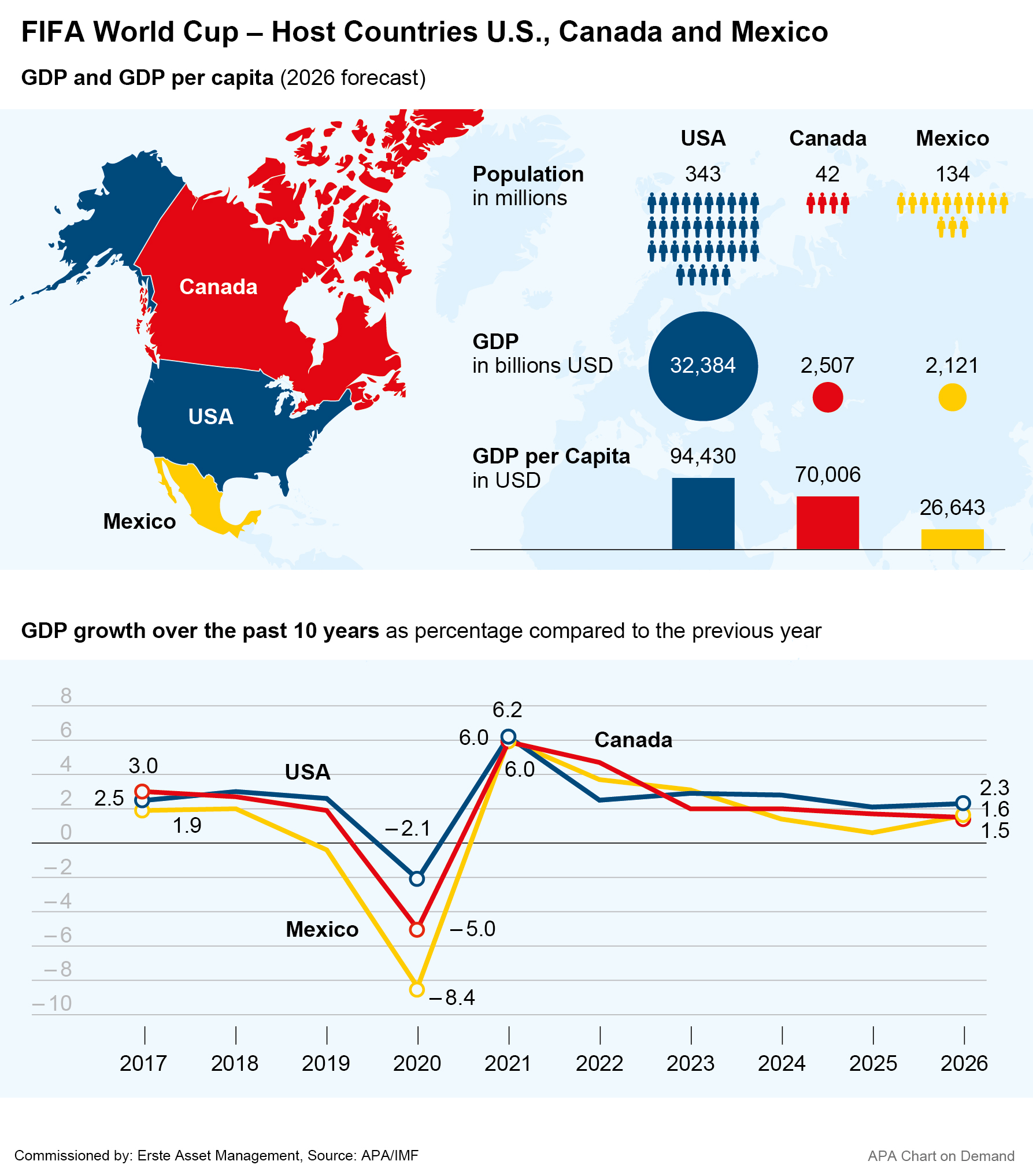
In its latest forecast update in April, the International Monetary Fund (IMF) made only minor adjustments to its estimates for the U.S. Due to the war in Iran, IMF economists lowered their economic growth forecast for the US this year from 2.4 to 2.3 percent. Industrial production has also remained stable recently. Although production in May rose by only 0.1 percent compared to the previous month – slightly less than expected – the April figure was revised upward from 0.7 to 0.9 percent.
The US trade balance recently showed a slight improvement. The U.S. trade deficit narrowed slightly in April due to record-high exports. Imports exceeded exports by only 55.9 billion dollars. In March, the deficit had stood at 56.6 billion dollars. The reason for this development: Exports grew by 2.6 percent from the previous month to a record 327 billion dollars, while imports rose by only 2.0 percent to 383 billion dollars. The record number could also be attributed to the increase in oil shipments.
Canada and Mexico are betting on new partnerships amid an economic slump
The other two World Cup host countries, Canada and Mexico, are currently experiencing slow economic growth. The tariffs imposed by Trump on imported goods already hit the Canadian manufacturing sector hard last year. This forced many companies to cut production, lay off workers, and reduce investments. In the first quarter of 2026, Canada’s gross domestic product (GDP) contracted by 0.1 percent. According to IMF forecasts, the country is expected to achieve 1.5 percent growth for the full year. For Mexico, the IMF expects 1.6 percent growth this year.
Both countries are currently seeking new trade partnerships and alliances to reduce their dependence on the U.S. Most recently, after years of negotiations, the EU and Mexico signed a modernised version of their trade and cooperation agreement from 2000. This is intended to eliminate further tariffs and trade barriers as well as update the framework for cooperation.
Canada plans to work with other countries to reduce its dependence on China for raw materials
For the most populous Spanish-speaking country, with 130 million inhabitants, the EU is the second largest export market after the US on a global scale. The annual bilateral trade volume with the EU amounts to around 86 billion euros. About 80 percent of Mexican exports go to the US, whose economy has become increasingly insular under the administration of US President Donald Trump due to the introduction of new tariffs.
Canada is currently working with Japan and France to explore alternatives to a U.S.-led trade bloc for critical raw materials. The goal is to reduce reliance on China and secure supply chains, government officials said. Options under discussion include import quotas for rare earths, subsidies for mining companies, and a buyers’ club initiated by Canada. In doing so, the countries appear to be distancing themselves from plans by U.S. Vice President JD Vance, who had proposed a U.S.-dominated trade bloc. In light of President Donald Trump’s policies, Canadian Prime Minister Mark Carney called for middle-power countries to unite.
Investment Idea: Adding North America to Your Portfolio in a Sustainable Way
Anyone who, after taking a look at the World Cup hosts, would also like to keep an eye on the North American market when it comes to investing will find that the ERSTE RESPONSIBLE STOCK AMERICA a sustainable investment solution. The fund invests primarily in stocks of selected companies headquartered or listed on stock exchanges in North America. It focuses on high-quality, high-growth companies that are among the pioneers in terms of environmental, social, and governance criteria.
The investment process is based on fundamental company analysis and also takes ethical considerations into account as part of a holistic ESG approach. Recent top holdings have included Alphabet, NVIDIA, Apple, Microsoft, Broadcom, JPMorgan Chase, Eli Lilly, AMD, and Johnson & Johnson, among others. The fund thus offers exposure to leading North American companies—but with sustainability criteria applied in the selection of securities.
You can learn more about the fund on our website.
Note: Please be aware that investing in securities involves both opportunities and risks. The companies mentioned in this article have been selected as examples and do not constitute an investment recommendation.
Risk notes ERSTE RESPONSIBLE STOCK AMERICA
The fund employs an active investment policy and is not oriented towards a benchmark. The assets are selected on a discretionary basis and the scope of discretion of the management company is not limited.
For further information on the sustainable focus of ERSTE RESPONSIBLE STOCK AMERICA as well as on the disclosures in accordance with the Disclosure Regulation (Regulation (EU) 2019/2088) and the Taxonomy Regulation (Regulation (EU) 2020/852), please refer to the current Prospectus, section 12 and the Annex “Sustainability Principles”. In deciding to invest in ERSTE RESPONSIBLE STOCK AMERICA, consideration should be given to any characteristics or objectives of the ERSTE RESPONSIBLE STOCK AMERICA as described in the Fund Documents.
Legal disclaimer
This document is an advertisement. Unless indicated otherwise, source: Erste Asset Management GmbH. The language of communication of the sales offices is German and the languages of communication of the Management Company also include English.
The prospectus for UCITS funds (including any amendments) is prepared and published in accordance with the provisions of the InvFG 2011 as amended. Information for Investors pursuant to § 21 AIFMG is prepared for the alternative investment funds (AIF) administered by Erste Asset Management GmbH pursuant to the provisions of the AIFMG in conjunction with the InvFG 2011.
The currently valid versions of the prospectus, the Information for Investors pursuant to § 21 AIFMG, and the key information document can be found on the website www.erste-am.com under “Mandatory publications” and can be obtained free of charge by interested investors at the offices of the Management Company and at the offices of the depositary bank. The exact date of the most recent publication of the prospectus, the languages in which the fund prospectus or the Information for Investors pursuant to Art 21 AIFMG and the key information document are available, and any other locations where the documents can be obtained are indicated on the website www.erste-am.com. A summary of the investor rights is available in German and English on the website www.erste-am.com/investor-rights and can also be obtained from the Management Company.
The Management Company can decide to suspend the provisions it has taken for the sale of unit certificates in other countries in accordance with the regulatory requirements.
Note: You are about to purchase a product that may be difficult to understand. We recommend that you read the indicated fund documents before making an investment decision. In addition to the locations listed above, you can obtain these documents free of charge at the offices of the referring Sparkassen bank and the offices of Erste Bank der oesterreichischen Sparkassen AG. You can also access these documents electronically at www.erste-am.com.
Our analyses and conclusions are general in nature and do not take into account the individual characteristics of our investors in terms of earnings, taxation, experience and knowledge, investment objective, financial position, capacity for loss, and risk tolerance. Past performance is not a reliable indicator of the future performance of a fund.
Please note: Investments in securities entail risks in addition to the opportunities presented here. The value of units and their earnings can rise and fall. Changes in exchange rates can also have a positive or negative effect on the value of an investment. For this reason, you may receive less than your originally invested amount when you redeem your units. Persons who are interested in purchasing units in investment funds are advised to read the current fund prospectus(es) and the Information for Investors pursuant to § 21 AIFMG, especially the risk notices they contain, before making an investment decision. If the fund currency is different than the investor’s home currency, changes in the relevant exchange rate can positively or negatively influence the value of the investment and the amount of the costs associated with the fund in the home currency.
We are not permitted to directly or indirectly offer, sell, transfer, or deliver this financial product to natural or legal persons whose place of residence or domicile is located in a country where this is legally prohibited. In this case, we may not provide any product information, either.
Please consult the corresponding information in the fund prospectus and the Information for Investors pursuant to § 21 AIFMG for restrictions on the sale of the fund to American or Russian citizens.
It is expressly noted that this communication does not provide any investment recommendations, but only expresses our current market assessment. Thus, this communication is not a substitute for investment advice.
This document does not represent a sales activity of the Management Company and therefore may not be construed as an offer for the purchase or sale of financial or investment instruments.
Erste Asset Management GmbH is affiliated with the Erste Bank and austrian Sparkassen banks.
Please also read the “Information about us and our securities services” published by your bank.
More on the topic

US draft budget: “The rules of the game for renewable forms of energy are changing”
The recently published US budget draft also contains interesting passages on the future of the Inflation Reduction Act and the associated subsidies for renewable energies. In an interview, environmental equity fund manager Alexander Weiss explains what the draft means for investors and why the market reacted positively to it.

Trump’s tariff plans: a game with no winners?
On 20 January, the world will once again look to Washington with anticipation as Donald Trump is sworn in as US President for the second time in front of the Capitol. In any case, his statements and plans are already the focus of attention on the financial markets.
Trump is planning high import tariffs for goods, for example from Mexico and China. The possible consequences range from the threat of a trade war to a comeback of inflation. In the end, will no one benefit from the planned tariff measures?