

Heat waves in Europe are becoming more frequent and intense, and so are their economic consequences. As temperatures rise, not only do the burdens on people and the environment increase—the economy is also feeling the effects.
According to a study by Allianz Research published in May, the number of extreme heat events worldwide has increased sevenfold since the 1980s. Europe is particularly hard-hit by heat waves, partly because of its aging population and the fact that, compared to other countries, air conditioning is still not widely used.
The critical threshold is 30 degrees
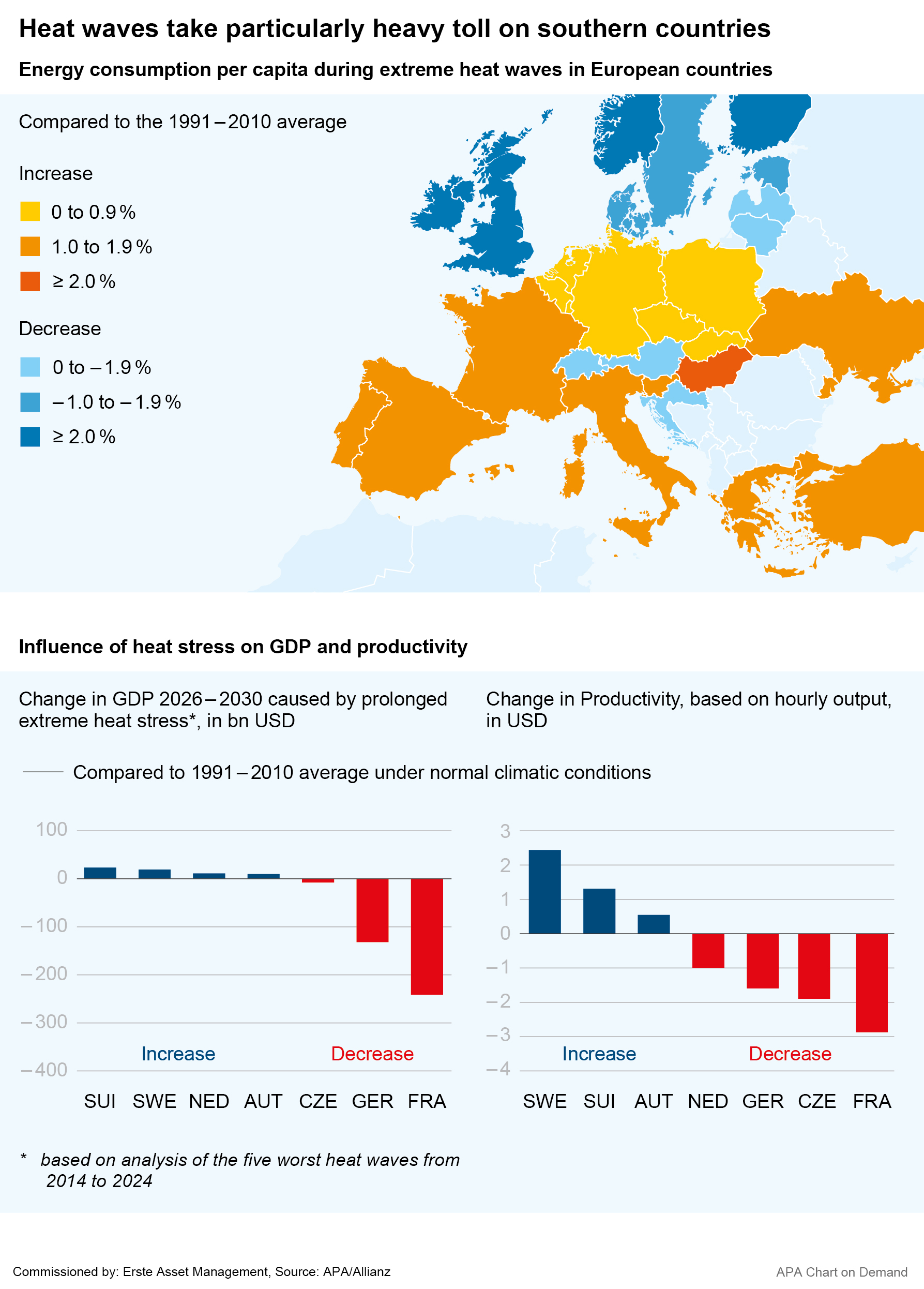
The economic impacts of heat waves are not proportional to the rise in temperature. Experts consider a temperature of 30 degrees to be the critical threshold beyond which extreme heat waves suddenly lead to sharp drops in productivity. In their model, Allianz economists calculate a productivity loss of $1 per hour worked, or 3 percent, for every additional degree in the 30 to 35-degree range.
The resulting losses in tax revenue are even greater under progressive tax rates. Although hourly wages fall in tandem with productivity, this happens with a time lag. In the short term, this leads to higher labor costs for companies. According to the Allianz study, this effect, combined with higher energy costs for cooling, also weighs on companies’ profitability.
Southern countries are particularly affected; positive effects are seen in northern countries
Below the 30-degree mark, the positive effects of the heat—such as lower heating costs—predominate. This is also evident in cross-country comparisons of the effects of heat. While northern countries such as Canada, Sweden, and Finland still benefit from heat waves, productivity declines sharply in warmer regions.
An econometric analysis by Allianz Research, based on data from 35 countries covering the period from 1997 to 2023, reveals a clear disparity among countries. According to the analysis, the more northerly countries—the United Kingdom, Sweden, Finland, Norway, and Ireland—actually benefit from heat waves, with increases in hourly labor output ranging from 2 to 3 percent. In these countries, temperatures also remained largely below the key 30-degree mark.
The situation is different in warmer regions. Southern countries such as Slovenia, Italy, France, and Australia were hit hardest by the heat, suffering productivity losses of up to just under 3 percent.
As of July 1, 2026
Sectors particularly affected: agriculture, construction, and tourism
Heat waves also have varying degrees of impact across different industries. “A major problem” arises for agriculture, for example, as Wifo economist Marcus Scheiblecker recently explained in an interview with the Austria Press Agency (APA).
Heat waves are occurring more and more frequently from June through September, rather than just in the middle of summer as they used to. However, many crops cannot tolerate extreme heat over extended periods, especially without adequate irrigation, according to the economist. Naturally, agriculture in southern regions is particularly affected. In Italy, industry associations have already warned of drastic impacts from the recent heat waves on wine and rice production.
New “obstacles” are also emerging for construction, though they may not be long-lasting. Different construction schedules and stricter heat regulations may become necessary, according to Scheiblecker. A shift to cooler seasons is likely, but this could drive up costs, as more construction would have to take place during shorter periods in the spring and fall. “There could be a lull in construction during the summer, just as there has been in the winter,” the expert said.
Scheiblecker expects city trips to become less attractive during the hottest months of the year. In the healthcare sector, higher costs are also looming, as more hospitalizations due to the heat are expected. Air conditioning manufacturers, on the other hand, are bracing for a boom, as the Handelsblatt learned from leading German producers. In 2024, manufacturers produced around 317,000 air conditioners in Germany alone. That represents an increase of more than 90 percent compared to the previous year.
A heat wave caused electricity prices to rise significantly at times
Naturally, the energy sector is particularly affected by heat waves, as demand for electricity to power cooling systems and air conditioners rises. This was also evident during the most recent heat wave in the electricity prices on Europe’s energy exchanges, which at times skyrocketed. Such high electricity prices are unusual, especially for the summer months. Comparably high levels were last recorded in 2022, after Russia’s war of aggression against Ukraine triggered an energy crisis.
Electricity demand is particularly high in the evening. That’s when homes, offices, and industrial facilities all have to contend with the heat, explained Christoph Maurer of the consulting firm Consentec in an interview with the *Handelsblatt*.
Note: Forecasts are not a reliable indicator of future performance.
The Allianz study also naturally identifies a noticeable disparity in electricity demand between cooler and warmer regions. According to the study, in hotter countries such as Egypt, China, Senegal, and Spain, electricity demand rises by between 2 and just under 6 percent during heat waves compared to a 20-year average. Cooler countries such as Ireland, Norway, the United Kingdom, and Finland have even benefited from lower heating costs in the past. However, the study’s authors warn that these positive effects are likely to erode in the future as temperatures continue to rise.
Against the backdrop of rising electricity demand, renewable energy is once again coming into sharper focus. “Recent forecasts predict a significant increase in electricity demand in the coming decades—not least due to the rapid expansion of AI infrastructure,” emphasizes Alexander Weiß, manager of the environmental equity fund at Erste Asset Management.
Renewable energy could play an important role here as a cost-effective and readily available energy source for meeting electricity demand, the expert continues. “In this context, grid infrastructure and battery solutions are also key growth areas that we are specifically targeting in the ERSTE GREEN INVEST environmental equity fund,” says Weiss.
Conclusion: Climate risks are coming more into focus
Extreme heat has long been more than just a weather phenomenon. It is changing production conditions, supply chains, energy demand, and investment decisions. For investors, it is therefore becoming increasingly important to assess how well companies are prepared for these developments.
At the same time, new opportunities are emerging. Investments in energy efficiency, renewable energy, smart grids, and solutions for adapting to climate change are becoming increasingly important. Companies that develop innovative responses to these challenges could gain long-term momentum from this structural change.
Sustainable Investing – With an Eye Toward the Future
For those who wish to invest in these long-term trends while also supporting companies that actively contribute to the transformation of the economy, the ERSTE GREEN INVEST offers an attractive investment opportunity. The fund invests globally in companies whose products and services contribute to environmental and climate protection—for example, in the areas of renewable energy, energy efficiency, water, the circular economy, or sustainable mobility.
Transformation and adaptation are also among the fund’s key focus areas. For example, the fund makes targeted investments in providers of refrigeration and air conditioning technologies, including Trane Technologies, which is active in the development, manufacturing, distribution, and servicing of building services systems, as well as in transport refrigeration and the production of customized cooling solutions. Portfolio company Johnson Controls International also develops solutions in the fields of building services and refrigeration technology.
You can learn more about ERSTE GREEN INVEST and its sustainable investment approach on our website.
Please note: investing in securities involves risks as well as opportunities. The companies listed in this article have been selected as examples and do not constitute an investment recommendation.
Risk notes ERSTE GREEN INVEST
The fund employs an active investment policy and is not oriented towards a benchmark. The assets are selected on a discretionary basis and the scope of discretion of the management company is not limited.
For further information on the sustainable focus of ERSTE GREEN INVEST as well as on the disclosures in accordance with the Disclosure Regulation (Regulation (EU) 2019/2088) and the Taxonomy Regulation (Regulation (EU) 2020/852), please refer to the current Prospectus, section 12 and the Annex “Sustainability Principles”. In deciding to invest in ERSTE GREEN INVEST, consideration should be given to any characteristics or objectives of the ERSTE GREEN INVEST as described in the Fund Documents.
Legal disclaimer
This document is an advertisement. Unless indicated otherwise, source: Erste Asset Management GmbH. The language of communication of the sales offices is German and the languages of communication of the Management Company also include English.
The prospectus for UCITS funds (including any amendments) is prepared and published in accordance with the provisions of the InvFG 2011 as amended. Information for Investors pursuant to § 21 AIFMG is prepared for the alternative investment funds (AIF) administered by Erste Asset Management GmbH pursuant to the provisions of the AIFMG in conjunction with the InvFG 2011.
The currently valid versions of the prospectus, the Information for Investors pursuant to § 21 AIFMG, and the key information document can be found on the website www.erste-am.com under “Mandatory publications” and can be obtained free of charge by interested investors at the offices of the Management Company and at the offices of the depositary bank. The exact date of the most recent publication of the prospectus, the languages in which the fund prospectus or the Information for Investors pursuant to Art 21 AIFMG and the key information document are available, and any other locations where the documents can be obtained are indicated on the website www.erste-am.com. A summary of the investor rights is available in German and English on the website www.erste-am.com/investor-rights and can also be obtained from the Management Company.
The Management Company can decide to suspend the provisions it has taken for the sale of unit certificates in other countries in accordance with the regulatory requirements.
Note: You are about to purchase a product that may be difficult to understand. We recommend that you read the indicated fund documents before making an investment decision. In addition to the locations listed above, you can obtain these documents free of charge at the offices of the referring Sparkassen bank and the offices of Erste Bank der oesterreichischen Sparkassen AG. You can also access these documents electronically at www.erste-am.com.
Our analyses and conclusions are general in nature and do not take into account the individual characteristics of our investors in terms of earnings, taxation, experience and knowledge, investment objective, financial position, capacity for loss, and risk tolerance. Past performance is not a reliable indicator of the future performance of a fund.
Please note: Investments in securities entail risks in addition to the opportunities presented here. The value of units and their earnings can rise and fall. Changes in exchange rates can also have a positive or negative effect on the value of an investment. For this reason, you may receive less than your originally invested amount when you redeem your units. Persons who are interested in purchasing units in investment funds are advised to read the current fund prospectus(es) and the Information for Investors pursuant to § 21 AIFMG, especially the risk notices they contain, before making an investment decision. If the fund currency is different than the investor’s home currency, changes in the relevant exchange rate can positively or negatively influence the value of the investment and the amount of the costs associated with the fund in the home currency.
We are not permitted to directly or indirectly offer, sell, transfer, or deliver this financial product to natural or legal persons whose place of residence or domicile is located in a country where this is legally prohibited. In this case, we may not provide any product information, either.
Please consult the corresponding information in the fund prospectus and the Information for Investors pursuant to § 21 AIFMG for restrictions on the sale of the fund to American or Russian citizens.
It is expressly noted that this communication does not provide any investment recommendations, but only expresses our current market assessment. Thus, this communication is not a substitute for investment advice.
This document does not represent a sales activity of the Management Company and therefore may not be construed as an offer for the purchase or sale of financial or investment instruments.
Erste Asset Management GmbH is affiliated with the Erste Bank and austrian Sparkassen banks.
Please also read the “Information about us and our securities services” published by your bank.
More on the topic
US draft budget: “The rules of the game for renewable forms of energy are changing”
The recently published US budget draft also contains interesting passages on the future of the Inflation Reduction Act and the associated subsidies for renewable energies. In an interview, environmental equity fund manager Alexander Weiss explains what the draft means for investors and why the market reacted positively to it.