

Global growth may not pick up momentum again until next year. At least that is what the International Monetary Fund (IMF) forecasts in its latest World Economic Outlook. While growth of 3.1% is expected for this year, the forecast for 2027 is 3.4%, provided the situation in the Middle East normalises as expected.
Note: Prognoses are not a reliable indicator of future performance.
High energy prices weighed on the global economy, the IMF added. At the same time, however, substantial investments in Artificial Intelligence (AI) supported the economy. The IMF expects significantly higher growth for India, and also for Germany, especially for this year. The USA and China are also key growth drivers.
AI Investments Bolster Global Economy
The global economy has performed better so far this year than expected, according to the IMF. However, in addition to the wars in the Middle East and Ukraine, there are numerous other risks. Trade disputes hang over the global economy like a dark cloud. Energy prices are not only higher but also more volatile. Debt is also high in major countries and continues to rise. The AI boom is providing a counterbalance. The share of trade in AI hardware has grown exponentially. The USA and China are particularly active here.
AI is also boosting growth in India and other Asian countries, said the new IMF Chief Economist Silvana Tenreyro to journalists last week during the presentation of the economic outlook in Bangkok. Without the AI boost, global trade would have grown much more slowly. It increased by 8.3% between 2023 and 2025, while the AI-related portion grew by 29%.
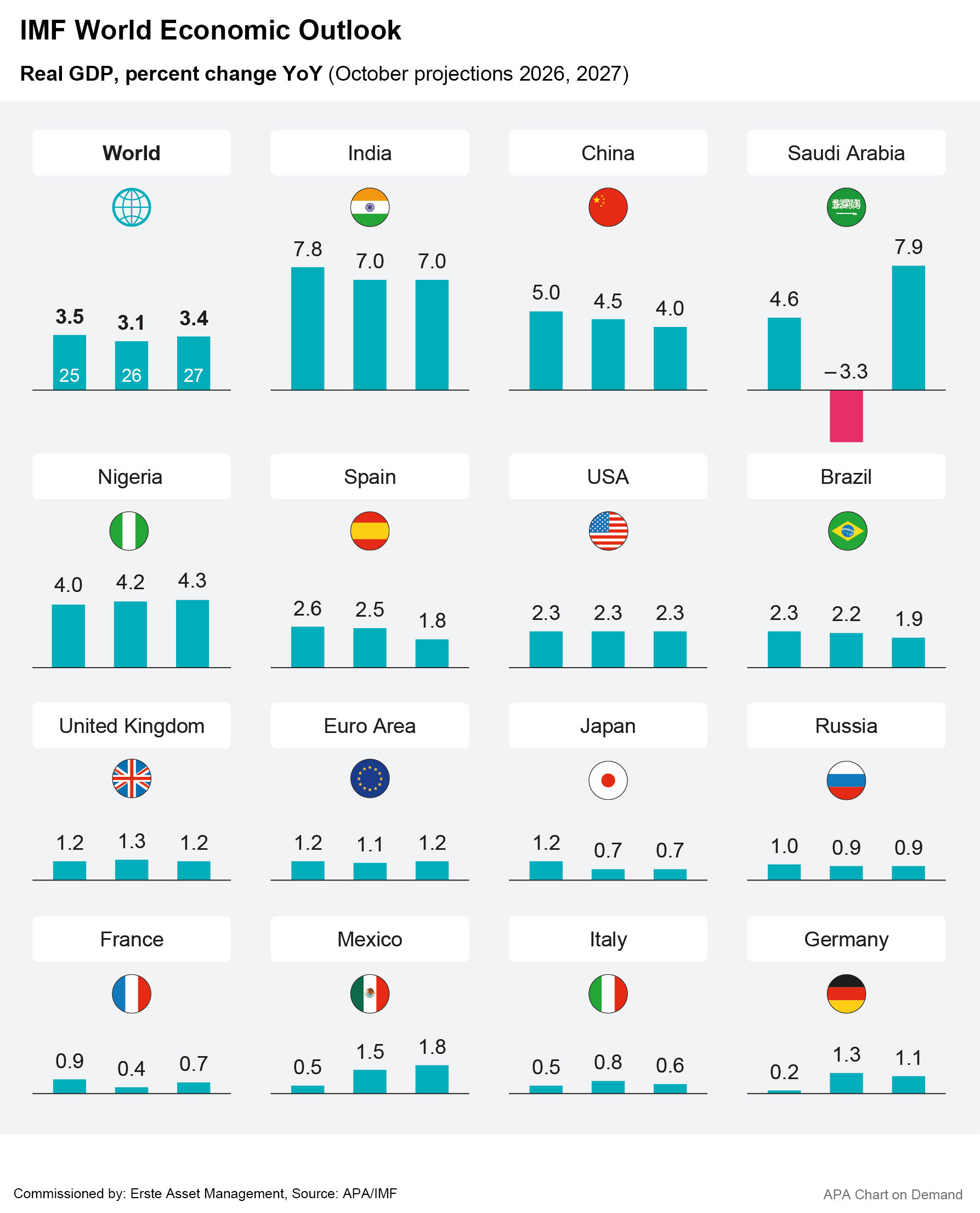
As of October 2026
Energy prices likely to remain high even if situation in Iran calms down
Energy prices and thus inflation are likely to remain high, the IMF expects. The Iran war started by the USA led to restrictions on oil and gas deliveries through the Strait of Hormuz this year. The IMF assumes that the situation in the important strait in the Persian Gulf will gradually improve in 2027. By October 2027, the shipping route should be largely usable again as it was before the war.
Nevertheless, uncertainty is likely to remain high, as are energy prices. Global inflation is thus expected to rise to 4.7% in 2026 (2025: 4.1%). In 2027, the IMF estimates it will fall back to 4.1%, but this is 0.2 percentage points higher than previously assumed.
Ireland and Spain grow particularly strongly compared to the EU average
In Europe, Ireland and Spain are likely to report particularly high growth rates. But the IMF also expects more from Germany—a plus of 1.3% in 2026, then 1.1% in 2027. This raised the estimate for 2026 by 0.6 points and for 2027 by 0.1 points. Leading research institutes and the German federal government had also recently significantly raised their forecasts.
Growth is driven primarily by debt-financed government investment, as well as exports. However, many companies are hesitant to invest in this country, and consumption is also weak. For Austria, the IMF forecasts a GDP increase of 0.06% for this year and 0.9% for 2027.
The IMF predicts growth of 2.3% each for 2026 and 2027 for the USA, supported by private consumption, high government spending, and technology investments. China will grow by 4.5% and 4.0%, a fraction lower than previously estimated.
India likely to overtake Japan to become fourth-largest economy
The IMF expects India to grow by 7.0% in both 2026 and 2027. This is 0.6 and 0.3 points more than previously assumed. According to the IMF, the country will overtake Japan economically next year and would then be the fourth-largest economy in the world. India was in a strong position at the start of the energy price crisis triggered by the Iran war, said IMF Asia Director Krishna Srinivasan at the presentation of the economic outlook in Bangkok. “Growth was strong, fiscal discipline was firmly established, the country had extensive reserves, and so on. Against this background, India responded well to the shock.”
Overall, 95% of global growth is supported by only 32 countries, compared to 54 countries in April. The Gulf states are being affected by the war in their immediate neighborhood. Saudi Arabia’s economy is expected to shrink by 3.3% this year. In July, growth of 1.7% was still expected. Deep recessions are also predicted for Iran, Iraq, Kuwait, Qatar, and the United Arab Emirates.
IMF: Urgency required for global debt reduction
During the presentation of the economic outlook, the International Monetary Fund called on wealthier countries to get their budgets in order. Chief Economist Tenreyro emphasized that the IMF remains concerned about high debt levels and urged countries to begin budget cuts to reduce deficits.
Spending cuts, a reduction of the sometimes very high deficits, and a lowering of debt levels are necessary, according to a new IMF report on global debt. A delay will only make the necessary adjustments more difficult in the coming years. IMF expert Rodrigo Valdes said the framework conditions have changed. In view of high inflation and rising yields on government bonds, urgency is required. The latter makes it more expensive for states to take on new debt on the capital market.
Valdes said the pressure is increasing. Average government debt is heading towards the 100% mark of economic output. This is the highest level since the Second World War and leaves countries with little room for maneuver. The fiscal situation is worse this year than expected six months ago and also worse than expected a year ago. However, the majority of states are planning higher spending instead.
USA must save more, China must consume more, and Europe must invest more
During the presentation of the World Economic Outlook, IMF chief Kristalina Georgieva explicitly called on the world’s two largest economies, the USA and China, to step up. The United States could not solve its debt problem—as is usually the case—only through more growth. To put debt on a more sustainable path, further adjustments are necessary, for example in tax revenue or spending. US Treasury Secretary Scott Bessent recognizes that US deficits and the total debt of over $40 trillion are too high, Georgieva told journalists. Growth helps, of course, but it is not enough.
According to the IMF, China must change its business model—away from excessive exports and towards stronger domestic consumption. European countries—such as France at the moment—are also among the worst sinners in terms of debt. Europe must above all invest more in its own competitiveness. “Put quite simply: China must spend more, the USA must save more, and Europe must invest more,” said Georgieva.
Investing Globally with an ETF
The ERSTE ETF GLOBAL EQUITIES UCITS ETF invests in companies from developed markets worldwide. It thus offers access to many stocks from different countries and sectors.
Note: Investing in the ERSTE ETF GLOBAL EQUITIES UCITS ETF involves opportunities and risks.
Risk information for ERSTE ETF GLOBAL EQUITIES UCITS ETF
The discretionary selection of assets permitted for the investment fund is limited. The fund follows a passive investment policy and the management company’s scope for discretion is restricted. The investment fund is a user within the meaning of Regulation (EU) 2016/1011 (Benchmarks Regulation). Please note that investing in securities involves risks in addition to the opportunities described.
Further details on the sustainable orientation of the Erste ETF Global Equities UCITS ETF as well as information in accordance with the Disclosure Regulation (Regulation (EU) 2019/2088) and Taxonomy Regulation (Regulation (EU) 2020/852) can be found in the current prospectus.
UCITS ETF’s units / shares purchased on the secondary market cannot usually be sold directly back to UCITS ETF. Investors must buy and sell units / shares on a secondary market with the assistance of an intermediary (e.g. a stockbroker) and may incur fees for doing so. In addition, investors may pay more than the current net asset value when buying units / shares and may receive less than the current net asset value when selling them.
The indicative net asset value is published via Deutsche Börse Xetra. Information on the composition of the ETF, as well as the latest net asset value and NAV history, can be found at https://etfplatformicav.fundsdata.carnegroup.com/fund/IE000GVBJMO6.
Authorized for distribution in Austria, Slovakia, Czech Republic, Hungary, Croatia, Romania
Portfolio transparency guidelines: Information on the portfolio transparency strategy and details of the portfolio’s composition are available at https://etfplatformicav.fundsdata.carnegroup.com.
Legal disclaimer
This document is an advertisement. Unless indicated otherwise, source: Erste Asset Management GmbH. The language of communication of the sales offices is German and the languages of communication of the Management Company also include English.
The prospectus for UCITS funds (including any amendments) is prepared and published in accordance with the provisions of the InvFG 2011 as amended. Information for Investors pursuant to § 21 AIFMG is prepared for the alternative investment funds (AIF) administered by Erste Asset Management GmbH pursuant to the provisions of the AIFMG in conjunction with the InvFG 2011.
The currently valid versions of the prospectus, the Information for Investors pursuant to § 21 AIFMG, and the key information document can be found on the website www.erste-am.com under “Mandatory publications” and can be obtained free of charge by interested investors at the offices of the Management Company and at the offices of the depositary bank. The exact date of the most recent publication of the prospectus, the languages in which the fund prospectus or the Information for Investors pursuant to Art 21 AIFMG and the key information document are available, and any other locations where the documents can be obtained are indicated on the website www.erste-am.com. A summary of the investor rights is available in German and English on the website www.erste-am.com/investor-rights and can also be obtained from the Management Company.
The Management Company can decide to suspend the provisions it has taken for the sale of unit certificates in other countries in accordance with the regulatory requirements.
Note: You are about to purchase a product that may be difficult to understand. We recommend that you read the indicated fund documents before making an investment decision. In addition to the locations listed above, you can obtain these documents free of charge at the offices of the referring Sparkassen bank and the offices of Erste Bank der oesterreichischen Sparkassen AG. You can also access these documents electronically at www.erste-am.com.
Our analyses and conclusions are general in nature and do not take into account the individual characteristics of our investors in terms of earnings, taxation, experience and knowledge, investment objective, financial position, capacity for loss, and risk tolerance. Past performance is not a reliable indicator of the future performance of a fund.
Please note: Investments in securities entail risks in addition to the opportunities presented here. The value of units and their earnings can rise and fall. Changes in exchange rates can also have a positive or negative effect on the value of an investment. For this reason, you may receive less than your originally invested amount when you redeem your units. Persons who are interested in purchasing units in investment funds are advised to read the current fund prospectus(es) and the Information for Investors pursuant to § 21 AIFMG, especially the risk notices they contain, before making an investment decision. If the fund currency is different than the investor’s home currency, changes in the relevant exchange rate can positively or negatively influence the value of the investment and the amount of the costs associated with the fund in the home currency.
We are not permitted to directly or indirectly offer, sell, transfer, or deliver this financial product to natural or legal persons whose place of residence or domicile is located in a country where this is legally prohibited. In this case, we may not provide any product information, either.
Please consult the corresponding information in the fund prospectus and the Information for Investors pursuant to § 21 AIFMG for restrictions on the sale of the fund to American or Russian citizens.
It is expressly noted that this communication does not provide any investment recommendations, but only expresses our current market assessment. Thus, this communication is not a substitute for investment advice.
This document does not represent a sales activity of the Management Company and therefore may not be construed as an offer for the purchase or sale of financial or investment instruments.
Erste Asset Management GmbH is affiliated with the Erste Bank and austrian Sparkassen banks.
Please also read the “Information about us and our securities services” published by your bank.