

France faces significant fiscal and political challenges. High public debt and rising interest costs are increasing pressure for reform, while political maneuvering room appears limited. Nevertheless, given France’s economic size and importance to the EU and the eurozone, a scenario involving serious payment problems seems extremely unlikely. For investors, the key question remains whether and when French policymakers will succeed in implementing credible reforms. The higher yields therefore imply greater risks – but can also open up opportunities for those with the appropriate risk appetite.
France Takes Center Stage in the Capital Markets
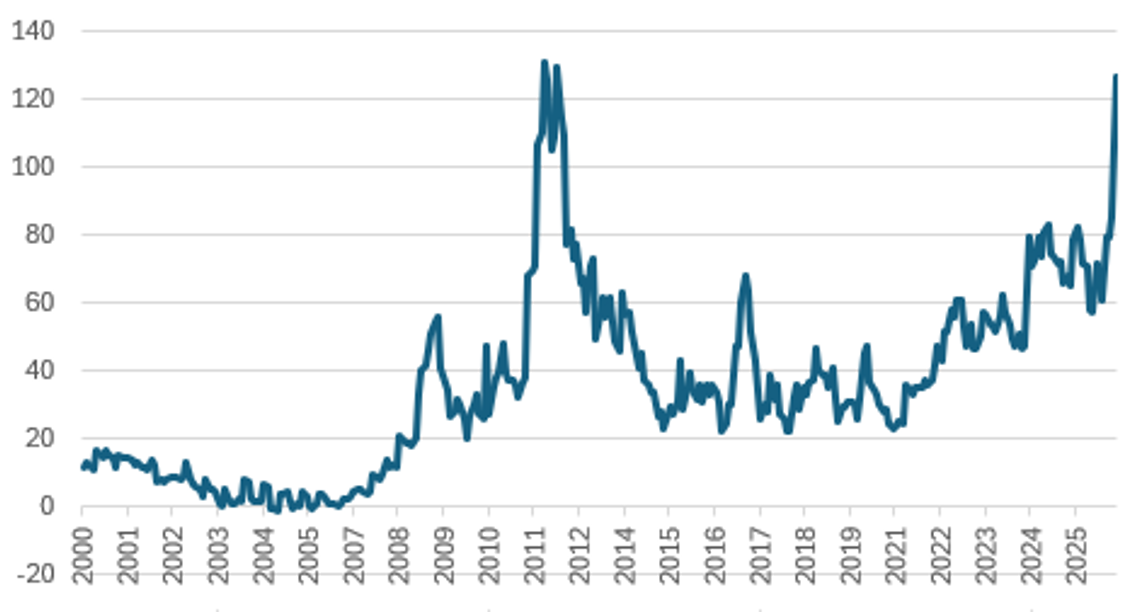
In recent weeks, the focus on European capital markets has been almost exclusively on one country: France. The yield on the 10-year government bond rose to nearly 5%, its highest level since 2002. The yield spread relative to the eurozone benchmark – the German government bond – also widened to 1.5%. A comparable figure was last seen during the 2012 euro crisis.
Note: Investments in securities involve both opportunities and risks. Past performance is not a reliable indicator of future performance.
10-Year Yield on French Government Bonds between October 2000 and October 2026
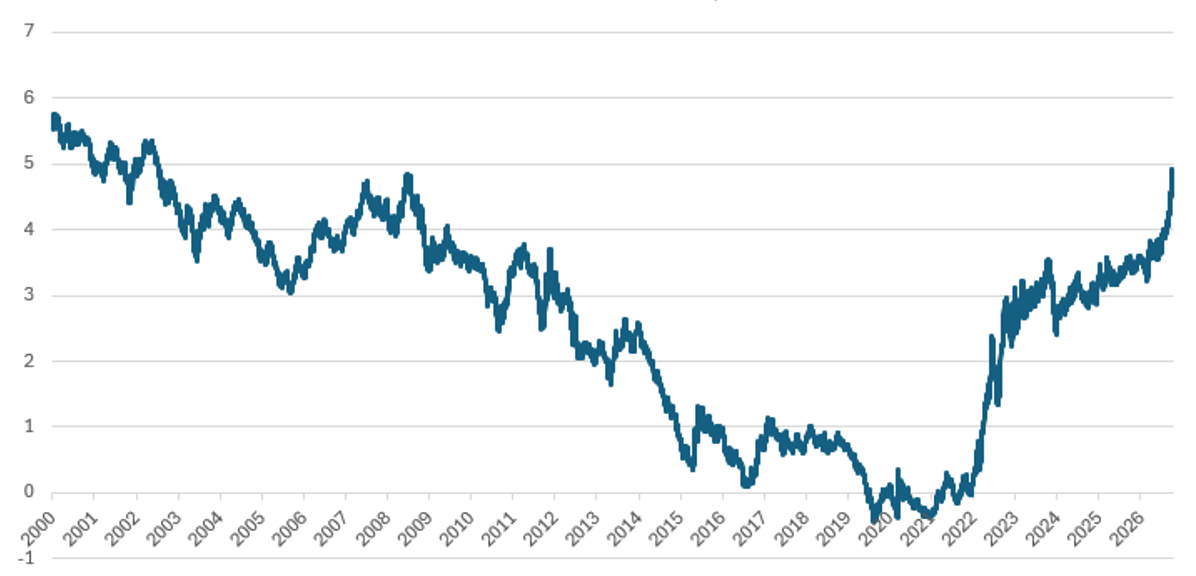
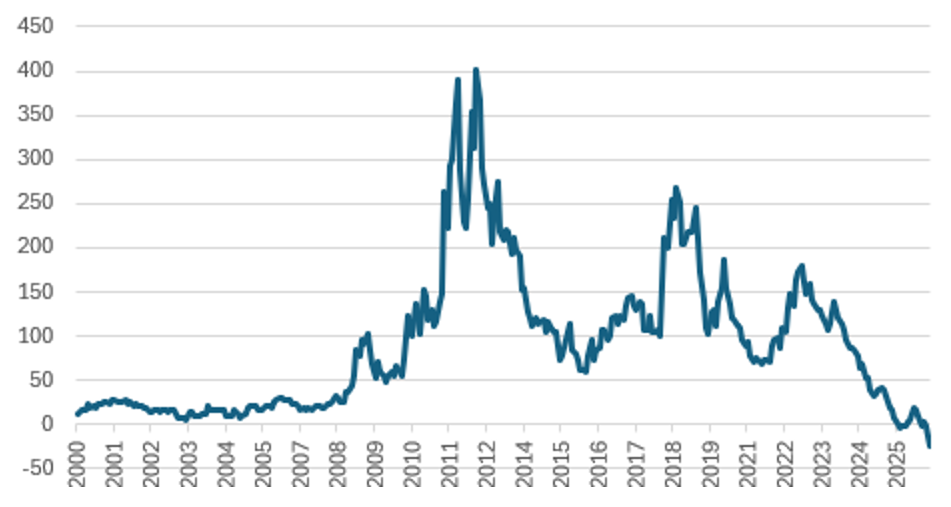
Market jitters were so intense that the bond yield of the “Grande Nation” rose significantly even relative to the eurozone’s former “problem child”: Most recently, the Italian government had to pay investors about 0.4 percentage points less on 10-year bonds than France – even though Italy has significantly weaker credit ratings. Incidentally, at the end of 2023, French bonds still had a yield about 1 percentage point lower than Italian government bonds.
Note: Past performance is not a reliable indicator of future results.
Yield spread between 10-year French government bonds and 10-year German government bonds
Yield spread between 10-year French government bonds and 10-year Italian government bonds
The reasons for this alarming trend can be found on several levels
1. Tight budget situation
The main trigger is France’s persistently strained budget situation. The government under Prime Minister Lecornu aimed to reduce the budget deficit to 5% this year through a combination of spending cuts – including smaller increases in pensions and civil servant salaries – and tax hikes. However, this target is likely to be missed. Instead, a deficit of 5.4% is projected. The 5% mark is now expected to be reached next year.
France has recorded budget deficits for more than 45 years, in %
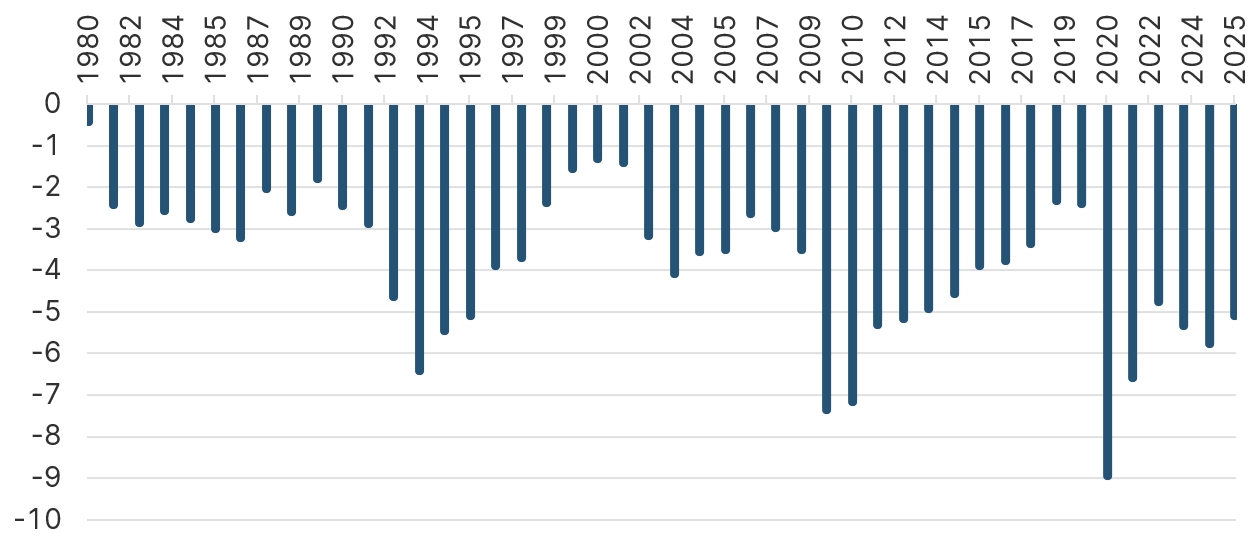
This continues a trend that has characterized France for decades. The last balanced budget, in 1974, now seems like a distant, fading mirage. Over the past 20 years, the French deficit has consistently exceeded the eurozone average; the 3% Maastricht criterion has also been met only rarely since its introduction.
As a result, French public debt now stands at around 120% of GDP – a record high and well above the eurozone average of around 90%.
The situation is further exacerbated by rising yields on French government bonds. These will significantly increase the government’s interest payments in the coming years. Next year, approximately 3% of French GDP is expected to be spent on interest payments. This threatens to create a downward spiral of high debt and rising financing costs.
2. Lack of Consensus on Reforms
At 44%, France’s tax-to-GDP ratio is among the highest in the OECD, where the average stands at 34%. Achieving budget consolidation through additional revenue therefore appears difficult. At the same time, the pension system is likely France’s biggest “area in need of reform”: The retirement age is low at 63, while pensions are comparatively high. The pension system already accounts for about 25% of government spending.
The problem is widely recognized. Nevertheless, reform attempts in recent years have repeatedly failed due to “public opposition”. A sustainable overhaul of the pension system still appears politically difficult to implement.
3. Political Gridlock
Ever since President Macron called for early elections in 2024 – without any immediate necessity – minority governments and changes at the top of the government after just a few months have become almost a regular part of France’s political landscape.
At the same time, next year’s presidential election – with the first round on April 18 and the runoff on May 2 – is already casting its shadow. Currently, the leading candidates from the left- and right-wing populist spectrums, Jean-Luc Mélenchon and Marine Le Pen, are considered to have a strong chance of advancing to the runoff.
In doing so, they are advocating positions that are, in some cases, high-profile but economically questionable. While Marine Le Pen advocates reducing the national debt to 60% – including corresponding spending cuts – she simultaneously proposes lowering the retirement age from 63 to 60.
Jean-Luc Mélenchon, for his part, caused a stir with the “idea” of simply declaring those French government bonds held by the Bank of France null and void. This hardly helped to win the trust of investors.
This complex situation has further escalated in recent weeks – exacerbated by the public “school protests” – and has led to the current situation.
What might happen next?
First, it should be noted that it seems entirely out of the question that France could even come close to facing serious payment problems or insolvency.
Doomsday scenarios have already proven to be exaggerated during the Greek crisis and would be even less plausible in the case of France. The EU’s second-largest economy is of considerable economic and political importance to the European project and would receive appropriate support in the event of an absolute crisis scenario.
The classic phrases “too big to fail” and Mario Draghi’s “whatever it takes” practically come to mind in this context.
Could the ECB intervene?
In the event of further market turmoil – that is, a significant widening of the yield spread relative to Germany or even higher yields on French government bonds – intervention by the European Central Bank would ultimately be conceivable. Using the so-called “Transmission Protection Instrument” (TPI), the ECB could purchase a member state’s bonds on the secondary market to combat “unjustified yield spreads.”
Among experts, however, the hurdles to using the TPI are considered high. Therefore, such an intervention is not expected in the short term. By way of comparison: In 2022, the yield spread on Italian government bonds relative to Germany stood at 2.5%, without the ECB feeling compelled to intervene.
Broader measures, which the ECB could in principle also implement – such as ending quantitative tightening – would be more relevant in the event that several member states were to experience “contagion”. That, too, is not currently foreseeable.
Will the capital markets force reforms?
A more realistic scenario appears to be one in which the capital markets implicitly demand reforms in France. For if yields continue to rise, financing the national budget would become increasingly difficult.
At the latest when such a “Liz Truss moment” occurs – and that still seems a long way off – we could likely expect greater cooperation among moderate forces within French politics. Pressure from the capital markets could then help push policymakers to finally commit to reforms.
Risk or Opportunity for Investors?
Are the high returns a risk or an opportunity? The answer depends in particular on one’s individual attitude toward volatility – and on the assessment of when, or even if, France will recognize the gravity of the situation.
However, the size and overall robustness of the French economy – along with its systemic importance within the EU and the eurozone – should not be overlooked in this assessment.
Investors who view the high spreads as an entry opportunity are, in a sense, acting in accordance with the French proverb:
“La vie comme elle vient” – “Life as it comes.”
Legal disclaimer
This document is an advertisement. Unless indicated otherwise, source: Erste Asset Management GmbH. The language of communication of the sales offices is German and the languages of communication of the Management Company also include English.
The prospectus for UCITS funds (including any amendments) is prepared and published in accordance with the provisions of the InvFG 2011 as amended. Information for Investors pursuant to § 21 AIFMG is prepared for the alternative investment funds (AIF) administered by Erste Asset Management GmbH pursuant to the provisions of the AIFMG in conjunction with the InvFG 2011.
The currently valid versions of the prospectus, the Information for Investors pursuant to § 21 AIFMG, and the key information document can be found on the website www.erste-am.com under “Mandatory publications” and can be obtained free of charge by interested investors at the offices of the Management Company and at the offices of the depositary bank. The exact date of the most recent publication of the prospectus, the languages in which the fund prospectus or the Information for Investors pursuant to Art 21 AIFMG and the key information document are available, and any other locations where the documents can be obtained are indicated on the website www.erste-am.com. A summary of the investor rights is available in German and English on the website www.erste-am.com/investor-rights and can also be obtained from the Management Company.
The Management Company can decide to suspend the provisions it has taken for the sale of unit certificates in other countries in accordance with the regulatory requirements.
Note: You are about to purchase a product that may be difficult to understand. We recommend that you read the indicated fund documents before making an investment decision. In addition to the locations listed above, you can obtain these documents free of charge at the offices of the referring Sparkassen bank and the offices of Erste Bank der oesterreichischen Sparkassen AG. You can also access these documents electronically at www.erste-am.com.
Our analyses and conclusions are general in nature and do not take into account the individual characteristics of our investors in terms of earnings, taxation, experience and knowledge, investment objective, financial position, capacity for loss, and risk tolerance. Past performance is not a reliable indicator of the future performance of a fund.
Please note: Investments in securities entail risks in addition to the opportunities presented here. The value of units and their earnings can rise and fall. Changes in exchange rates can also have a positive or negative effect on the value of an investment. For this reason, you may receive less than your originally invested amount when you redeem your units. Persons who are interested in purchasing units in investment funds are advised to read the current fund prospectus(es) and the Information for Investors pursuant to § 21 AIFMG, especially the risk notices they contain, before making an investment decision. If the fund currency is different than the investor’s home currency, changes in the relevant exchange rate can positively or negatively influence the value of the investment and the amount of the costs associated with the fund in the home currency.
We are not permitted to directly or indirectly offer, sell, transfer, or deliver this financial product to natural or legal persons whose place of residence or domicile is located in a country where this is legally prohibited. In this case, we may not provide any product information, either.
Please consult the corresponding information in the fund prospectus and the Information for Investors pursuant to § 21 AIFMG for restrictions on the sale of the fund to American or Russian citizens.
It is expressly noted that this communication does not provide any investment recommendations, but only expresses our current market assessment. Thus, this communication is not a substitute for investment advice.
This document does not represent a sales activity of the Management Company and therefore may not be construed as an offer for the purchase or sale of financial or investment instruments.
Erste Asset Management GmbH is affiliated with the Erste Bank and austrian Sparkassen banks.
Please also read the “Information about us and our securities services” published by your bank.
More on the topic

Why is the tech stocks rally continuing?
The boom in artificial intelligence, cloud technologies and digital infrastructure has made technology shares some of the biggest winners on the stock markets in recent years. Following the sharp rises in share prices, attention is now increasingly turning to the question of where further potential lies, how to invest, and which risks investors should keep an eye on. These are the questions we aim to answer in this blog.

Investment View | February 2025
What’s happening on the markets? In our Investment View, the experts of our Investment Division regularly provide insights of current market events and their opinion on the various asset classes.