

The European bond market is currently undergoing a remarkable development: US companies are raising capital on a large scale in euros, British pounds, and Swiss francs. The focus is particularly on US hyperscalers, which, since last year, have been issuing bonds denominated in currencies other than their own to finance their extensive investments, for example in data centres and artificial intelligence.
Such foreign-currency bonds issued by American issuers are known in technical jargon as reverse Yankees or reverse Yankee bonds. This term refers to bonds issued by US companies not in US dollars but, for example, in euros. The term is the counterpart to the classic Yankee bond: here, unlike the case where a non-US company raises capital on the US bond market, a US company raises funds outside its home market through a reverse Yankee.
While this market segment is not new, the issue volume, the structure of issuers, and its strategic importance have grown in significance in recent years. In this article, we analyse how the market for reverse Yankees has developed in comparison with the broader euro investment-grade corporate bond market (EUR-IG market), and what significance recent developments hold from the perspective of issuers and investors.
Reverse Yankee bonds are gaining market share
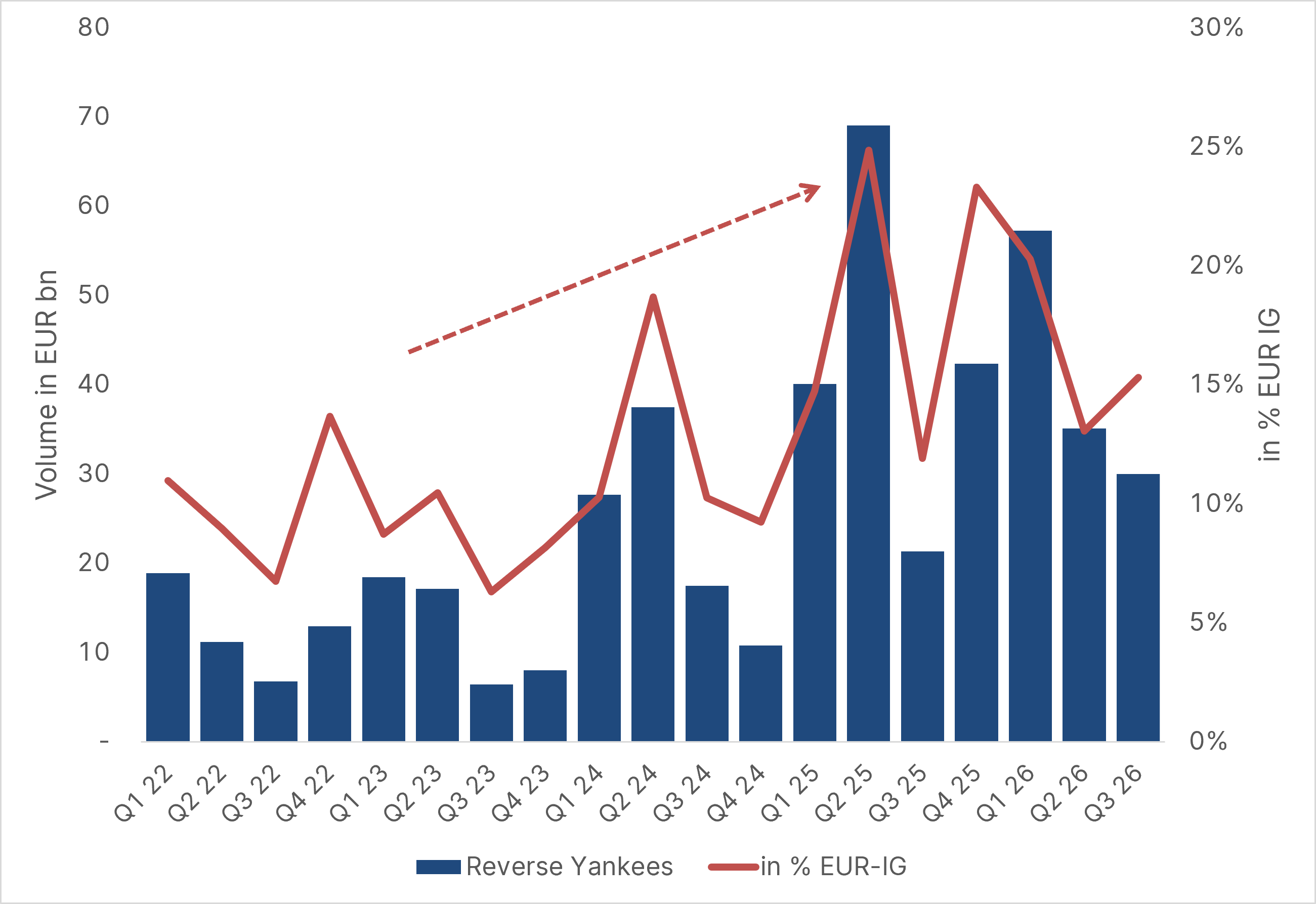
According to the latest surveys, the issue volume of reverse Yankees in the EUR-IG market amounted to EUR 122bn in the first three quarters of 2026. In the third quarter alone – which typically experiences lower issue volumes for reasons of seasonality – bonds totalling about EUR 30bn were issued.
However, the trend in market share is more telling than the absolute issue volume. Measured against the total volume of new issues in the EUR-IG market, reverse Yankees have accounted for 16.4% in the year to date. This continues the strong trend seen in the previous year, when the share stood at 19.0%. In 2024 and 2023, the figures had been significantly lower at 12.3% and 8.7%, respectively.
According to the latest surveys, the issue volume of reverse Yankees in the EUR-IG market amounted to EUR 122bn in the first three quarters of 2026. In the third quarter alone – which typically experiences lower issue volumes for reasons of seasonality – bonds totalling about EUR 30bn were issued.
However, the trend in market share is more telling than the absolute issue volume. Measured against the total volume of new issues in the EUR-IG market, reverse Yankees have accounted for 16.4% in the year to date. This continues the strong trend seen in the previous year, when the share stood at 19.0%. In 2024 and 2023, the figures had been significantly lower at 12.3% and 8.7%, respectively.
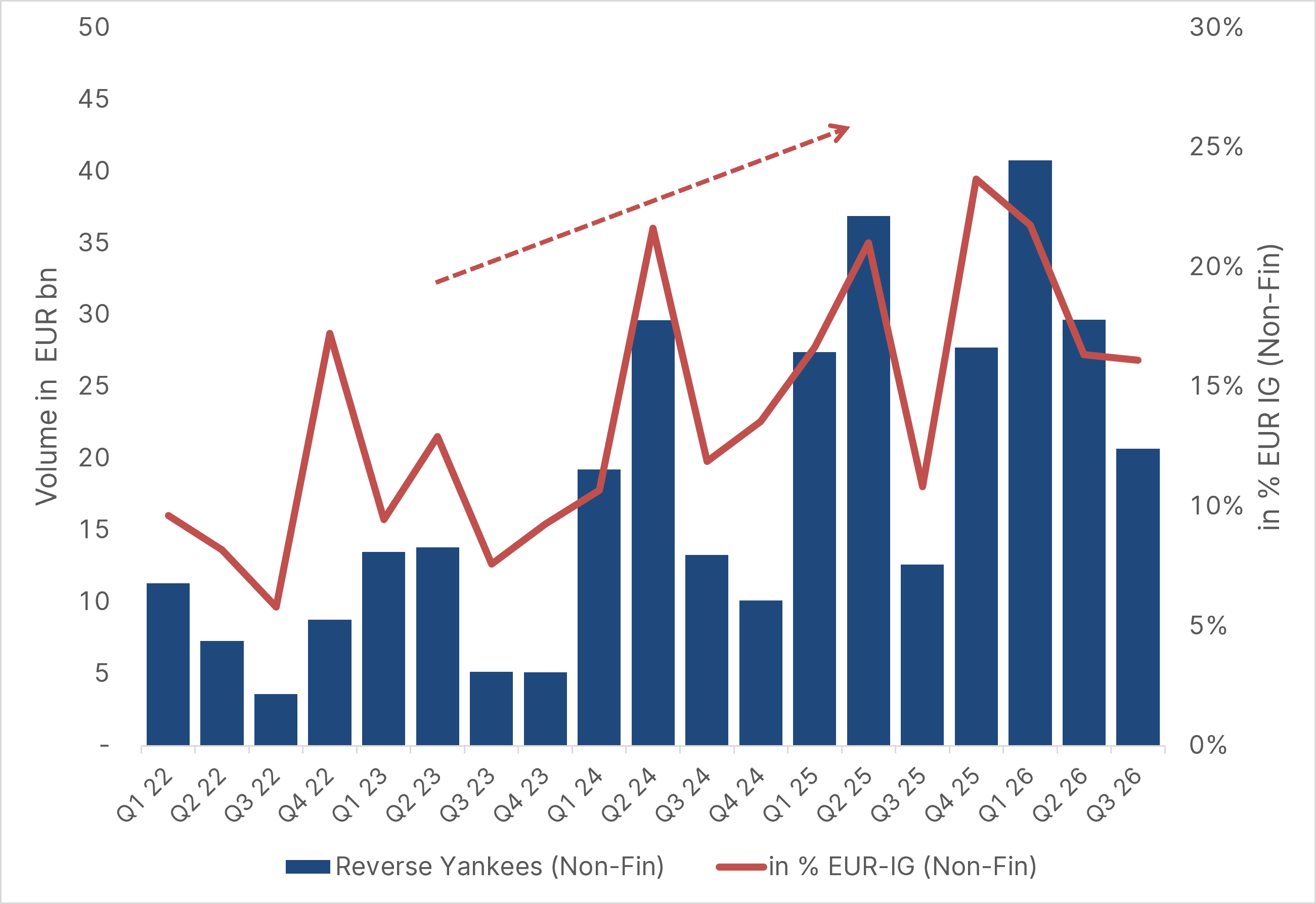
Issue volume of reverse Yankee bonds (left scale: overall market; right scale: non-financials)
Source: Bloomberg, data as of 30 September 2026; own illustration
Hyperscalers are driving the trend, but they are not alone
This trend is particularly pronounced when it comes to non-financial companies, i.e. excluding banks and insurance companies. In the year to date, a total of about EUR 91bn worth of reverse Yankees has been issued. This represents 18.3% of the total volume of new issues on the EUR-IG market for non-financial companies.
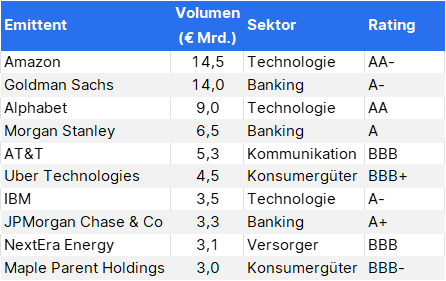
Here, too, the trend of previous years is confirmed: while the share reached as much as 18.2% in the previous year, it stood at 14.4% in 2024 and at just 10.1% in 2023. US hyperscalers have recently made a significant contribution, issuing reverse Yankees bonds in the total amount of EUR 23.5bn this year. Of this, EUR 9bn came from Google and EUR 14.5bn from Amazon. However, the data shows that this trend is not solely attributable to the hyperscalers’ high financing requirements. Issuers from other sectors are also increasingly using the European capital market as a source of funding. In the banking sector, issuers over the course of the year have included Goldman Sachs, Morgan Stanley, and JPMorgan. In addition, well-known companies from the communications, utilities, and consumer goods sectors, such as AT&T, NextEra Energy, and Uber, also resorted to the European bond market.
Note: The companies mentioned in this post were selected as examples and do not constitute investment advice.
Largest reverse Yankee issuers in the EUR-IG market 2026
(Top 10)
Source: Bloomberg, data as of 30 September 2026; own illustration
Why US companies issue reverse Yankee bonds
There are many reasons for issuing debt on the European bond market. One obvious reason is potential financing advantages. In addition to the general level of interest rates – which is currently higher in the USA than in Europe – credit spreads, i.e. the risk premiums demanded by investors, play a particularly decisive role in determining a company’s actual financing costs.
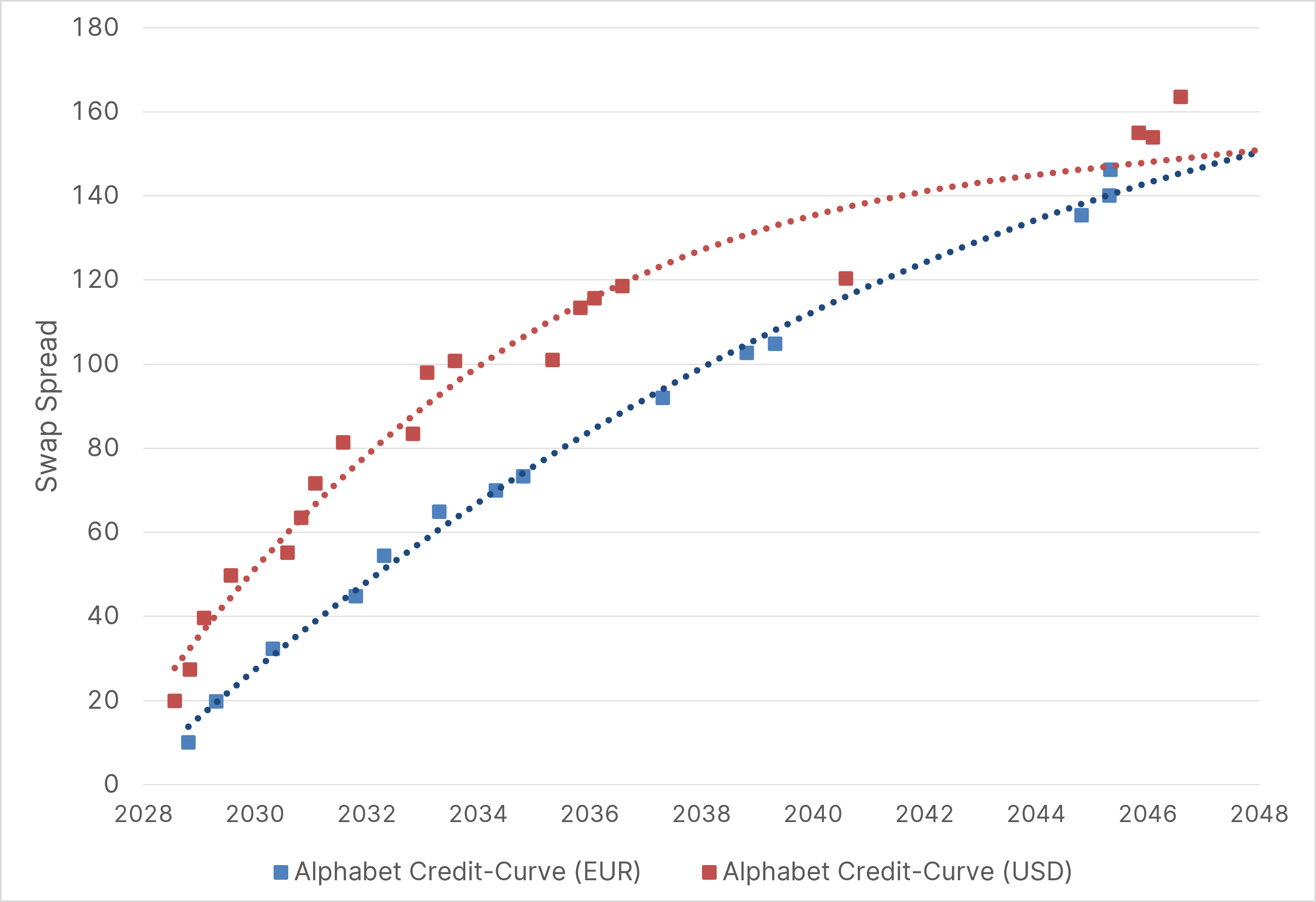
Taking Alphabet as an example, it is clear that the company’s euro-denominated bonds (blue line) command lower credit spreads than corresponding US dollar-denominated bonds (red line) across much of the maturity structure. At first glance, this suggests more favourable financing terms. Whether this results in a financing advantage ultimately depends on the maturity, the rating, investor demand, the interest rate environment, and the costs of any currency hedging via cross-currency swaps.
Through a EUR/USD cross-currency swap, issuers can exchange the proceeds from a euro-denominated bond for US dollars and, in economic terms, convert the euro liability into a US dollar liability. The so-called cross-currency basis reflects the cost of this currency conversion. A negative basis means that demand for US dollar funding is higher than that for euro funding, making it more expensive to raise dollars via the swap market. The EUR/USD basis has recovered significantly in recent years and is now trading just below the zero line. As a result, the cost of currency hedging is now considerably lower than it was a few years ago, which increases the attractiveness of euro-denominated issues for issuers.
Alphabet’s credit spread curves in EUR and USD
EUR-USD cross-currency basis
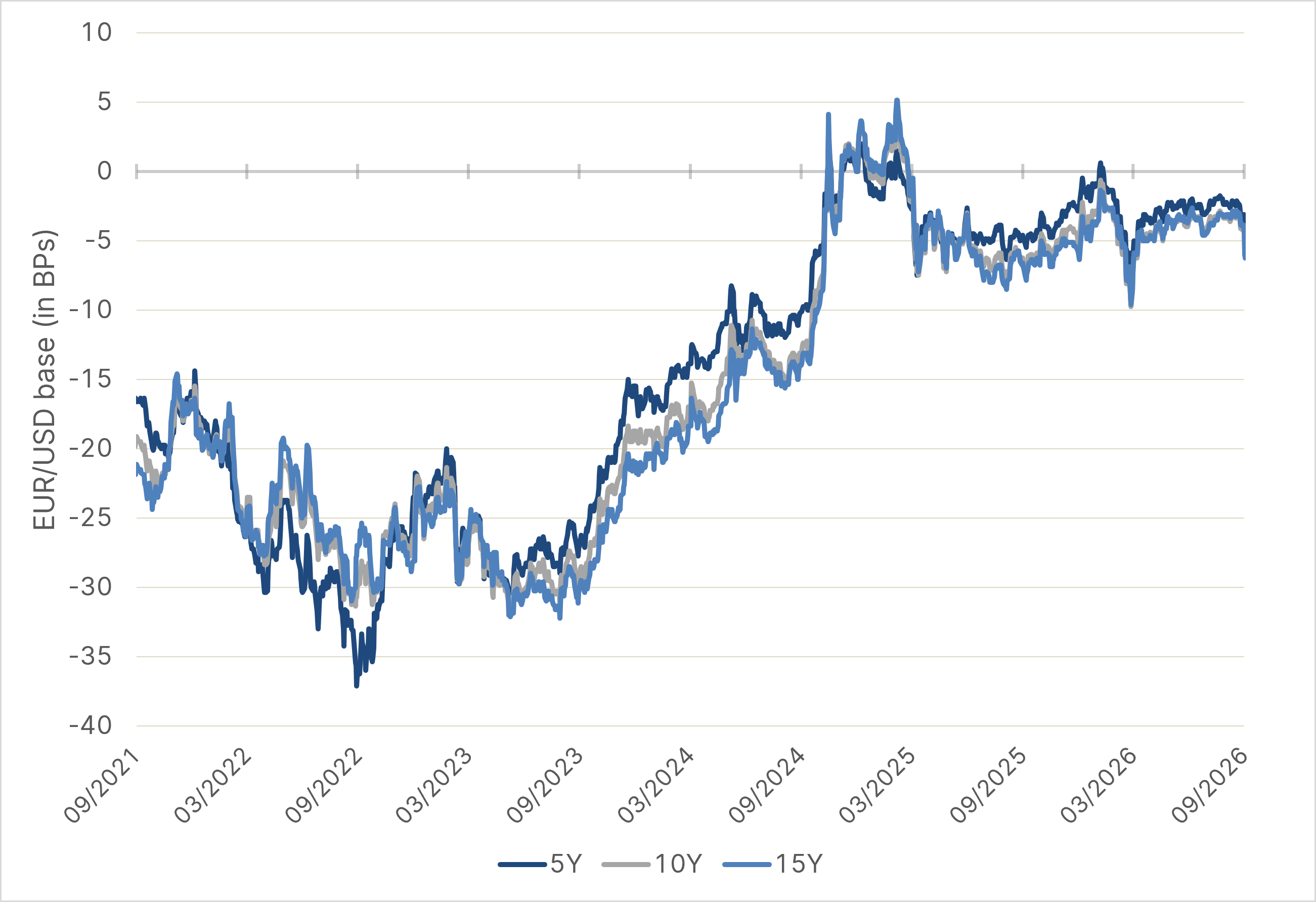
Source: Bloomberg, data as of 15 October 2026; own illustration
Currency and cash flow matching is another reason. For companies with sales in Europe, financing in euros can be attractive if the funds raised are also used within the Eurozone. In this case, interest and principal repayments can be met directly from euro cash flows. The natural alignment of liabilities and cash flows reduces currency risk and makes financing easier to plan.
A third reason is the diversification of funding sources. Companies with high capital requirements often do not wish to rely exclusively on the US dollar market for their funding. By issuing in euros, they can broaden their investor base and strengthen their presence on the European capital market. That said, financing in euros is not necessarily cheaper than a comparable issue in US dollars. Market receptiveness and reliable, repeatable access to capital can be just as crucial.
This is currently particularly evident among US hyperscalers, which are investing billions in AI infrastructure. Given the sharp rise in capital requirements, international capital markets are becoming increasingly important as a source of funding. Reverse Yankees not only give these companies access to an additional investor base but also allow them to link European liabilities to European cash flows. The high issue volume in recent quarters underlines that, for many US companies, the European bond market has long been more than just an opportunistic financing alternative.
Currency and cash flow matching is another reason. For companies with sales in Europe, financing in euros can be attractive if the funds raised are also used within the Eurozone. In this case, interest and principal repayments can be met directly from euro cash flows. The natural alignment of liabilities and cash flows reduces currency risk and makes financing easier to plan.
A third reason is the diversification of funding sources. Companies with high capital requirements often do not wish to rely exclusively on the US dollar market for their funding. By issuing in euros, they can broaden their investor base and strengthen their presence on the European capital market. That said, financing in euros is not necessarily cheaper than a comparable issue in US dollars. Market receptiveness and reliable, repeatable access to capital can be just as crucial.
This is currently particularly evident among US hyperscalers, which are investing billions in AI infrastructure. Given the sharp rise in capital requirements, international capital markets are becoming increasingly important as a source of funding. Reverse Yankees not only give these companies access to an additional investor base but also allow them to link European liabilities to European cash flows. The high issue volume in recent quarters underlines that, for many US companies, the European bond market has long been more than just an opportunistic financing alternative.
What does this mean for European issuers…
For European issuers, this development presents both opportunities and challenges. On the one hand, international borrowers enhance the depth, liquidity, and global significance of the European corporate bond market. On the other hand, every new issue competes for available investor capital. Large-volume transactions by established US companies can divert attention away from smaller European issuers. Also, new reverse Yankees create additional benchmarks for existing bonds. If new issues are offered with attractive spreads or new issue premiums, this can lead to valuation adjustments for comparable European bonds.
However, no widespread crowding-out effect has been observed to date. Despite the high issue volume of reverse Yankee bonds, order books for European issuers have remained well-filled recently. Even smaller or unrated companies have been able to successfully place bonds. The stable demand suggests that the European bond market has so far been able to absorb the growing supply effectively.
…and for investors?
For investors, the investment universe is expanding to include issuers, sectors, and credit profiles that have traditionally been less well represented in the European market. This applies in particular to technology companies with good ratings, as can currently be seen quite clearly: as the technology sector is significantly under-represented in European corporate bond indices, issues from major hyperscalers can contribute to better sector diversification within a portfolio. Also, reverse Yankees facilitate investment in US companies without having to directly assume the exchange rate and interest rate risk associated with a dollar-denominated bond.
That being said, this trend also brings new challenges. As hyperscalers issue more bonds, they are gaining weight both in market indices and, potentially, in investors’ portfolios. As a result, the performance of the US economy and the success of extensive AI investments may exert a greater influence on corporate bond investors. It should also be noted that an issuer’s profile and the attractiveness of a bond are not the same thing. For investors, valuation, maturity, capital structure, leverage ratio, and the relationship between the offered spread and the actual credit risk remain crucial analytical criteria.
Conclusion
Reverse Yankees have evolved from an occasionally used financing instrument into an integral part of the European corporate bond market and are likely to continue to shape it in the future. For many US companies, euro-denominated issues have long since ceased to be merely an opportunistic alternative and have instead become a strategic component of their international financing. They enhance the market’s internationalisation, liquidity, and diversity, while at the same time intensifying competition for investor capital and strengthening the prominence of major US issuers within the European investment universe.
For issuers, the economic attractiveness remains a question of total costs, including any hedging costs. For investors, the wider choice offers additional opportunities but does not replace the careful analysis of credit quality and the valuation of individual bonds, which forms the basis of the investment process in our fixed income management.
Note: Investments in securities entail risks in addition to the opportunities described.
Legal disclaimer
This document is an advertisement. Unless indicated otherwise, source: Erste Asset Management GmbH. The language of communication of the sales offices is German and the languages of communication of the Management Company also include English.
The prospectus for UCITS funds (including any amendments) is prepared and published in accordance with the provisions of the InvFG 2011 as amended. Information for Investors pursuant to § 21 AIFMG is prepared for the alternative investment funds (AIF) administered by Erste Asset Management GmbH pursuant to the provisions of the AIFMG in conjunction with the InvFG 2011.
The currently valid versions of the prospectus, the Information for Investors pursuant to § 21 AIFMG, and the key information document can be found on the website www.erste-am.com under “Mandatory publications” and can be obtained free of charge by interested investors at the offices of the Management Company and at the offices of the depositary bank. The exact date of the most recent publication of the prospectus, the languages in which the fund prospectus or the Information for Investors pursuant to Art 21 AIFMG and the key information document are available, and any other locations where the documents can be obtained are indicated on the website www.erste-am.com. A summary of the investor rights is available in German and English on the website www.erste-am.com/investor-rights and can also be obtained from the Management Company.
The Management Company can decide to suspend the provisions it has taken for the sale of unit certificates in other countries in accordance with the regulatory requirements.
Note: You are about to purchase a product that may be difficult to understand. We recommend that you read the indicated fund documents before making an investment decision. In addition to the locations listed above, you can obtain these documents free of charge at the offices of the referring Sparkassen bank and the offices of Erste Bank der oesterreichischen Sparkassen AG. You can also access these documents electronically at www.erste-am.com.
Our analyses and conclusions are general in nature and do not take into account the individual characteristics of our investors in terms of earnings, taxation, experience and knowledge, investment objective, financial position, capacity for loss, and risk tolerance. Past performance is not a reliable indicator of the future performance of a fund.
Please note: Investments in securities entail risks in addition to the opportunities presented here. The value of units and their earnings can rise and fall. Changes in exchange rates can also have a positive or negative effect on the value of an investment. For this reason, you may receive less than your originally invested amount when you redeem your units. Persons who are interested in purchasing units in investment funds are advised to read the current fund prospectus(es) and the Information for Investors pursuant to § 21 AIFMG, especially the risk notices they contain, before making an investment decision. If the fund currency is different than the investor’s home currency, changes in the relevant exchange rate can positively or negatively influence the value of the investment and the amount of the costs associated with the fund in the home currency.
We are not permitted to directly or indirectly offer, sell, transfer, or deliver this financial product to natural or legal persons whose place of residence or domicile is located in a country where this is legally prohibited. In this case, we may not provide any product information, either.
Please consult the corresponding information in the fund prospectus and the Information for Investors pursuant to § 21 AIFMG for restrictions on the sale of the fund to American or Russian citizens.
It is expressly noted that this communication does not provide any investment recommendations, but only expresses our current market assessment. Thus, this communication is not a substitute for investment advice.
This document does not represent a sales activity of the Management Company and therefore may not be construed as an offer for the purchase or sale of financial or investment instruments.
Erste Asset Management GmbH is affiliated with the Erste Bank and austrian Sparkassen banks.
Please also read the “Information about us and our securities services” published by your bank.
More on the topic

Winds of Change? The 2026 Midterms
The midterm elections could alter the political balance of power in Washington. But what are the implications for the US economy, national debt, and financial markets? Todays blog post provides the answers.

Turkish financial markets temporarily under pressure following political turbulence
The Turkish stock market has been turbulent recently: the arrest of Istanbul mayor Ekrem Imamoglu caused massive uncertainty. What does the political unrest mean for the Turkish economy and the Istanbul stock exchange?