

Infrastructure is the invisible backbone of our modern world. In the past, energy producers, utility companies, transport routes, power lines, ports, social infrastructure such as hospitals, and other public infrastructure facilities were predominantly funded by the state. For many years now, however, an increasing number of countries have been facing rising public debt and the associated growing interest burden, as well as demographic challenges. Furthermore, the fight against climate change and the acceleration of the digital transformation mean that existing infrastructure is overburdened or outdated in many places.
In its Global Infrastructure Outlook, the World Bank forecasts a global cumulative infrastructure investment shortfall of a staggering 11 trillion dollars between 2025 and 2040 (source: Global Infrastructure Outlook by GIHub, part of the World Bank Group, as of April 2026). Consequently, private investors are increasingly providing capital for urgently needed investments, which has led to private infrastructure emerging as an asset class over recent years.
Note: Please note that investing in private markets involves risks as well as opportunities.
The foundation of a functioning economy
Private infrastructure is characterised by long-lived assets, high barriers to market entry, and stable and often inflation-protected cash flows, and is broadly divided into the following sectors:
- Transport and logistics: roads, bridges, railways, ports, airports
- Energy and electricity: power grids, storage, renewable energy, charging infrastructure
- Digital infrastructure: Data centres, mobile phone masts, fibre-optic cables
- Social infrastructure: Hospitals, schools, care homes
- Water and waste: Water treatment, supply networks, waste management
The future requires significant investment

USD 94 trillion
Global demand for infrastructure investment by 2040

…of which USD 28 trillion
for investment in energy utilities and renewable energy

…of which USD 49.9 trillion
for investment in airports, roads, bridges, ports and rail networks

…of which USD 8.9 trillion
for investment in telecommunications and digital infrastructure

…of which USD 6.4 trillion
for investment in global water supply and treatment
What are the characteristics of private infrastructure?
For investors seeking to build a resilient, long-term portfolio, private infrastructure can be a sensible addition to a diversified portfolio.
Low correlation with the broader economy
Infrastructure assets provide essential services that are in demand regardless of the global economic climate. People and businesses rely on transport infrastructure functioning, electricity flowing, water being treated and the digital world (the internet and related services) being accessible every single day. As a result, there is a low correlation between returns and those of other asset classes such as equities or bonds. Adding private infrastructure to a portfolio can therefore help reduce the volatility of a diversified portfolio.
Note: Investments in securities involve both opportunities and risks.
Resilient and long-term focus
The economic success of infrastructure projects is based on co-ownership of real, tangible assets and long-term contracts that generate predictable revenue. Investments in the infrastructure sector typically face high barriers to entry, regulatory constraints and require significant capital. Through long-term off-take agreements (e.g. with network operators or governments), regulated tariffs or usage-based revenues, infrastructure investments can generate continuous and predictable cash flows.
Stability
Returns from infrastructure projects often have inflation-hedging properties. In many cases, there are inflation-indexed pricing arrangements or tariff models through which rising costs (such as those driven by inflation) can be passed on more directly to customers. Furthermore, essential infrastructure assets such as an electricity grid, a water supply facility or a toll road are subject to only a low risk of technological obsolescence.
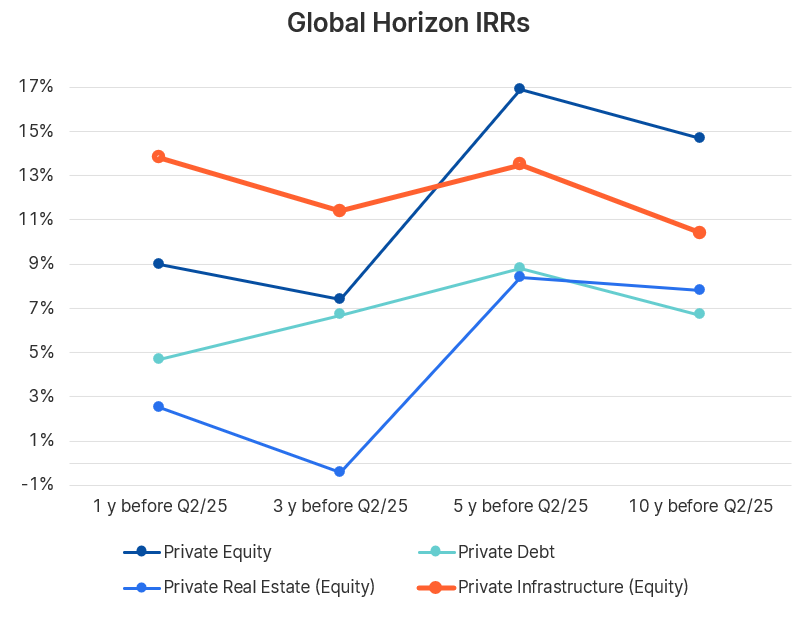
The historical performance of private infrastructure investments has been characterised by stable returns, with returns proving particularly impressive over long investment horizons. The chart below compares private infrastructure returns over various time periods with those of other private markets asset classes.
Note: Past performance is not a reliable indicator of future results.
Legal disclaimer
This document is an advertisement. Unless indicated otherwise, source: Erste Asset Management GmbH. The language of communication of the sales offices is German and the languages of communication of the Management Company also include English.
The prospectus for UCITS funds (including any amendments) is prepared and published in accordance with the provisions of the InvFG 2011 as amended. Information for Investors pursuant to § 21 AIFMG is prepared for the alternative investment funds (AIF) administered by Erste Asset Management GmbH pursuant to the provisions of the AIFMG in conjunction with the InvFG 2011.
The currently valid versions of the prospectus, the Information for Investors pursuant to § 21 AIFMG, and the key information document can be found on the website www.erste-am.com under “Mandatory publications” and can be obtained free of charge by interested investors at the offices of the Management Company and at the offices of the depositary bank. The exact date of the most recent publication of the prospectus, the languages in which the fund prospectus or the Information for Investors pursuant to Art 21 AIFMG and the key information document are available, and any other locations where the documents can be obtained are indicated on the website www.erste-am.com. A summary of the investor rights is available in German and English on the website www.erste-am.com/investor-rights and can also be obtained from the Management Company.
The Management Company can decide to suspend the provisions it has taken for the sale of unit certificates in other countries in accordance with the regulatory requirements.
Note: You are about to purchase a product that may be difficult to understand. We recommend that you read the indicated fund documents before making an investment decision. In addition to the locations listed above, you can obtain these documents free of charge at the offices of the referring Sparkassen bank and the offices of Erste Bank der oesterreichischen Sparkassen AG. You can also access these documents electronically at www.erste-am.com.
Our analyses and conclusions are general in nature and do not take into account the individual characteristics of our investors in terms of earnings, taxation, experience and knowledge, investment objective, financial position, capacity for loss, and risk tolerance. Past performance is not a reliable indicator of the future performance of a fund.
Please note: Investments in securities entail risks in addition to the opportunities presented here. The value of units and their earnings can rise and fall. Changes in exchange rates can also have a positive or negative effect on the value of an investment. For this reason, you may receive less than your originally invested amount when you redeem your units. Persons who are interested in purchasing units in investment funds are advised to read the current fund prospectus(es) and the Information for Investors pursuant to § 21 AIFMG, especially the risk notices they contain, before making an investment decision. If the fund currency is different than the investor’s home currency, changes in the relevant exchange rate can positively or negatively influence the value of the investment and the amount of the costs associated with the fund in the home currency.
We are not permitted to directly or indirectly offer, sell, transfer, or deliver this financial product to natural or legal persons whose place of residence or domicile is located in a country where this is legally prohibited. In this case, we may not provide any product information, either.
Please consult the corresponding information in the fund prospectus and the Information for Investors pursuant to § 21 AIFMG for restrictions on the sale of the fund to American or Russian citizens.
It is expressly noted that this communication does not provide any investment recommendations, but only expresses our current market assessment. Thus, this communication is not a substitute for investment advice.
This document does not represent a sales activity of the Management Company and therefore may not be construed as an offer for the purchase or sale of financial or investment instruments.
Erste Asset Management GmbH is affiliated with the Erste Bank and austrian Sparkassen banks.
Please also read the “Information about us and our securities services” published by your bank.
More on the topic

Signs of easing in the Persian Gulf
The US, Israel, and Iran have agreed to a two-week ceasefire. The markets have reacted positively, but does this mean lasting peace? Chief Economist Gerhard Winzer analyzes this in his weekly market commentary.