

For a long time, security was a term primarily associated with national defence and military deterrence. In recent years, however, this understanding has changed fundamentally. Geopolitical tensions, technological dependencies, and the ongoing digitalisation have made the concept of security significantly broader as well as more complex. For investors, this brings into focus an area that extends far beyond traditional defence companies.
Geopolitical developments as structural backdrop
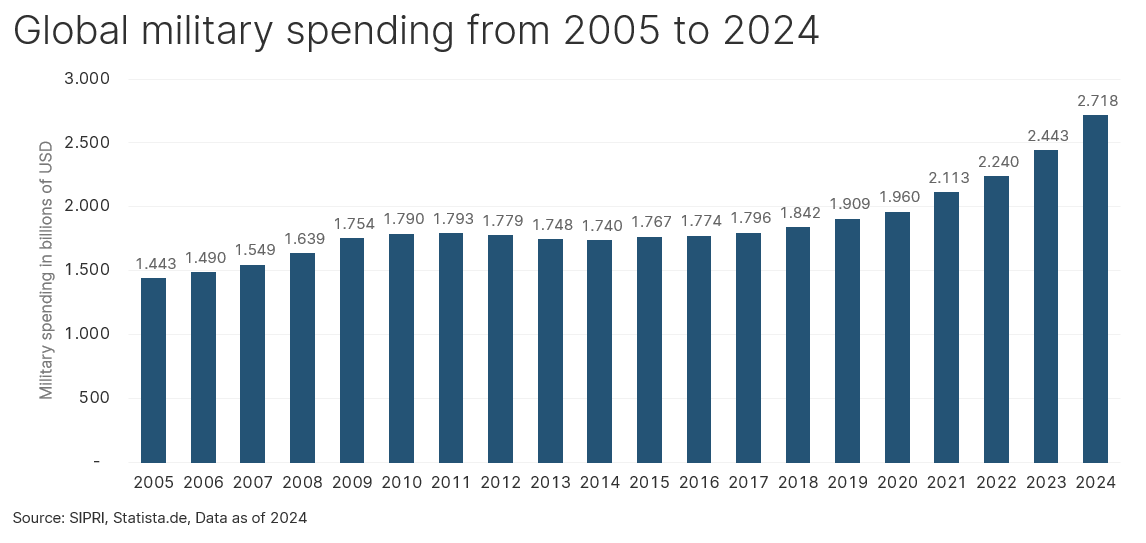
While global defence spending barely increased from 2010 to 2021, we have seen a marked rise in recent years. The reasons for this are obvious: growing geopolitical tensions and a more complex threat landscape.
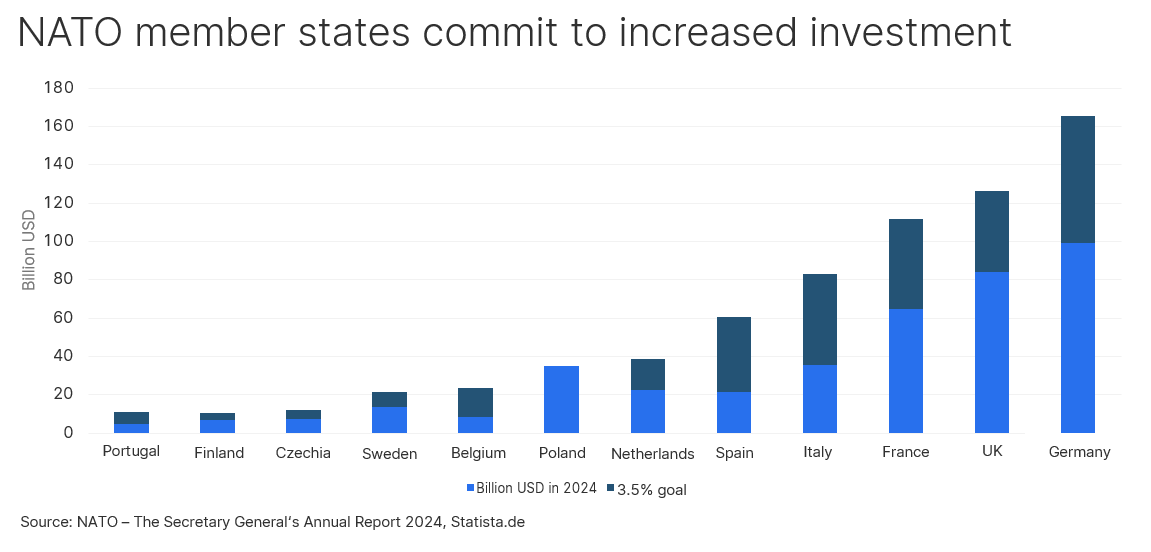
Ever since Russia’s invasion of Ukraine, at the very latest, the issue of security has returned to centre stage. NATO member states have recently agreed to significantly increase their defence budgets – not only for conventional military equipment, but also for infrastructure, intelligence, and digital resilience. That being said, most European NATO countries are still some way off the 3.5% target, i.e. the requirement to spend at least 3.5% of GDP on traditional military expenditure.
The agreement on higher defence spending stems from the NATO summit in June 2025. At that summit, member states agreed to spend a total of 5% of GDP on defence in future. In addition to the aforementioned 3.5% for traditional military expenditure, the target also includes investment in infrastructure that can be used for military purposes and in counterterrorism.
The NATO objectives highlight two key points:
- Investment in security today encompasses far more than it did a few years ago – infrastructure and cyber defence play a central role.
- This is a structural shift: investment in security is driven by a changing world order, not by short-term economic cycles.
Cybersecurity: The invisible front line
Alongside geopolitical tensions, a second, often less visible threat is growing: cyberattacks. New forms of online attack – often AI-driven – mean that digital security is becoming a key issue for governments and businesses alike.
“Security is understood in a much broader sense today than it was just a few years ago. Governments are investing not only in military capabilities, but increasingly also in protective measures for critical infrastructure and digital systems,” emphasises Kilian Minderlein, Head of Wholesale Germany at Erste Asset Management.
The use of artificial intelligence is transforming not only entire business models, but also the threat landscape. As a result, the number of automated attacks and deepfakes is currently on the rise.
However, in the context of the growing use of AI, the cybersecurity sector itself has recently come under pressure on the equity market. This was due to concerns that AI-based security solutions could increasingly push established providers and systems out of the market. Bernhard Haas, fund manager of the ERSTE SECURITY INVEST security equity fund, takes a completely different view: “We believe that the democratisation of AI technologies lowers the barriers to entry for cyberattacks. This does not increase the risk for cybersecurity companies but rather boosts demand for their solutions”. The fund management team has therefore used recent price declines in cybersecurity companies to make further purchases.
A survey of CIOs conducted by the US investment bank Morgan Stanley in October 2025 shows that spending on cybersecurity is rarely cut. Whereas other budgets may come under pressure in uncertain times, security ranks among the most stable areas of investment alongside cloud infrastructure and AI.
Suppliers with full order books
A look at the sector’s supply chain also shows that security & defence is a more structural growth driver. According to data from Morgan Stanley, the defence supply industry expects its capacity to be largely utilised over the next two years. The majority of orders are long-term contracts. For the sector, this means one thing above all: planning certainty. This is also evident in investment plans: 9 out of 10 supplier companies intend to further expand their production capacities in the security & defence sector over the next twelve months.
How security turns into an investment opportunity
For investors, the question arises as to how this broad understanding of security can be reflected in investment strategies. In addition to traditional defence companies, the focus is shifting towards suppliers, technology providers, and specialist software firms. A thematic approach makes it possible to invest across the entire value chain – from physical security and industrial capabilities to digital protection.
ERSTE SECURITY INVEST focuses specifically on these three key sectors: defence, defence suppliers, and cybersecurity. It is important to note the clear distinction: the fund is a so-called Article 6 fund under the EU Sustainable Finance Disclosure Regulation (SFDR) and is therefore not part of Erste Asset Management’s sustainable product range. However, the Erste AM Guidelines on minimum ethical standards also apply in this case. This includes the exclusion of companies that manufacture prohibited weapons.
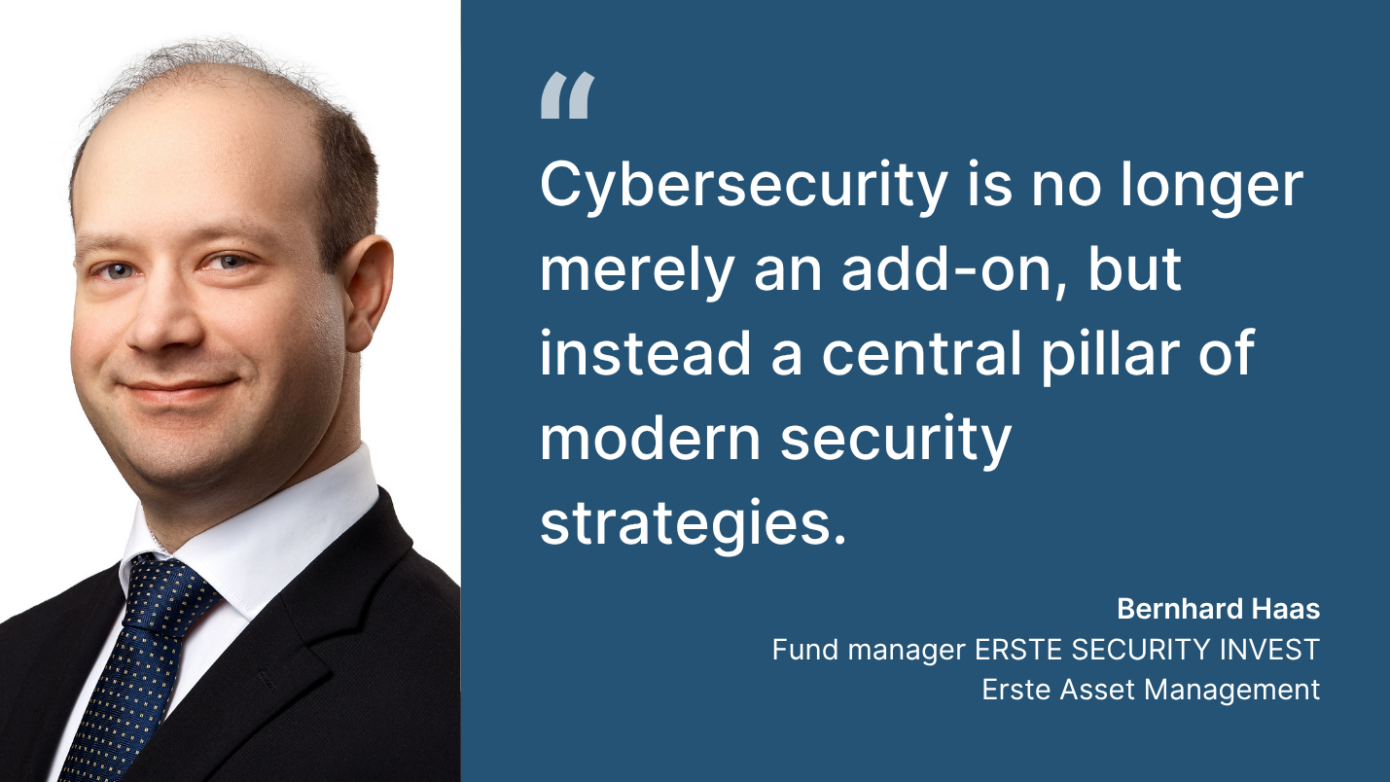
At the same time, cybersecurity is regarded as an integral part of the concept of security. The portfolio allocation reflects this three-pronged approach and takes into account both geopolitical and technological developments. “Our approach aims to view security as a cross-cutting issue – both in physical and digital terms. Cybersecurity is no longer merely an add-on, but instead a central pillar of modern security strategies,” says Bernhard Haas.
Note: Please note that an investment in securities entails risks in addition to the opportunities described.
Corporate case studies: applied security
A look at the fund’s largest holdings shows just how broadly the security theme is implemented. Among the top holdings is Rheinmetall. The company is a major supplier of military vehicles, ammunition, and defence systems. At the same time, the electronics and digitalisation sectors are gaining in importance. Rheinmetall thus embodies the shift from traditional defence towards technologically complex security solutions.
On the digital side, Palo Alto Networks is one of our key holdings. The company is a leading provider of cybersecurity platforms. The focus is on the protection of networks, cloud infrastructure, and data.
Other important holdings in the fund come from both sectors. These include, for example, CrowdStrike, Zscaler, and SentinelOne in the cyber sector, as well as Airbus, RTX, Saab, and Kongsberg on the industrial and defence-related side.
Note: Investment in securities entail risks in addition to the opportunities described. The companies listed here have been selected as examples and do not constitute an investment recommendation. Portfolio positioning can change at any time as part of active management.
Positioning by country and region
From a regional perspective, the US market accounts by far for the largest share of the fund. This is due, among other things, to the high number of leading cybersecurity companies based in the United States. Many global market leaders in this sector are headquartered there. Also, US companies benefit from substantial government and private security budgets.
Alongside this, companies from France and Germany in particular play a key role in the portfolio’s positioning. Italy, Sweden, the UK, and Norway follow some way behind. European equities are frequently found in the defence and defence supply industry as well as in specialist technologies. Rising defence spending and long-term government programmes are driving the region’s growing importance.
Conclusion
The issue of security is unlikely to disappear any time soon. Budgets are rising – and they are being funnelled into new areas. It is no longer just about defence armaments. Satellites, sensor technology and, above all, digital defences play an equally central role in the security of states, individuals and businesses.
Over the next few years, the focus is likely to shift further: more systems will be networked, more processes will run in the cloud, and AI will make attacks faster and cheaper. This increases the pressure on companies and states to constantly modernise their defences. Cybersecurity is thus becoming an ongoing task – much like energy supply or infrastructure. For investors, this means that anyone wishing to understand security must consider physical and digital risks together.
Risikohinweise ERSTE SECURITY INVEST
Please note that investing in securities also involves risks besides the opportunities described. The fund employs an active investment policy and is not oriented towards a benchmark. The assets are selected on a discretionary basis and the scope of discretion of the management company is not limited.
Legal disclaimer
This document is an advertisement. Unless indicated otherwise, source: Erste Asset Management GmbH. The language of communication of the sales offices is German and the languages of communication of the Management Company also include English.
The prospectus for UCITS funds (including any amendments) is prepared and published in accordance with the provisions of the InvFG 2011 as amended. Information for Investors pursuant to § 21 AIFMG is prepared for the alternative investment funds (AIF) administered by Erste Asset Management GmbH pursuant to the provisions of the AIFMG in conjunction with the InvFG 2011.
The currently valid versions of the prospectus, the Information for Investors pursuant to § 21 AIFMG, and the key information document can be found on the website www.erste-am.com under “Mandatory publications” and can be obtained free of charge by interested investors at the offices of the Management Company and at the offices of the depositary bank. The exact date of the most recent publication of the prospectus, the languages in which the fund prospectus or the Information for Investors pursuant to Art 21 AIFMG and the key information document are available, and any other locations where the documents can be obtained are indicated on the website www.erste-am.com. A summary of the investor rights is available in German and English on the website www.erste-am.com/investor-rights and can also be obtained from the Management Company.
The Management Company can decide to suspend the provisions it has taken for the sale of unit certificates in other countries in accordance with the regulatory requirements.
Note: You are about to purchase a product that may be difficult to understand. We recommend that you read the indicated fund documents before making an investment decision. In addition to the locations listed above, you can obtain these documents free of charge at the offices of the referring Sparkassen bank and the offices of Erste Bank der oesterreichischen Sparkassen AG. You can also access these documents electronically at www.erste-am.com.
Our analyses and conclusions are general in nature and do not take into account the individual characteristics of our investors in terms of earnings, taxation, experience and knowledge, investment objective, financial position, capacity for loss, and risk tolerance. Past performance is not a reliable indicator of the future performance of a fund.
Please note: Investments in securities entail risks in addition to the opportunities presented here. The value of units and their earnings can rise and fall. Changes in exchange rates can also have a positive or negative effect on the value of an investment. For this reason, you may receive less than your originally invested amount when you redeem your units. Persons who are interested in purchasing units in investment funds are advised to read the current fund prospectus(es) and the Information for Investors pursuant to § 21 AIFMG, especially the risk notices they contain, before making an investment decision. If the fund currency is different than the investor’s home currency, changes in the relevant exchange rate can positively or negatively influence the value of the investment and the amount of the costs associated with the fund in the home currency.
We are not permitted to directly or indirectly offer, sell, transfer, or deliver this financial product to natural or legal persons whose place of residence or domicile is located in a country where this is legally prohibited. In this case, we may not provide any product information, either.
Please consult the corresponding information in the fund prospectus and the Information for Investors pursuant to § 21 AIFMG for restrictions on the sale of the fund to American or Russian citizens.
It is expressly noted that this communication does not provide any investment recommendations, but only expresses our current market assessment. Thus, this communication is not a substitute for investment advice.
This document does not represent a sales activity of the Management Company and therefore may not be construed as an offer for the purchase or sale of financial or investment instruments.
Erste Asset Management GmbH is affiliated with the Erste Bank and austrian Sparkassen banks.
Please also read the “Information about us and our securities services” published by your bank.
More on the topic
Election in Germany: New government must lead the country out of the economic crisis
Following the premature end of the traffic light coalition, Germany will elect a new Bundestag in around a week’s time. The challenges for the future government are manifold. First and foremost, the weakening economy needs to be revitalised. We take a look at the real state of the EU’s former economic engine and what the parties have in store for the crisis.
Semiconductor Industry Optimistic for the Future Despite Tariff Uncertainties Thanks to AI Boom
The semiconductor industry is expected to continue growing strongly in 2025, despite uncertainties surrounding US President Donald Trump’s trade policy, thanks to the AI boom. The World Semiconductor Trade Statistics organisation (WSTS) recently raised its growth forecasts for this year slightly.