
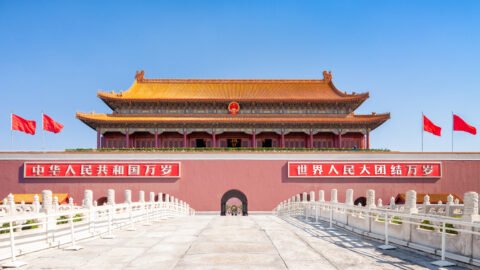
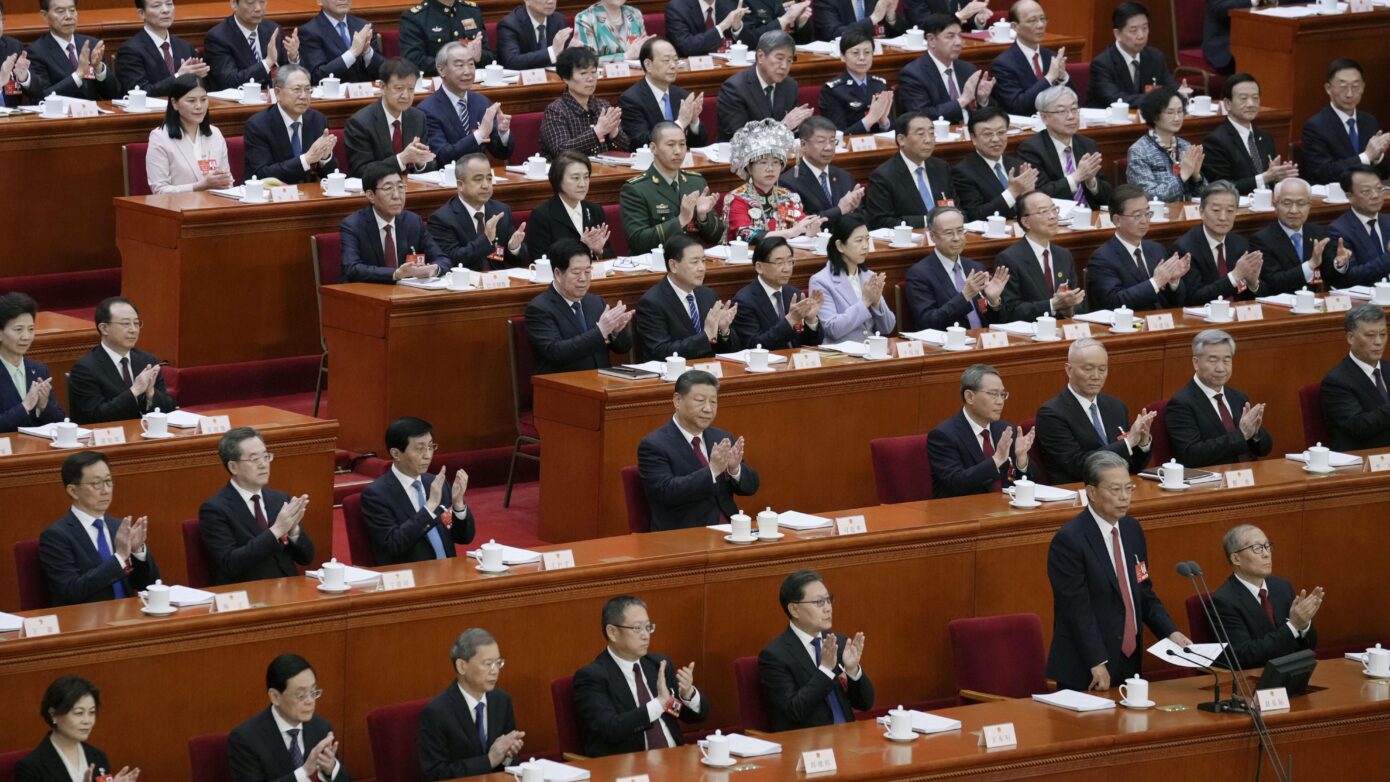
The National People’s Congress in China is regarded as the central forum where the country’s political and economic direction is determined. This year’s session concluded last week and provided important signals – though less through spectacular innovations than through a clear reaffirmation of the course that had already been set.
The focus remains on the transition from purely quantitative growth towards greater quality, innovation, and technological strength. This strategic direction is also reflected in the central government’s new five-year plan.
China’s firm commitment to high-tech
A crucial outcome of the National People’s Congress is the adjustment of the growth target. Going forward, China is aiming for economic growth of around 4.5 to 5% – the lowest level since the 1990s. However, Gabriela Tinti, fund manager at Erste Asset Management and an expert in emerging market equities, does not regard this as the end of China’s growth story: “The lower growth target was to be expected, as the economic base has changed quite drastically. In recent years, the central government has already emphasised that the focus is shifting more towards the quality of growth and away from purely quantitative growth.”
This development is particularly evident in the stronger focus on future-oriented sectors – especially in high-tech and security. China is thus consistently pursuing the goal of becoming more technologically independent and positioning itself globally in key future industries. At the same time, a look back supports the National People’s Congress’s targets: in the past, China would usually achieve the growth targets it had set itself.
Private consumption remains a work in progress
As ambitious as the central government may be in many key sectors, one area remains a cause for concern: private consumption. Despite rising income, a large proportion of Chinese households’ additional funds continues to go towards savings. The share of consumption remains below 40% of GDP, i.e. significantly lower than in many Western economies. There are many reasons for this:
- Weak real estate market. For years, a large proportion of private wealth was tied up in property – at its peak, as much as 80%. With the crash of the Chinese property sector and falling prices, many households’ sense of security has also declined. The central government is trying to contain the damage. State-owned property firms are required to take over projects that have run into difficulties in order to ensure their completion and thereby prevent social unrest. “However, prices are still expected to fall due to overcapacity in the property market,” explains Tinti.
- Loss of trust. The prolonged and far-reaching measures taken during the coronavirus pandemic have left their mark. A loss of trust is particularly evident in relation to local authorities, which were responsible for implementing the measures. Many households are adopting a more cautious approach and increasing their savings rate.
- Change in mindset. At the same time, attitudes have also shifted, particularly among the younger generation: after years of steady growth, job prospects suddenly became uncertain during the pandemic, and incomes also stagnated. All of this has dampened the younger generation’s enthusiasm for spending.
Economic measures are having an impact
While consumer spending remains sluggish, economic policy is already having an impact in a different set of areas. Whilst business confidence and the economic situation were still at a low point in mid-2024, the situation has improved significantly since then.
A key driver of this was government measures aimed at supporting the economy. For example, minimum reserve requirements for banks were reduced to stimulate lending and specifically promote new sectors. “Lending in China has now completely shifted. Previously, a large proportion went to the property sector and large companies. Today, significantly more capital is being funnelled into the industrial sector and small and medium-sized enterprises,” says Tinti.
Dependence on exports has also fallen significantly. They now account for less than 10% of GDP. At the same time, China has successfully diversified its export markets, with the importance of the USA having declined significantly. After all, the country began looking for new sales channels as early as during US President Donald Trump’s first term in office. “The greatest export growth is now taking place within Asia – for example in India, the ASEAN countries, and Vietnam,” explains the equity expert.
Iran war is only a minor stress factor
The war in Iran is likely to have a less drastic impact on the Chinese economy than on other markets. “The Chinese stocked up on oil from the region early on and have sufficient reserves,” explains Tinti.
Also, China’s energy supply is broadly diversified. Alongside imports from the Middle East, Russia and domestic resources such as coal play an important role. This makes China less vulnerable to short-term price fluctuations than many other countries. In an environment of rising energy prices, this could even prove to be an advantage – particularly as China has recently been facing deflationary pressures.
Artificial intelligence: not a new topic – but increasingly relevant
One area that already played a key role in the central government’s previous five-year plan is, of course, being further prioritised: artificial intelligence. China has been investing consistently in this sector for years and is now one of the world’s leading nations in this field. It has long since overtaken the USA in terms of AI patent applications – for every US patent, there are currently three from China. “AI is not a new topic, but it is anchored much more firmly in the current plan,” says Tinti.
According to the market expert, a look at the market over the past few years demonstrates that the political priorities set out in the five-year plan are also having an impact on the capital markets: “Around 80% of the sub-sectors that were the focus of the previous five-year plan have outperformed the overall market since then.”
Where we can currently see opportunities
The fund manager of the emerging markets equity fund ERSTE STOCK EM GLOBAL is currently focusing primarily on technology-driven sectors. These include, for example, companies in the semiconductor and artificial intelligence sectors, which are benefiting from increasing digitalisation and the strategic goal of technological independence. Industrial equities are also gaining in relevance, for instance as part of the expansion of digital infrastructure such as data centres.
The robotics and internet banking sectors offer potential, as does the healthcare sector, particularly innovative biotechnology and e-commerce companies. “In China in the past, you had to collect medicines directly from the hospital. This has now changed, leading to many online platforms through which medicines can be purchased entering the market,” says Tinti, who sees growth potential in this area. In addition, alongside China, other Asian markets are also coming into focus. South Korea, in particular, is currently riding the wave of the AI boom, for example in the field of memory chips.
Conclusion
China remains on a clearly defined, long-term growth trajectory. The focus is on quality, innovation, and structural change. For investors, this means that those who invest strategically in the right sectors will continue to benefit from the growth potential of the Chinese economy in the future – for example, through broad diversification with the ERSTE STOCK EM GLOBAL equity fund.
Note: Investments in securities entail risks in addition to the opportunities described.
An overview of ERSTE STOCK EM GLOBAL
The ERSTE STOCK EM GLOBAL fund invests broadly across equities from emerging markets and adopts an active investment approach with a clear focus on structural growth trends. In addition to China as its core market, the fund places particular emphasis on selected Asian countries such as South Korea and Taiwan.
Please note: Past performance is no reliable indicator of future value development. The performance is calculated according to the OeKB method. The performance assumes full reinvestment of the distribution and takes into account the management fee and any performance-related remuneration. The one-off issue premium that may be incurred on purchase and any individual transaction-related or ongoing income-reducing costs (e.g. account and custody account fees) are not included in the presentation. 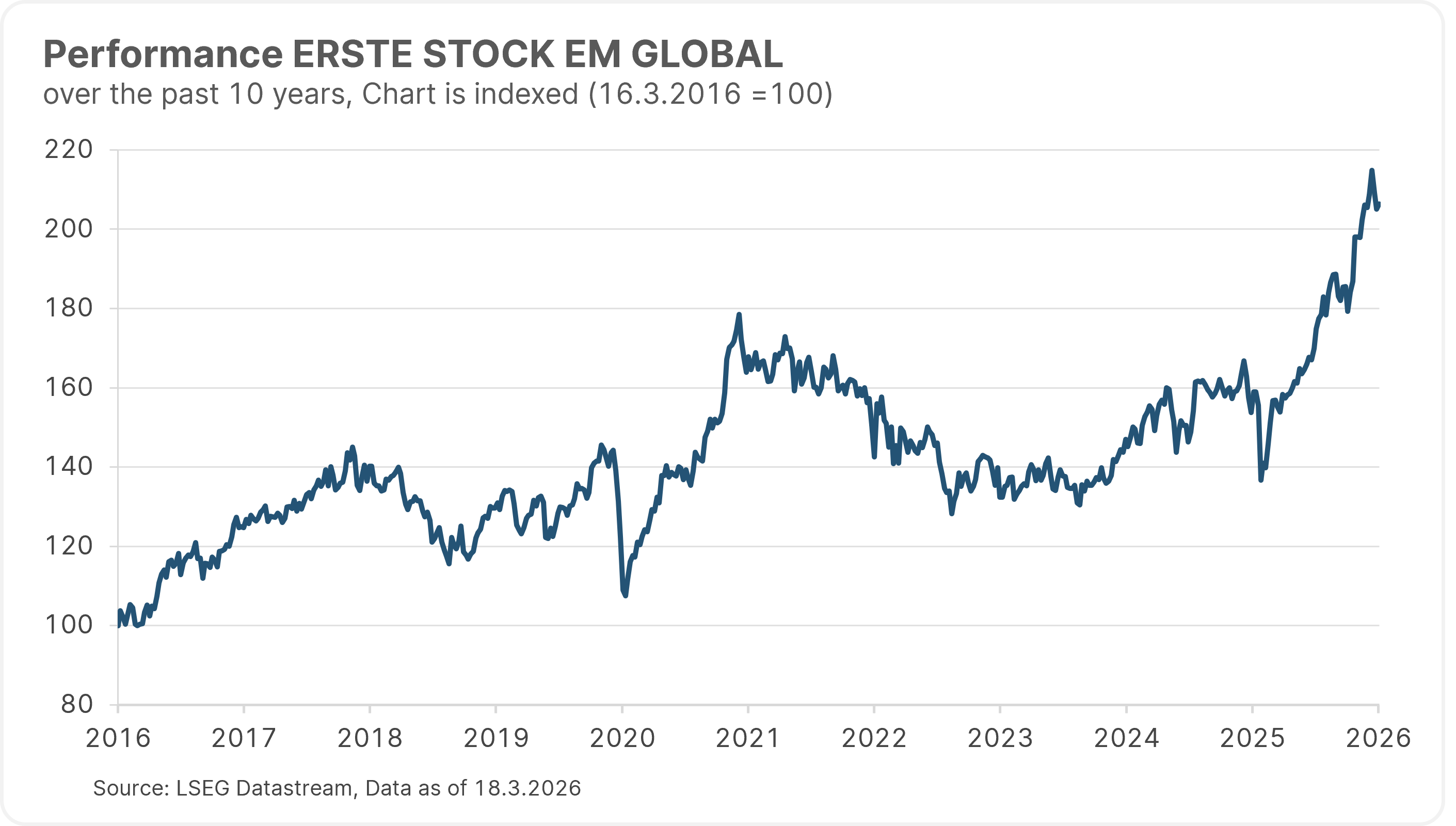
The strategy hinges on the targeted selection of companies with above-average growth potential. In doing so, the fund management team deliberately focuses on future-oriented themes such as technology, digitalisation, and healthcare. The aim is to achieve attractive long-term returns whilst benefiting from structural changes in global emerging markets.
Note: Investments in securities entail risks in addition to the opportunities described.
👉 For more information about the fund, please visit our website.
Risk information ERSTE STOCK EM GLOBAL
Please note that investing in securities also involves risks besides the opportunities described.
The fund pursues an active investment policy. The assets are selected at our discretion. The fund follows a benchmark index (N.B. for licensing reasons, the index used is specifically named in the prospectus, point 12, or in the key information document, “Objectives”). The composition and performance of the fund may deviate materially, up to completely, positively or negatively, in the short and long term, from that of the benchmark. The management company’s discretion is not restricted.
Legal disclaimer
This document is an advertisement. Unless indicated otherwise, source: Erste Asset Management GmbH. The language of communication of the sales offices is German and the languages of communication of the Management Company also include English.
The prospectus for UCITS funds (including any amendments) is prepared and published in accordance with the provisions of the InvFG 2011 as amended. Information for Investors pursuant to § 21 AIFMG is prepared for the alternative investment funds (AIF) administered by Erste Asset Management GmbH pursuant to the provisions of the AIFMG in conjunction with the InvFG 2011.
The currently valid versions of the prospectus, the Information for Investors pursuant to § 21 AIFMG, and the key information document can be found on the website www.erste-am.com under “Mandatory publications” and can be obtained free of charge by interested investors at the offices of the Management Company and at the offices of the depositary bank. The exact date of the most recent publication of the prospectus, the languages in which the fund prospectus or the Information for Investors pursuant to Art 21 AIFMG and the key information document are available, and any other locations where the documents can be obtained are indicated on the website www.erste-am.com. A summary of the investor rights is available in German and English on the website www.erste-am.com/investor-rights and can also be obtained from the Management Company.
The Management Company can decide to suspend the provisions it has taken for the sale of unit certificates in other countries in accordance with the regulatory requirements.
Note: You are about to purchase a product that may be difficult to understand. We recommend that you read the indicated fund documents before making an investment decision. In addition to the locations listed above, you can obtain these documents free of charge at the offices of the referring Sparkassen bank and the offices of Erste Bank der oesterreichischen Sparkassen AG. You can also access these documents electronically at www.erste-am.com.
Our analyses and conclusions are general in nature and do not take into account the individual characteristics of our investors in terms of earnings, taxation, experience and knowledge, investment objective, financial position, capacity for loss, and risk tolerance. Past performance is not a reliable indicator of the future performance of a fund.
Please note: Investments in securities entail risks in addition to the opportunities presented here. The value of units and their earnings can rise and fall. Changes in exchange rates can also have a positive or negative effect on the value of an investment. For this reason, you may receive less than your originally invested amount when you redeem your units. Persons who are interested in purchasing units in investment funds are advised to read the current fund prospectus(es) and the Information for Investors pursuant to § 21 AIFMG, especially the risk notices they contain, before making an investment decision. If the fund currency is different than the investor’s home currency, changes in the relevant exchange rate can positively or negatively influence the value of the investment and the amount of the costs associated with the fund in the home currency.
We are not permitted to directly or indirectly offer, sell, transfer, or deliver this financial product to natural or legal persons whose place of residence or domicile is located in a country where this is legally prohibited. In this case, we may not provide any product information, either.
Please consult the corresponding information in the fund prospectus and the Information for Investors pursuant to § 21 AIFMG for restrictions on the sale of the fund to American or Russian citizens.
It is expressly noted that this communication does not provide any investment recommendations, but only expresses our current market assessment. Thus, this communication is not a substitute for investment advice.
This document does not represent a sales activity of the Management Company and therefore may not be construed as an offer for the purchase or sale of financial or investment instruments.
Erste Asset Management GmbH is affiliated with the Erste Bank and austrian Sparkassen banks.
Please also read the “Information about us and our securities services” published by your bank.
More on the topic

Deficit spiraling out of control: French government plans drastic austerity program
The high deficit in the French national budget is forcing the new government to implement drastic austerity measures. Investors are keeping a close eye on the announced plans, as the tense financial situation has been noticeable on the stock market for some time.

Strong US labor market report: just an outlier?
In September, the US labor market performed surprisingly well, with significantly more new jobs created than expected. This has pushed back concerns about an impending recession, which is positive for the financial markets. Was the strong labor market report just an outlier, or is the US Federal Reserve perhaps on the right track to achieving the hoped-for “soft landing”?

International Monetary Fund/World Bank Group Spring Meetings 2025
At this year’s spring meeting of the International Monetary Fund and the World Bank, US tariffs were the dominant topic.