

For a long time, the Austrian stock market was considered undervalued, but it tended to be overshadowed by larger markets among international investors. The picture has since changed significantly: Following strong performance last year, the domestic benchmark index, the ATX 2026, has gained nearly 30 percent so far this year and reached new all-time highs.
Note: Past performance is not a reliable indicator for future performance.
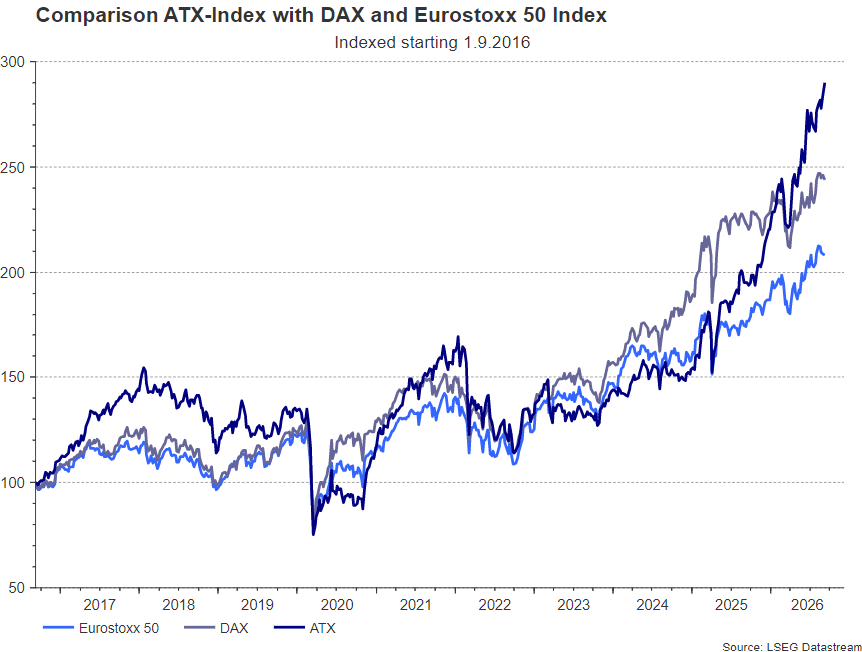
A look at the long-term trend shows that the ATX has largely moved in tandem with other European stock indices. Recently, however, the pace of growth has accelerated, allowing the leading Austrian index to significantly outperform the DAX and the Euro Stoxx 50. It’s also important to note that the DAX is a total return index, meaning it includes dividend payments. This is not the case for the ATX and the Euro Stoxx 50. The difference would therefore be even greater.
And this is despite the fact that the Austrian economy continues to grow only modestly and many companies are facing high energy prices, geopolitical uncertainties, and a weak industrial economy. Has the Vienna Stock Exchange simply completed a long-overdue rebound – or is there more to this development? We spoke with Bernhard Haas, fund manager of ERSTE STOCK VIENNA, about this.
A year ago, the ATX had already outperformed many international stock indices. Were you surprised by its strong performance in 2026?
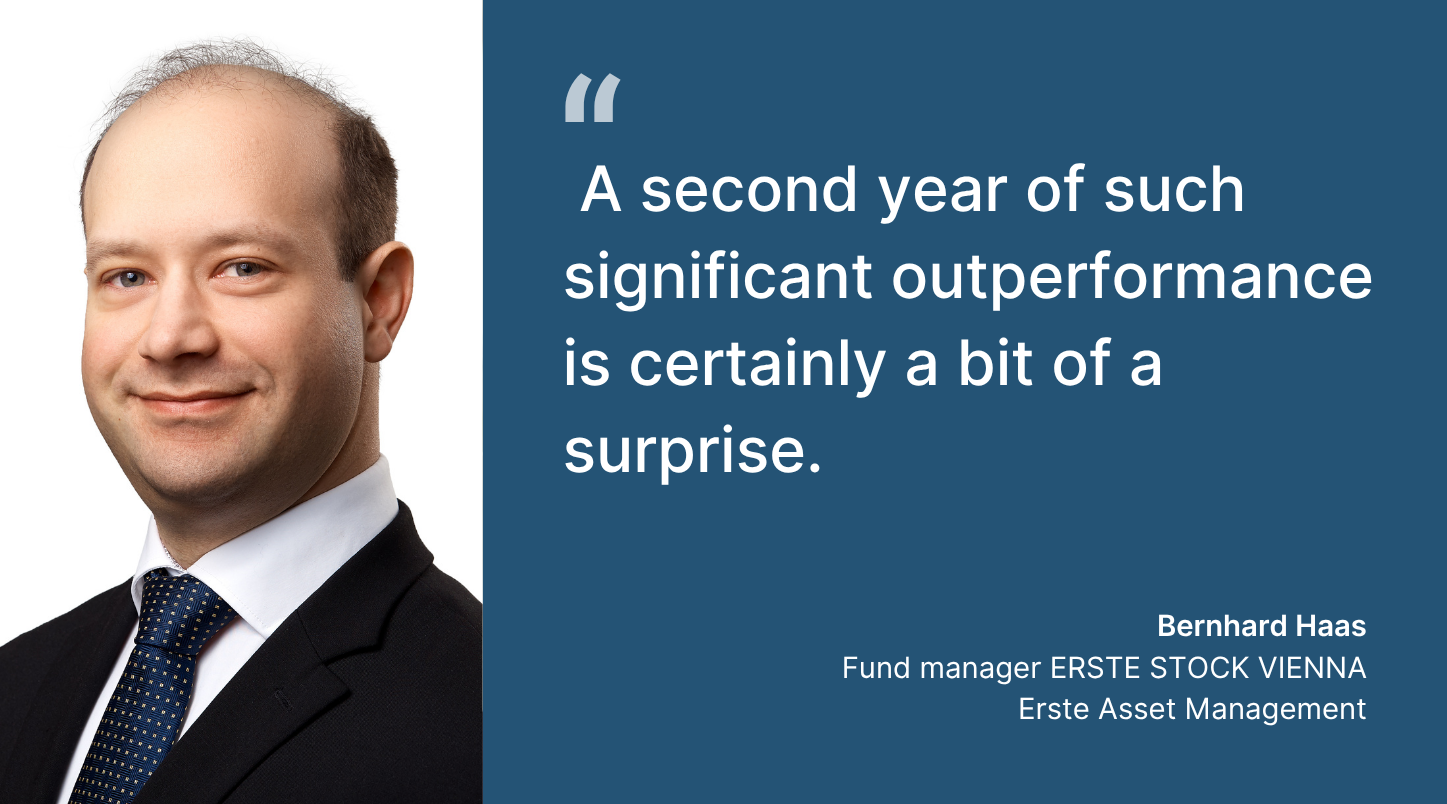
A second year of such significant outperformance is certainly a bit of a surprise. In the past, the “fat years” were often followed by a few lean ones. The fact that things turned out differently this time is primarily due to the index heavyweights. The banks are reporting excellent results, OMV is benefiting from higher energy prices, and Andritz and voestalpine are also performing better than economic data would suggest. Among other factors, the companies’ strong market positions are paying off here.
Note: The companies mentioned in this article have been selected by way of example and do not constitute an investment recommendation. Please note that an investment in ERSTE STOCK VIENNA or other securities involves risks as well as opportunities.
Was the stock price performance primarily a catch-up rally, or have the companies’ fundamental prospects improved?
The positive performance was driven primarily by better corporate earnings. In terms of valuation – as measured, for example, by the price-to-earnings ratio – not much has changed overall. So stock prices have risen mainly because companies are earning more.
Austrian stocks have long been considered undervalued. Is that still true after the sharp rise in stock prices?
Compared to other stock indices, the Austrian market remains relatively undervalued. However, this is also due to the high weighting of financial stocks, which typically trade at lower valuation multiples. If you compare banks with banks and industrial stocks with industrial stocks, the valuation discount on Austrian stocks has narrowed significantly over the past year. However, there are still individual stocks with attractive valuations. Today, you have to be more selective and look more closely.
How important is the Austrian economy to companies in the ATX these days, anyway?
A large proportion of ATX companies generate the majority of their revenue internationally, that is, outside of Austria. The domestic economy therefore plays a secondary role for many companies – otherwise, the currently strong corporate earnings would hardly be possible. However, constructive signals from policymakers regarding the Austrian labor and capital markets would be important. Special taxes, such as those imposed on energy companies and, to some extent, the banking sector, can deter international investors and harm the capital market in the long term – even if there may be other arguments in favor of such measures from a political perspective.
Where do you currently see the biggest positive and negative surprises among companies?
The banks are consistently posting solid results – both Erste Group and RBI, which are more focused on Central and Eastern Europe, and BAWAG, which has a stronger western orientation. In the oil and gas sector, OMV and SBO have also delivered positive surprises. The situation is more challenging for utilities, where water shortages, among other factors, are weighing on electricity production. Economic prospects also remain subdued in the automotive sector and in some industrial niches.
Can the announced infrastructure push in Germany and Europe give Austrian industry a new boost?
This could become very important for numerous Austrian industrial companies. While the domestic export industry remains heavily dependent on the German automotive industry, which is only slowly overcoming its challenges, we are seeing positive signs in sectors such as aviation and infrastructure. Companies such as voestalpine, AMAG, FACC, Strabag, and Porr, among others, could benefit from this. However, large infrastructure projects often have long lead times. The first major contracts could be awarded in 2027 – but the stock markets might anticipate such a development even sooner.
Following the strong price performance: How are you currently positioning the ERSTE STOCK VIENNA fund?
Our main focus remains on individual growth stories that are as independent as possible from the general economic cycle. One example is DO & CO. The company should be able to continue growing thanks to its strong position in premium catering – largely regardless of whether interest rates are slightly higher or lower next year. We remain cautious, however, regarding utilities. There could still be negative surprises here in the second half of the year, especially if the water shortage persists. In general, higher energy prices pose a risk to the Austrian economy and many companies. If this leads to a permanent rise in inflation and transportation costs, it could also limit the central banks’ room for maneuver and weigh on growth. It will therefore be crucial to determine how sustainable the current elevated level of energy prices is.
Risk notes ERSTE STOCK VIENNA
The fund employs an active investment policy and is not oriented towards a benchmark. The assets are selected on a discretionary basis and the scope of discretion of the management company is not limited.
For further information on the sustainable focus of ERSTE STOCK VIENNA as well as on the disclosures in accordance with the Disclosure Regulation (Regulation (EU) 2019/2088) and the Taxonomy Regulation (Regulation (EU) 2020/852), please refer to the current Prospectus, section 12 and the Annex “Sustainability Principles”. In deciding to invest in ERSTE STOCK VIENNA, consideration should be given to any characteristics or objectives of the ERSTE STOCK VIENNA as described in the Fund Documents.
Legal disclaimer
This document is an advertisement. Unless indicated otherwise, source: Erste Asset Management GmbH. The language of communication of the sales offices is German and the languages of communication of the Management Company also include English.
The prospectus for UCITS funds (including any amendments) is prepared and published in accordance with the provisions of the InvFG 2011 as amended. Information for Investors pursuant to § 21 AIFMG is prepared for the alternative investment funds (AIF) administered by Erste Asset Management GmbH pursuant to the provisions of the AIFMG in conjunction with the InvFG 2011.
The currently valid versions of the prospectus, the Information for Investors pursuant to § 21 AIFMG, and the key information document can be found on the website www.erste-am.com under “Mandatory publications” and can be obtained free of charge by interested investors at the offices of the Management Company and at the offices of the depositary bank. The exact date of the most recent publication of the prospectus, the languages in which the fund prospectus or the Information for Investors pursuant to Art 21 AIFMG and the key information document are available, and any other locations where the documents can be obtained are indicated on the website www.erste-am.com. A summary of the investor rights is available in German and English on the website www.erste-am.com/investor-rights and can also be obtained from the Management Company.
The Management Company can decide to suspend the provisions it has taken for the sale of unit certificates in other countries in accordance with the regulatory requirements.
Note: You are about to purchase a product that may be difficult to understand. We recommend that you read the indicated fund documents before making an investment decision. In addition to the locations listed above, you can obtain these documents free of charge at the offices of the referring Sparkassen bank and the offices of Erste Bank der oesterreichischen Sparkassen AG. You can also access these documents electronically at www.erste-am.com.
Our analyses and conclusions are general in nature and do not take into account the individual characteristics of our investors in terms of earnings, taxation, experience and knowledge, investment objective, financial position, capacity for loss, and risk tolerance. Past performance is not a reliable indicator of the future performance of a fund.
Please note: Investments in securities entail risks in addition to the opportunities presented here. The value of units and their earnings can rise and fall. Changes in exchange rates can also have a positive or negative effect on the value of an investment. For this reason, you may receive less than your originally invested amount when you redeem your units. Persons who are interested in purchasing units in investment funds are advised to read the current fund prospectus(es) and the Information for Investors pursuant to § 21 AIFMG, especially the risk notices they contain, before making an investment decision. If the fund currency is different than the investor’s home currency, changes in the relevant exchange rate can positively or negatively influence the value of the investment and the amount of the costs associated with the fund in the home currency.
We are not permitted to directly or indirectly offer, sell, transfer, or deliver this financial product to natural or legal persons whose place of residence or domicile is located in a country where this is legally prohibited. In this case, we may not provide any product information, either.
Please consult the corresponding information in the fund prospectus and the Information for Investors pursuant to § 21 AIFMG for restrictions on the sale of the fund to American or Russian citizens.
It is expressly noted that this communication does not provide any investment recommendations, but only expresses our current market assessment. Thus, this communication is not a substitute for investment advice.
This document does not represent a sales activity of the Management Company and therefore may not be construed as an offer for the purchase or sale of financial or investment instruments.
Erste Asset Management GmbH is affiliated with the Erste Bank and austrian Sparkassen banks.
Please also read the “Information about us and our securities services” published by your bank.