

Hardly any other month is as feared on the capital markets as September. While May at least garners proverbial attention thanks to the saying “Sell in May and go away,” September has earned a particularly bad reputation in the statistics: Depending on the index and the time period under consideration, it ranks among the historically weakest stock market months of the year.
However, a striking historical statistic does not yield a reliable forecast. The “September effect” is an interesting chapter in market history – but it is not a reliable signal for managing a portfolio in the short term.
What the numbers show
For the S&P 500, the trend over long periods is striking. Since 1928, the broad U.S. stock index has lost an average of about one percent in September. Depending on the data source, the average September return ranges from about -0.7% to -1.2%. No other month has shown a negative average return over this long time series.
A distinct seasonal pattern can also be observed in the DAX. A scientific analysis of data from 1959 to 1999 concluded that performance in September was below average and, on average, negative. This finding remained robust even under various empirical specifications.
A recent analysis of 38 Septembers since 1988 for the DAX, S&P 500, and Nasdaq 100 confirms this picture but also reveals some important nuances.
Note: Investing in securities has advantages and risks. Past performance is not a reliable indicator for the future performance.
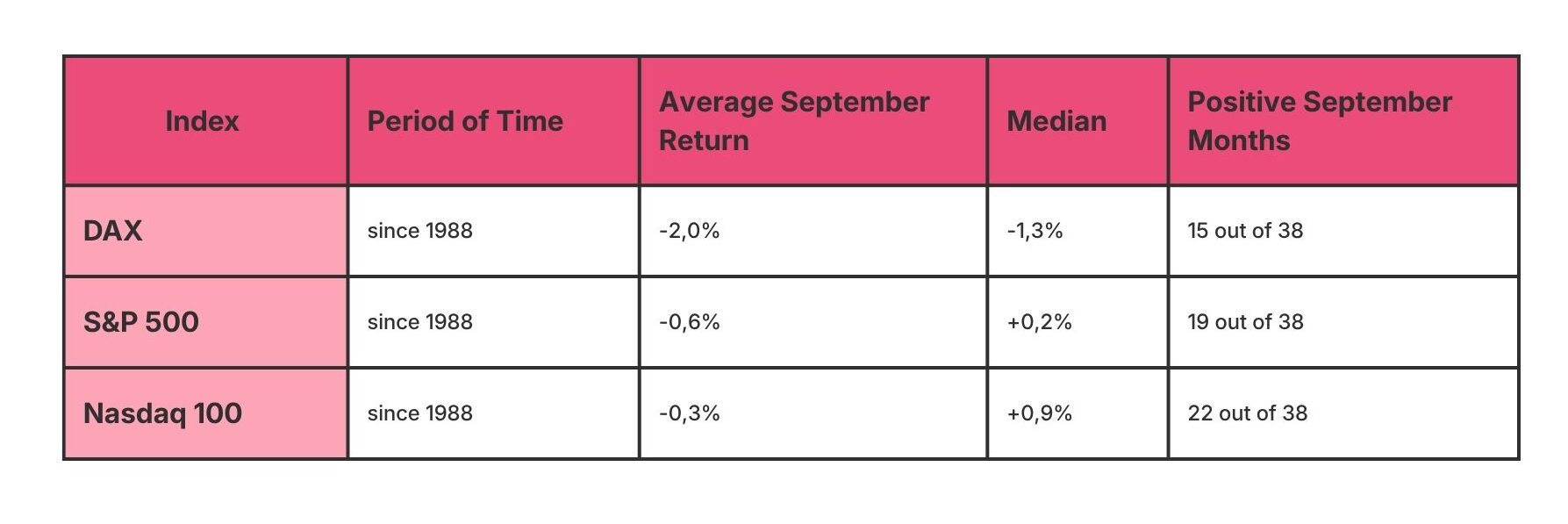
The difference between the average and the median is particularly revealing. For the S&P 500 and the Nasdaq 100, the median is slightly positive. A typical September was therefore by no means necessarily weak. Rather, individual particularly negative months can drag down the long-term average.
In this sample, the Nasdaq 100 proved less vulnerable than the DAX and the S&P 500. However, this is not evidence that technology stocks are fundamentally immune to seasonal weakness.
A Look at Europe
The EURO STOXX 50, which tracks the largest publicly traded companies in the eurozone, also shows weak seasonal performance in September. In an analysis of the past 30 years, the index lost an average of 1.56% in September. In 15 of the 30 years analyzed, it closed the month in negative territory. In this data series, August was actually the weakest month by a narrow margin, with an average loss of -1.59%.
Different time frames yield different figures but confirm the underlying trend. An analysis covering a different long-term period found an average decline of 2.13% for September and classified it as the weakest month for the EURO STOXX 50. October followed with an average return of 2.82%, a statistically notable but equally unreliable counterpoint for trading purposes.
These differences are not a flaw in the statistics, but rather part of their proper interpretation. Even small changes in the start and end periods, the index variant used, or the calculation method can significantly alter seasonal averages.
Why September, of all months?
To this day, there is no scientifically conclusive explanation. Several hypotheses are being discussed:
- Portfolio Adjustments Before the End of the Quarter: After the typically quieter summer, many market participants are returning from their vacations. This leads to an increase in trading activity and liquidity, as well as a greater willingness to implement decisions that had previously been postponed.
- Back from the Summer Break: As the quieter, often lower-revenue summer months come to an end, trading activity and liquidity pick up. Decisions to sell or reallocate holdings that had been postponed may then come to the market.
- Psychology and Expectations: The effect is well known. This can lead to negative news being perceived particularly strongly in September and reinforce cautious behavior.
- Historical Events: Significant moments of crisis, such as the terrorist attacks of September 11, 2001, the escalation of the financial crisis in September 2008, or the turmoil in China in 2015, have been etched into the collective memory of the markets.
These are plausible explanations, not proven causality. Markets don’t fall just because it’s September. They react to the economy, inflation, interest rates, corporate earnings, valuations, and geopolitical risks.
September 2026: A Good Reality Check
This month is already showing just how cautious one should be when interpreting seasonal trends. The S&P 500 got off to a weak start on September 1, falling 0.71% to 7,631.47 points. Rising yields, higher oil prices, and geopolitical risks weighed on market sentiment.
But the market turned around as early as the following trading days. After signals from Fed Governor Christopher Waller that he would be open to keeping interest rates unchanged if there were confirmation of easing price pressures, fears of interest rate hikes subsided. On September 3, the S&P 500 rose 1.06% to 7,747.71 points. As a result, the index was back above its level at the start of the month after just a few trading days.
This is not evidence against the September Effect. However, it is a clear example of its limitations: The calendar may provide a historical context. Actual price movements, however, are determined by current expectations regarding interest rates, inflation, growth, and corporate earnings.
From a technical perspective as well, the initial picture was less fragile than the September statistics would suggest. After a strong August and trading near record highs, the S&P 500 entered the month above its 200-day moving average. Historical analysis shows that Septembers tend to be weaker when the index starts the month below this long-term trend indicator.
What investors can take away from this
The September Effect is an interesting example of how market psychology, statistics, and historical memory interact. It can serve as a reason to take a more conscious look at the current risk landscape. However, it is unsuitable as the sole basis for investment decisions.
Investors who exit the stock market solely because of a weak calendar month risk missing out on recoveries and long-term performance. This is especially true because positive Septembers are by no means rare, and price movements are often driven by individual news events or shifts in interest rate expectations.
For long-term investors, other questions are more important:
- Does the equity allocation align with your risk tolerance and investment horizon?
- Is the portfolio sufficiently diversified across regions, sectors, and asset classes?
- Is there a clear strategy for periods of higher volatility?
- Is the portfolio reviewed regularly, without chasing short-term headlines?
The more sensible response to a volatile month in the market is therefore not automatic market timing, but rather a review of one’s own strategic positioning.
Conclusion
September’s bad reputation isn’t entirely unwarranted. Long-term data show that many stock indices tend to perform weaker on average than in other months. However, this does not provide a reliable forecast for the current month of September, let alone justify a blanket decision to sell.
For investors, therefore, the most important principle remains: A long-term, broadly diversified investment approach and a risk profile tailored to one’s personal situation are more resilient than attempting to trade on calendar effects.
The “September effect” is an interesting phenomenon in stock market history. For long-term investors, it serves above all as a reminder not to confuse historical patterns with reliable forecasts.
Note on Comparability: In German-speaking countries, the DAX is generally reported as a performance index and includes reinvested dividends. The S&P 500 is often considered a price index. Historical returns for different indices are therefore only directly comparable to a limited extent.
Legal disclaimer
This document is an advertisement. Unless indicated otherwise, source: Erste Asset Management GmbH. The language of communication of the sales offices is German and the languages of communication of the Management Company also include English.
The prospectus for UCITS funds (including any amendments) is prepared and published in accordance with the provisions of the InvFG 2011 as amended. Information for Investors pursuant to § 21 AIFMG is prepared for the alternative investment funds (AIF) administered by Erste Asset Management GmbH pursuant to the provisions of the AIFMG in conjunction with the InvFG 2011.
The currently valid versions of the prospectus, the Information for Investors pursuant to § 21 AIFMG, and the key information document can be found on the website www.erste-am.com under “Mandatory publications” and can be obtained free of charge by interested investors at the offices of the Management Company and at the offices of the depositary bank. The exact date of the most recent publication of the prospectus, the languages in which the fund prospectus or the Information for Investors pursuant to Art 21 AIFMG and the key information document are available, and any other locations where the documents can be obtained are indicated on the website www.erste-am.com. A summary of the investor rights is available in German and English on the website www.erste-am.com/investor-rights and can also be obtained from the Management Company.
The Management Company can decide to suspend the provisions it has taken for the sale of unit certificates in other countries in accordance with the regulatory requirements.
Note: You are about to purchase a product that may be difficult to understand. We recommend that you read the indicated fund documents before making an investment decision. In addition to the locations listed above, you can obtain these documents free of charge at the offices of the referring Sparkassen bank and the offices of Erste Bank der oesterreichischen Sparkassen AG. You can also access these documents electronically at www.erste-am.com.
Our analyses and conclusions are general in nature and do not take into account the individual characteristics of our investors in terms of earnings, taxation, experience and knowledge, investment objective, financial position, capacity for loss, and risk tolerance. Past performance is not a reliable indicator of the future performance of a fund.
Please note: Investments in securities entail risks in addition to the opportunities presented here. The value of units and their earnings can rise and fall. Changes in exchange rates can also have a positive or negative effect on the value of an investment. For this reason, you may receive less than your originally invested amount when you redeem your units. Persons who are interested in purchasing units in investment funds are advised to read the current fund prospectus(es) and the Information for Investors pursuant to § 21 AIFMG, especially the risk notices they contain, before making an investment decision. If the fund currency is different than the investor’s home currency, changes in the relevant exchange rate can positively or negatively influence the value of the investment and the amount of the costs associated with the fund in the home currency.
We are not permitted to directly or indirectly offer, sell, transfer, or deliver this financial product to natural or legal persons whose place of residence or domicile is located in a country where this is legally prohibited. In this case, we may not provide any product information, either.
Please consult the corresponding information in the fund prospectus and the Information for Investors pursuant to § 21 AIFMG for restrictions on the sale of the fund to American or Russian citizens.
It is expressly noted that this communication does not provide any investment recommendations, but only expresses our current market assessment. Thus, this communication is not a substitute for investment advice.
This document does not represent a sales activity of the Management Company and therefore may not be construed as an offer for the purchase or sale of financial or investment instruments.
Erste Asset Management GmbH is affiliated with the Erste Bank and austrian Sparkassen banks.
Please also read the “Information about us and our securities services” published by your bank.
More on the topic

Semiconductor Industry Optimistic for the Future Despite Tariff Uncertainties Thanks to AI Boom
The semiconductor industry is expected to continue growing strongly in 2025, despite uncertainties surrounding US President Donald Trump’s trade policy, thanks to the AI boom. The World Semiconductor Trade Statistics organisation (WSTS) recently raised its growth forecasts for this year slightly.