
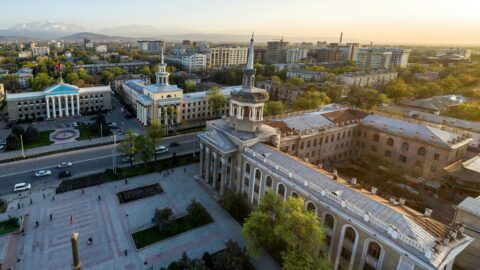
In recent years, Kyrgyzstan has quietly emerged as one of the most dynamic economies in Central Asia. Although the country remains small in terms of economic output and continues to face structural challenges, strong economic growth, rising incomes, and the increasing professionalization of the financial sector have created an attractive environment for responsible microfinance investments.
Today, Kyrgyzstan offers an increasingly attractive combination of macroeconomic dynamism, strong demand for financial services, and a well-developed microfinance sector that plays a central role in financing households and small businesses.
A macroeconomic success story that continues to exceed expectations
The Kyrgyz economy has been experiencing exceptionally strong growth since 2022. Initially supported by increasing regional trade flows, high remittances from migrant workers, and robust domestic demand, economic activity has remained remarkably resilient even as some of the growth drivers from the years following 2022 gradually faded. According to World Bank estimates, real economic growth exceeded 11% in 2025, making Kyrgyzstan one of the fastest-growing economies in Europe and Central Asia.
Behind these impressive growth figures, long-term growth drivers are becoming increasingly important. Extensive public and private investments are flowing into infrastructure, logistics, energy supply, and connectivity projects, including the China–Kyrgyzstan–Uzbekistan railway and the Kambarata-1 hydropower project. These investments have the potential to boost the country’s long-term productivity and further expand its role as a regional transportation corridor.
Another key pillar of the Kyrgyz economy is the natural resources sector. Precious metals and other mineral resources represent a significant source of export earnings, foreign exchange inflows, and government revenue. High gold prices, in particular, have provided additional momentum in recent years by increasing export earnings and strengthening public finances.
At the same time, policymakers continue to focus on improving the business environment, promoting the formalization of economic activities, and attracting private investment. Despite existing challenges, the trend is positive and supports the further development of the private sector.
Growth improves living conditions, but development gaps remain
Economic growth leads to noticeable improvements in the living conditions of many households
The poverty rate has declined significantly in recent years, supported by robust labor markets, rising wages, remittances from abroad, and increasing economic opportunities. The World Bank expects that the proportion of the population living below the international poverty line will have continued to decline by 2025, thus continuing the positive trend of recent years.
Nevertheless, Kyrgyzstan remains a lower-middle-income country, with a per capita GDP of approximately $1,500 in 2025. A significant portion of employment continues to be concentrated in micro and small enterprises, agriculture, trade, and informal activities. According to World Bank analyses, a large portion of employment remains informal, which limits both productivity growth and access to formal financial services.
This creates a unique situation: On the one hand, households are becoming more economically resilient and active. On the other hand, millions of people continue to rely on microenterprises, family-run businesses, and self-employment to secure their income. Access to financial services tailored to their needs therefore remains a central pillar of inclusive economic development.
Microfinance remains a cornerstone of financial inclusion
Few countries have developed their microfinance sector as successfully as Kyrgyzstan. Over the past two decades, the sector has evolved from donor-funded programs into a professional and well-regulated financial ecosystem that serves entrepreneurs in both urban and rural areas.
Microfinance institutions (MFIs) play a particularly important role in this regard, as they reach client groups that are often underserved by traditional banks. Small farmers, market vendors, service providers, and family-run businesses often rely on microfinance to secure working capital, make investments, or strengthen their economic resilience.
What sets Kyrgyzstan apart is not only the sector’s reach but also its level of maturity. Leading microfinance institutions have invested significantly in governance, risk management, digitalization, and customer protection. Many of them have impressively demonstrated that financial inclusion and economic sustainability are compatible. This is reflected in sound lending standards, professional management teams, a high degree of transparency, and increased resilience across various economic cycles.
Demand for credit remains high
One of the most notable developments in recent years has been the sharp expansion of lending to the private sector. Robust domestic demand, rising incomes, and increasing entrepreneurial activity have significantly boosted demand for credit among both households and small businesses. Economic growth has been accompanied by rising demand for productive loans, particularly in the micro- and small-business segment.
The need for financing remains high, especially in rural areas. Agriculture continues to be an important source of income and generates a steady demand for seasonal working capital loans and investment financing. At the same time, urbanization and a vibrant SME sector are creating new business opportunities in trade, transportation, services, and light industry.
Digital distribution channels are also increasingly transforming the market. Mobile banking, electronic payment services, and digital lending processes boost efficiency and enable financial institutions to reach customer groups that were previously underserved. This development is particularly encouraging, as it fosters growth without compromising operational discipline.
Why Kyrgyzstan Is Important for Impact Investors
For impact-oriented investors, Kyrgyzstan offers a compelling investment story. The country combines strong economic momentum with a clear need for financial inclusion. Many borrowers are economically active, entrepreneurial, and increasingly part of the formal economy, yet they continue to face significant barriers to accessing traditional banking services. Well-managed microfinance institutions help bridge this gap. They provide capital where it is most urgently needed, promote income generation, strengthen local businesses, and contribute to poverty reduction.
Outlook
Although risks remain—including dependence on remittances from abroad, external economic developments, and the need for further structural reforms—the outlook for Kyrgyzstan remains positive. Economic growth is expected to remain above average compared to the rest of the region, infrastructure investments are laying the groundwork for future expansion, and the poverty rate continues to decline.
Political risks nevertheless remain a factor that should be closely monitored. Kyrgyzstan experienced political upheavals and changes in government in 2005, 2010, and 2020, demonstrating that social tensions can quickly lead to political changes. The current environment is, however, significantly more stable, although political risks remain part of the country’s long-term profile.
The microfinance sector is well positioned to remain a key driver of inclusive development in the future. For investors seeking both impact and long-term sustainability, Kyrgyzstan is now one of the most interesting microfinance markets in Central Asia. The country’s story is no longer just one of financial inclusion—it is increasingly one of economic transformation.
I-AM Vision Microfinance in Kyrgyzstan
For the I-AM Vision Microfinance Funds, Kyrgyzstan is far more than just an attractive investment destination—it has been one of the portfolio’s core markets since the I-AM Vision Microfinance Fund was launched in 2006. As of June 2026, the funds had granted a total of 67 loans in the country, providing a cumulative investment volume of just under 68 million USD.
👉 Learn more
Notes: Please be aware that investing in securities involves risks as well as opportunities.
With regard to the environmental and social criteria taken into account in each individual investment fund, the applicable EU criteria for environmentally sustainable economic activities, and the most significant adverse impacts of investment decisions on sustainability factors as well as sustainability risks, please refer to the complete information or the respective investment management company—in particular in the prospectus—as well as the comprehensive disclosures under “ESG Disclosure.”
This marketing communication is provided solely for informational purposes and is not intended to be an offer or a solicitation to buy or sell fund shares, nor should it be construed as a solicitation to make an offer to enter into a contract for investment services or ancillary services. This document is not a substitute for advice from your personal investment advisor.
Any unauthorized use of this document, including, but not limited to, its reproduction, modification, distribution, or publication, is prohibited. The author of this document and its affiliated companies expressly disclaim any liability for the accuracy, completeness, or timeliness of the information contained herein and the opinions expressed.
All performance figures shown represent gross performance, which includes all applicable fund-level expenses and assumes the reinvestment of any distributions. Past performance results, backtest data, and simulations based on past or future scenarios do not allow for any conclusions regarding the current or future performance of these figures or the underlying financial instruments or indices, and are not a reliable indicator of future performance. This applies in particular to the use of backtest data, which always results in hypothetical, historical representations.
Please note: An investment in mutual funds is subject to general economic risks and fluctuations in value, which may result in losses—including the total loss of the capital invested. Please refer specifically to the detailed risk disclosures in the prospectus.
The basis for purchasing investment shares is the currently valid prospectus, the Key Investor Information Document (“KIID”), the fund’s articles of association, the annual report, and—if older than eight months—the semi-annual report. These documents are available free of charge in German to prospective investors from the respective investment management company. Share classes denominated in foreign currencies entail additional currency risk; performance may rise or fall as a result of currency fluctuations. This document was prepared by Impact Asset Management GmbH (Am Belvedere 1, A-1100 Vienna, sales@impact-am.eu, www.impact-am.eu).
Legal disclaimer
This document is an advertisement. Unless indicated otherwise, source: Erste Asset Management GmbH. The language of communication of the sales offices is German and the languages of communication of the Management Company also include English.
The prospectus for UCITS funds (including any amendments) is prepared and published in accordance with the provisions of the InvFG 2011 as amended. Information for Investors pursuant to § 21 AIFMG is prepared for the alternative investment funds (AIF) administered by Erste Asset Management GmbH pursuant to the provisions of the AIFMG in conjunction with the InvFG 2011.
The currently valid versions of the prospectus, the Information for Investors pursuant to § 21 AIFMG, and the key information document can be found on the website www.erste-am.com under “Mandatory publications” and can be obtained free of charge by interested investors at the offices of the Management Company and at the offices of the depositary bank. The exact date of the most recent publication of the prospectus, the languages in which the fund prospectus or the Information for Investors pursuant to Art 21 AIFMG and the key information document are available, and any other locations where the documents can be obtained are indicated on the website www.erste-am.com. A summary of the investor rights is available in German and English on the website www.erste-am.com/investor-rights and can also be obtained from the Management Company.
The Management Company can decide to suspend the provisions it has taken for the sale of unit certificates in other countries in accordance with the regulatory requirements.
Note: You are about to purchase a product that may be difficult to understand. We recommend that you read the indicated fund documents before making an investment decision. In addition to the locations listed above, you can obtain these documents free of charge at the offices of the referring Sparkassen bank and the offices of Erste Bank der oesterreichischen Sparkassen AG. You can also access these documents electronically at www.erste-am.com.
Our analyses and conclusions are general in nature and do not take into account the individual characteristics of our investors in terms of earnings, taxation, experience and knowledge, investment objective, financial position, capacity for loss, and risk tolerance. Past performance is not a reliable indicator of the future performance of a fund.
Please note: Investments in securities entail risks in addition to the opportunities presented here. The value of units and their earnings can rise and fall. Changes in exchange rates can also have a positive or negative effect on the value of an investment. For this reason, you may receive less than your originally invested amount when you redeem your units. Persons who are interested in purchasing units in investment funds are advised to read the current fund prospectus(es) and the Information for Investors pursuant to § 21 AIFMG, especially the risk notices they contain, before making an investment decision. If the fund currency is different than the investor’s home currency, changes in the relevant exchange rate can positively or negatively influence the value of the investment and the amount of the costs associated with the fund in the home currency.
We are not permitted to directly or indirectly offer, sell, transfer, or deliver this financial product to natural or legal persons whose place of residence or domicile is located in a country where this is legally prohibited. In this case, we may not provide any product information, either.
Please consult the corresponding information in the fund prospectus and the Information for Investors pursuant to § 21 AIFMG for restrictions on the sale of the fund to American or Russian citizens.
It is expressly noted that this communication does not provide any investment recommendations, but only expresses our current market assessment. Thus, this communication is not a substitute for investment advice.
This document does not represent a sales activity of the Management Company and therefore may not be construed as an offer for the purchase or sale of financial or investment instruments.
Erste Asset Management GmbH is affiliated with the Erste Bank and austrian Sparkassen banks.
Please also read the “Information about us and our securities services” published by your bank.
More on the topic
Tense situation in the Middle East: Will oil prices rise again?
Oil prices have fallen significantly in the year to date, which also had a noticeable dampening effect on inflation. However, this could change with the further escalation in the Middle East. Following the Iranian missile attack on Israel, Prime Minister Netanyahu announced retaliation.