

What role do private markets play?
The primary role of private markets is to finance the real economy. This consists largely of established companies and physical assets that are not listed on the stock exchange. Some of the most technologically advanced companies are privately owned. Private markets can help these companies to finance innovation and thus shape the economy of the future.
Unsurprisingly, the number of private companies, particularly when taking into account all SMEs and family-owned businesses, exceeds that of listed companies. The figure below therefore only includes companies with revenue in excess of USD 100 million. In North America and Asia, over 80% of these companies are privately owned, whilst in Europe – likely due to a lack of capital market culture – as many as 95% of companies with revenue exceeding US$100 million are not listed on the stock exchange.
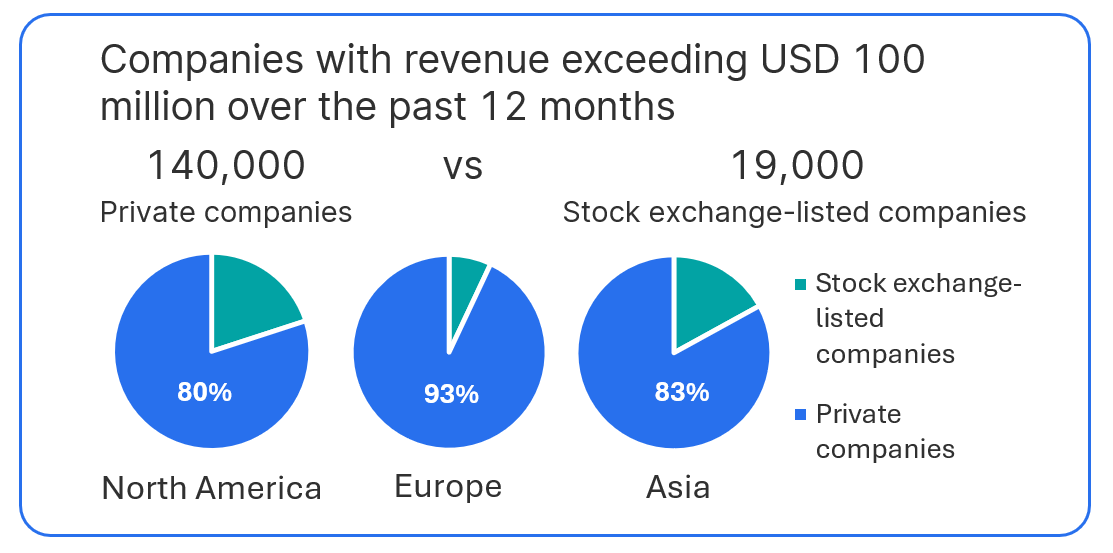
Source: Capital IQ, as of August 2025
The number of new IPOs is also declining because companies remain private for longer. In private markets, companies are under less pressure to achieve short-term success. Instead, they can focus on sustainable growth because their owners aim for a long-term holding period.
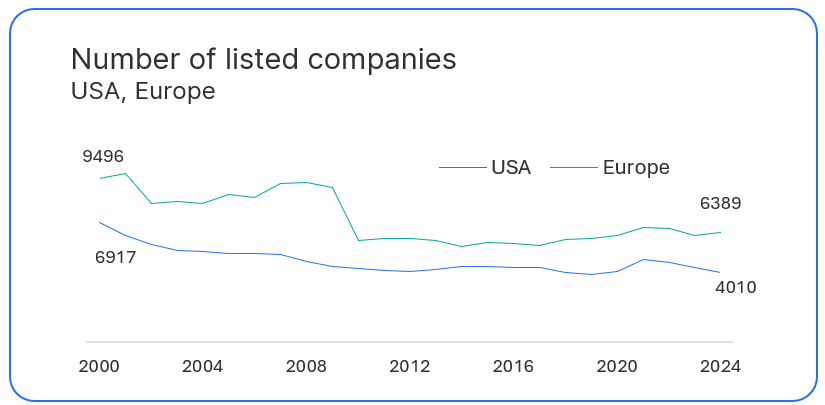
Source: World Bank, Federation of European Securities Exchanges, as of end of 2025
Asset classes in private markets

Private Equity
Private companies are acquired, developed and sold across various sectors.

Private Infrastructure
Physical assets in sectors such as energy, transport and communications are financed.

Private Credit
Investments in corporate debt serve to finance current expenditure or new investments.

Royalties
Investments in licensing, exploitation or mining rights, as well as revenue-sharing arrangements, enable a share in the generated income.
Note: Please note that investments in private markets involve both opportunities and risks.
How does active value creation work?
Active managers in public markets selectively choose shares of listed companies – based on their analysis of publicly available information – and buy and sell these positions opportunistically. However, they generally hold minority stakes and can only exert limited influence over company management and its decisions.
In private markets, managers generally invest actively and pursue a hands-on, entrepreneurial approach to creating value. They take control of a company, shape its strategy and support its implementation in collaboration with the management team. Investors in private markets are legal insiders and have full access to a private company’s books, enabling them to conduct more thorough due diligence. As majority owners, they use their control to generate objectively measurable operational value creation – the main driver of returns. Their focus on sustainable growth through operational value creation can lead to greater stability.
Leverages for active value creation in private markets
- Platform building: Market leaders are acquired and consolidated with several smaller companies to increase reach and create synergies.
- Operational improvements: Processes along the entire value chain are optimised, for example through digitalisation and automation.
- Sustainability & ESG: Measures are taken to improve environmental, social and governance aspects, such as reducing emissions and improving employee safety.
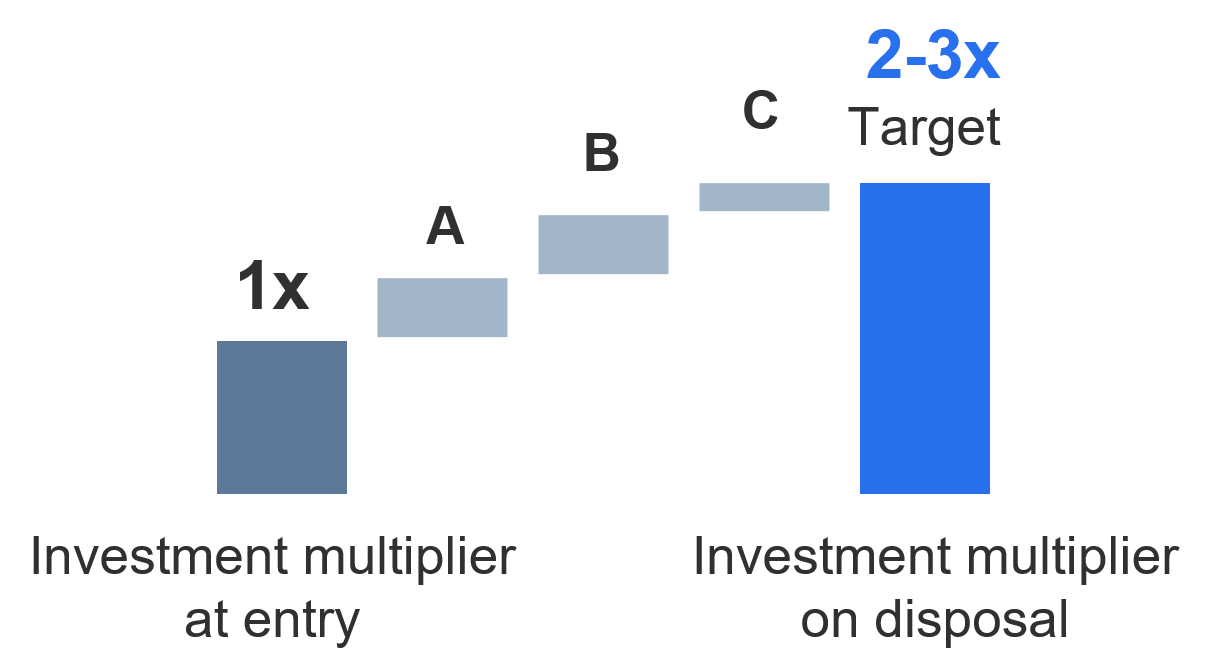
Upon entry, managers make an investment to acquire the company. After approximately 4–6 years, when the company is sold, the aim is for the value of the initial investment to be 2–3 times higher due to the value created.
Legal disclaimer
This document is an advertisement. Unless indicated otherwise, source: Erste Asset Management GmbH. The language of communication of the sales offices is German and the languages of communication of the Management Company also include English.
The prospectus for UCITS funds (including any amendments) is prepared and published in accordance with the provisions of the InvFG 2011 as amended. Information for Investors pursuant to § 21 AIFMG is prepared for the alternative investment funds (AIF) administered by Erste Asset Management GmbH pursuant to the provisions of the AIFMG in conjunction with the InvFG 2011.
The currently valid versions of the prospectus, the Information for Investors pursuant to § 21 AIFMG, and the key information document can be found on the website www.erste-am.com under “Mandatory publications” and can be obtained free of charge by interested investors at the offices of the Management Company and at the offices of the depositary bank. The exact date of the most recent publication of the prospectus, the languages in which the fund prospectus or the Information for Investors pursuant to Art 21 AIFMG and the key information document are available, and any other locations where the documents can be obtained are indicated on the website www.erste-am.com. A summary of the investor rights is available in German and English on the website www.erste-am.com/investor-rights and can also be obtained from the Management Company.
The Management Company can decide to suspend the provisions it has taken for the sale of unit certificates in other countries in accordance with the regulatory requirements.
Note: You are about to purchase a product that may be difficult to understand. We recommend that you read the indicated fund documents before making an investment decision. In addition to the locations listed above, you can obtain these documents free of charge at the offices of the referring Sparkassen bank and the offices of Erste Bank der oesterreichischen Sparkassen AG. You can also access these documents electronically at www.erste-am.com.
Our analyses and conclusions are general in nature and do not take into account the individual characteristics of our investors in terms of earnings, taxation, experience and knowledge, investment objective, financial position, capacity for loss, and risk tolerance. Past performance is not a reliable indicator of the future performance of a fund.
Please note: Investments in securities entail risks in addition to the opportunities presented here. The value of units and their earnings can rise and fall. Changes in exchange rates can also have a positive or negative effect on the value of an investment. For this reason, you may receive less than your originally invested amount when you redeem your units. Persons who are interested in purchasing units in investment funds are advised to read the current fund prospectus(es) and the Information for Investors pursuant to § 21 AIFMG, especially the risk notices they contain, before making an investment decision. If the fund currency is different than the investor’s home currency, changes in the relevant exchange rate can positively or negatively influence the value of the investment and the amount of the costs associated with the fund in the home currency.
We are not permitted to directly or indirectly offer, sell, transfer, or deliver this financial product to natural or legal persons whose place of residence or domicile is located in a country where this is legally prohibited. In this case, we may not provide any product information, either.
Please consult the corresponding information in the fund prospectus and the Information for Investors pursuant to § 21 AIFMG for restrictions on the sale of the fund to American or Russian citizens.
It is expressly noted that this communication does not provide any investment recommendations, but only expresses our current market assessment. Thus, this communication is not a substitute for investment advice.
This document does not represent a sales activity of the Management Company and therefore may not be construed as an offer for the purchase or sale of financial or investment instruments.
Erste Asset Management GmbH is affiliated with the Erste Bank and austrian Sparkassen banks.
Please also read the “Information about us and our securities services” published by your bank.
More on the topic
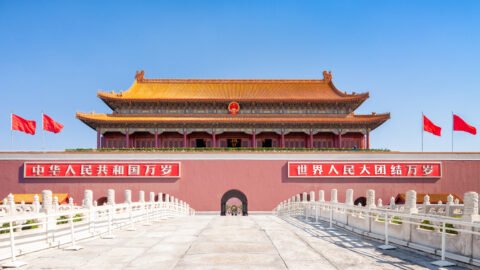
China’s roadmap for the future: A look at the new five-year plan
Although China’s economy is expected to grow less strongly in the coming years, Beijing is focusing on quality and therefore growth in promising sectors. Read today’s blog post to find out why innovation, technology and key strategic industries are the focus of the new five-year plan and what opportunities this presents for investors.